Standing Alternating Arm Lift
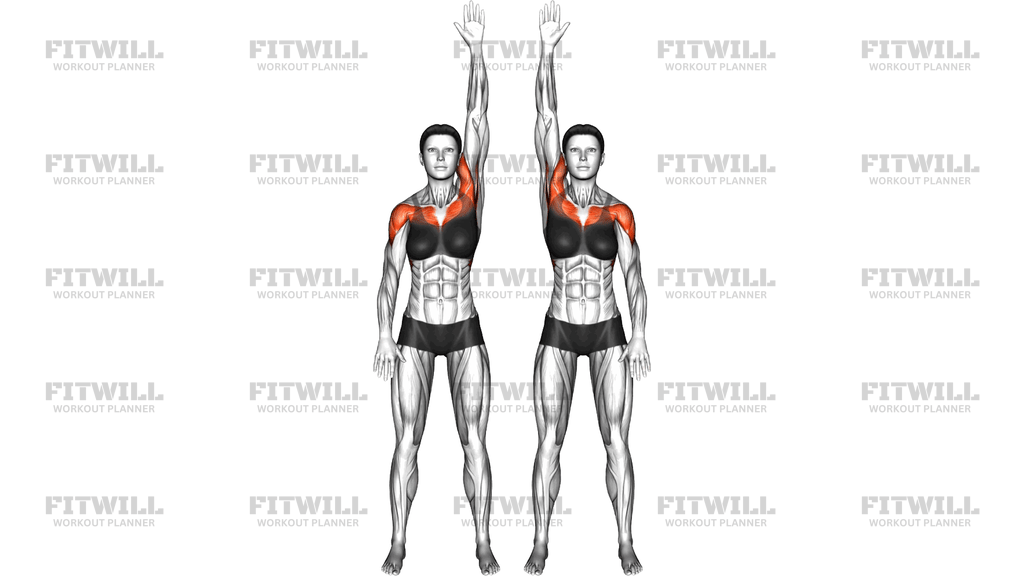
The Standing Alternating Arm Lift is a simple bodyweight movement performed from an upright stance with the feet about hip-width apart and the arms hanging relaxed at the sides. From there, you raise one straight arm forward and up until it points toward the ceiling, lower it back down, and immediately repeat with the other arm, continuing in a steady alternating rhythm. Because no equipment is required, it can be done anywhere — as a warm-up before upper-body training, as an active recovery drill, or as a low-load shoulder exercise on days when heavier pressing work is not appropriate.
The main muscles working here are the front shoulders, which lift the arm forward and overhead, with support from the upper chest as the arm travels through the lower half of the arc. The side shoulders and upper traps assist near the top, and the muscles of the standing leg, hip, and trunk stay quietly busy the whole time to keep your torso tall and still while the arms move. That combination makes this a surprisingly effective drill for shoulder health and postural control, not just for feeling a burn in the delts.
Setup matters more than it looks. Stand with your weight balanced evenly across both feet, ribs stacked over the pelvis, and shoulders relaxed rather than shrugged toward the ears. If you lean back, arch the lower back, or let the ribcage flare as the arm rises, you shift work away from the shoulders and turn the drill into a compensation pattern. Keeping the torso quiet is what makes the shoulders do their job.
To execute it well, raise the arm in a smooth vertical path roughly in line with the ear, palm facing inward or forward — pick one and stay consistent. Reach fully at the top without forcing the shoulder upward, then lower the arm under control along the same line before the other arm starts. Both hands should not be moving at once; one works while the other returns, which is what makes this an alternating pattern rather than a double-arm raise.
This exercise suits beginners learning overhead control, older trainees who want joint-friendly shoulder work, and experienced lifters using it as a warm-up primer before pressing or pulling sessions. It also works well in circuit training and rehab-style routines where the shoulders need movement and blood flow without external load. Keep the reps moderate, the tempo smooth, and stop the set if you feel any pinching at the front of the shoulder.
[ Workout Log & Planner ]
Put your next workout in Fitwill
Keep your plan and training log ready when you are.


Instructions
- Stand upright with your feet hip-width apart, weight spread evenly across both feet, and arms hanging relaxed at your sides.
- Draw your shoulder blades down and back slightly, keep your ribs stacked over your pelvis, and brace your trunk gently so your torso stays tall.
- Choose a hand position — palms facing inward toward your body or facing forward — and keep it consistent for the whole set.
- Exhale as you raise one straight arm forward and upward in a smooth vertical arc until it is fully extended overhead, roughly in line with your ear.
- At the top, reach actively toward the ceiling without shrugging the raised shoulder up toward the ear.
- Inhale as you lower that arm back down along the same path to your side under control.
- As soon as the first arm returns, begin raising the opposite arm, keeping one arm working while the other rests at your side.
- Keep your head neutral, eyes forward, and avoid leaning backward or arching your lower back as each arm lifts.
- Continue alternating for your target number of reps per side, then relax your shoulders and shake out your arms before the next set.
Tips & Tricks
- If you feel a pinch at the front of the shoulder at the top, turn your palm to face inward and stop the lift just short of full overhead — the arc should feel free, not forced.
- The most common mistake is shrugging the working shoulder toward the ear as the arm rises; think of reaching long through the fingertips instead of lifting the shoulder blade.
- Watch for lower-back arching as the arm reaches overhead — that usually means the trunk is borrowing from the shoulders; tighten your brace slightly and reduce how high you reach.
- Do not swing the arm or use momentum from the torso; the lift should be smooth enough that you could pause at any point in the arc.
- Keep both feet planted and your hips square — shifting weight or rotating the trunk as one arm lifts signals the range or tempo is too aggressive.
- If standing balance feels shaky, widen your stance slightly to give yourself a more stable base before adding reps.
- Match your tempo on the way up and the way down; a fast drop with a slow lift makes the set easier and removes half the benefit.
- As a warm-up, use higher reps at an easy pace; as a strength-endurance set, slow the tempo and pause for a beat at the top of each reach.
- Keep the non-working arm quiet at your side rather than flailing — a still lower arm keeps tension off your neck and helps you feel the working shoulder clearly.
Frequently Asked Questions
What muscles does the Standing Alternating Arm Lift work?
The front shoulders do most of the lifting, with the upper chest assisting through the lower half of the arc. The side shoulders and upper traps help near the top, and your trunk and standing posture muscles stabilize throughout.
Is the Standing Alternating Arm Lift good for beginners?
Yes, it is one of the most beginner-friendly overhead drills because it uses no load and trains one arm at a time. It teaches you to lift the arm cleanly overhead without shrugging or arching, which carries over to later pressing work.
Should my palms face forward or inward during the Standing Alternating Arm Lift?
Either works — palms-in is usually more comfortable for stiff shoulders, while palms-forward gives a slightly different feel across the front of the shoulder. Pick one at the start of the set and keep it consistent.
Why do I feel this more in my neck than my shoulders?
That usually means the upper traps are taking over because the shoulder blade is riding up as you lift. Reach long through the fingertips and actively keep the raised shoulder down away from your ear.
Can I use the Standing Alternating Arm Lift as a warm-up before pressing?
Absolutely. One to two sets of fifteen to twenty easy reps per side raises the shoulders' temperature and rehearses the overhead path without fatigue, making it a good primer before overhead presses or bench work.
How many reps should I do per side?
For warm-up or circulation work, 12 to 20 controlled reps per side is plenty. For a strength-endurance set, slow the tempo and add a short pause at the top, aiming for 8 to 12 reps per side.
What can I substitute if the Standing Alternating Arm Lift bothers my shoulder?
Try stopping the lift at shoulder height instead of full overhead, or perform the same alternating pattern seated to remove any balance demand. If discomfort persists, have a qualified professional assess the shoulder before continuing.
Should both arms move at the same time?
No — the defining feature is the alternating rhythm, with one arm lifting while the other stays at your side. Raising both together turns it into a different exercise and changes the demand on your trunk.
Do I need to lean back to get my arm fully overhead?
No, leaning back is a compensation that shifts work away from the shoulders and stresses the lower back. If you cannot reach overhead without arching, lift slightly short of full range and gradually work toward it.