Standing Hands On Shoulder Raise And Elbow Touch
The Standing Hands On Shoulder Raise And Elbow Touch is a bodyweight shoulder movement performed from an upright standing position. You place the fingertips of each hand on the opposite shoulder, lift your elbows out to the sides until they are roughly level with your shoulders, and then sweep the elbows forward and inward until they touch in front of your chest. From there, you open the elbows back out wide and repeat the cycle. It looks simple, but the arc the elbows travel through hits the front of the shoulders in a way that few unloaded movements do.
The main work falls on the front delts, which lift and draw the elbows forward, with the upper chest assisting as the elbows come together and the traps and upper back stabilizing the shoulder girdle throughout. Because the hands stay anchored on the shoulders, the movement also gives you a built-in checkpoint: if your hands drift off your shoulders, your form has slipped. That makes it easy to self-correct without a mirror or a coach watching.
This exercise is a good fit for people warming up before pressing work, anyone rebuilding shoulder mobility and control after time away from training, and those who train at home with no equipment and still want direct shoulder work. Office workers with stiff, rounded shoulders often find the wide-elbow opening phase genuinely helpful for restoring overhead freedom. Because it is performed standing with no load, it is also gentle enough for older trainees and beginners.
The setup matters more than it appears. A tall stance with the ribs stacked over the hips keeps the trunk from swaying as the elbows move, and keeping the hands lightly touching the shoulders stops you from swinging the arms and turning the drill into a momentum exercise. The elbow path should be a smooth arc: wide and high at the outside, meeting at the center front of the chest, then opening back to the start without the shoulders shrugging up toward the ears.
For programming, treat this as a higher-repetition movement. Since there is no external load, sets of 12 to 20 controlled reps work well, either as part of a warm-up, as a superset between harder pressing exercises, or as a finisher to leave the shoulders feeling worked without heavy fatigue. Move deliberately rather than fast; the value comes from the arc, not the speed.
[ Workout Log & Planner ]
Put your next workout in Fitwill
Keep your plan and training log ready when you are.


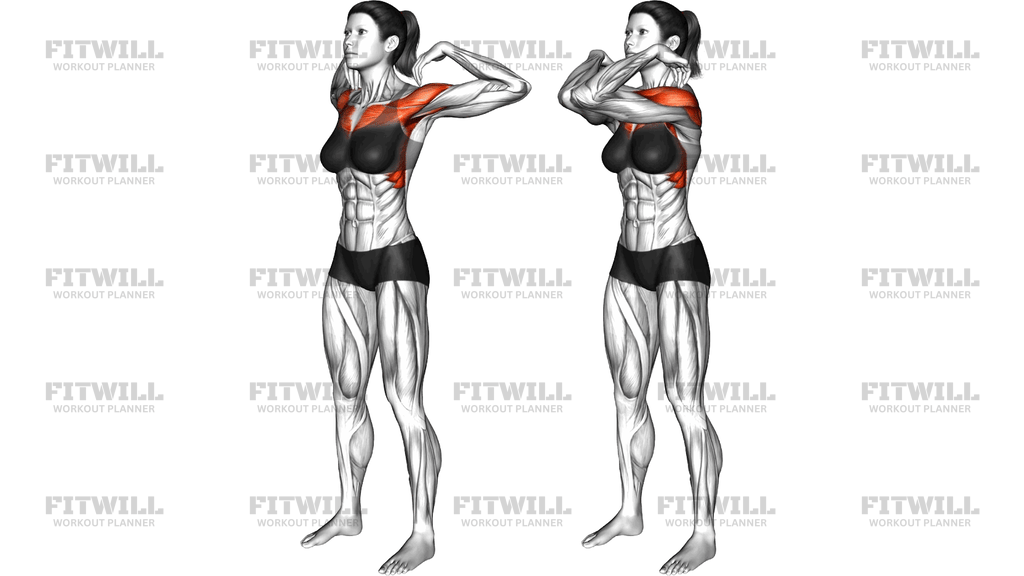
Instructions
- Stand upright with your feet about hip-width apart, knees soft but not bent, and your weight balanced evenly across both feet.
- Bring both arms up and place the fingertips of each hand lightly on the opposite shoulder, crossing your forearms loosely in front of your chest.
- Draw your elbows in toward each other first, then open them out to the sides and raise them until they are at or just below shoulder height.
- Brace your abdominal muscles lightly and keep your ribcage stacked over your hips so your torso stays tall and still.
- From the wide, raised position, sweep both elbows forward and inward along a smooth arc until they touch in front of your chest, keeping the hands on the shoulders the whole time.
- Pause for a brief moment when the elbows meet, feeling the front of the shoulders and upper chest do the work.
- Reverse the arc in a controlled way, opening the elbows back out wide to the starting position without letting them drop.
- Breathe out as the elbows come together in front and breathe in as they open back out wide.
- Complete your repetitions, then lower the arms, roll the shoulders gently, and shake out the arms to reset before the next set.
Tips & Tricks
- If your hands keep slipping off your shoulders, press less hard with the fingertips rather than squeezing; a light touch is all the anchor you need.
- Shrugging toward the ears is the most common fault here. If you feel it in your neck, deliberately pull the shoulder blades down and slightly back before starting each rep.
- Do not let the elbows dive below shoulder height on the opening phase. If they drop, the front delts stop working and the movement loses its point.
- Keep the torso from rocking backward as the elbows come together. If you catch yourself leaning, narrow your stance slightly and re-brace your core.
- Aim to touch the elbows, not the forearms. If your forearms collide first, your elbows have dropped too low; lift them a little before sweeping forward.
- Slow the inward sweep down rather than the outward one. The forward-and-together phase is where most of the shoulder work happens.
- If one elbow leads the other, count reps in front of a mirror occasionally or slow the tempo so both sides move symmetrically.
- Warm the shoulders up with a few arm circles before starting if you feel any pinching when the elbows lift to the wide position.
- Treat this as a volume and control exercise, not a strength test. Adding a dumbbell on top of the hands does not improve it and only invites neck strain.
Frequently Asked Questions
Which muscles does the Standing Hands On Shoulder Raise And Elbow Touch work?
The front shoulders do most of the work as the elbows sweep forward and touch, with the upper chest assisting and the traps and upper back stabilizing the shoulder blades. The movement also lightly involves the side shoulders during the wide opening phase.
Is this exercise suitable for complete beginners?
Yes. It is bodyweight only, needs no equipment, and the hands-on-shoulder position gives immediate feedback on control. Beginners should start with 10 to 12 slow reps and focus on keeping the elbows high.
Why do my hands need to stay on my shoulders during the movement?
The hands anchor the arms and prevent you from swinging, so the elbows have to travel the full arc under muscular control. If your hands drift off, it is a clear sign the rep has become loose or momentum-driven.
I feel this in my neck instead of my shoulders. What am I doing wrong?
You are most likely shrugging your shoulders up toward your ears as the elbows lift. Keep the shoulder blades pulled down and the elbows only as high as you can raise them without the traps taking over.
Can I do the Standing Hands On Shoulder Raise And Elbow Touch as a warm-up before bench pressing or overhead pressing?
Yes, it works well as a warm-up because it takes the shoulders through a wide, controlled arc without load. Two sets of 12 to 15 reps before pressing is a practical place to start.
What can I substitute if my shoulders cannot tolerate the elbow arc?
Arm circles and shoulder rolls are gentler options that still move the shoulder girdle through a range. You can also reduce the height of the arc in this exercise, keeping the elbows below shoulder level until tolerance improves.
Should the elbows touch hard at the front, or just meet?
Let them meet and briefly touch rather than forcing them together with impact. The contact is a useful target to confirm a full range, but the squeeze itself should come from the shoulders, not a jolt.
How many reps and sets should I use?
Because there is no external load, aim for 12 to 20 controlled reps per set for 2 to 3 sets. Use it in a warm-up, as a superset between pressing exercises, or as a shoulder finisher.
Can I add weight to make this exercise harder?
Adding load on top of the shoulders does not improve the movement and tends to strain the neck and traps. To make it harder, slow the tempo, pause when the elbows touch, or increase the number of reps.
Is it a problem if one elbow touches before the other?
Minor asymmetry is common and usually just a coordination issue. Slow the tempo and check yourself in a mirror occasionally; if one side is consistently restricted or painful, ease off that side and progress it gradually.