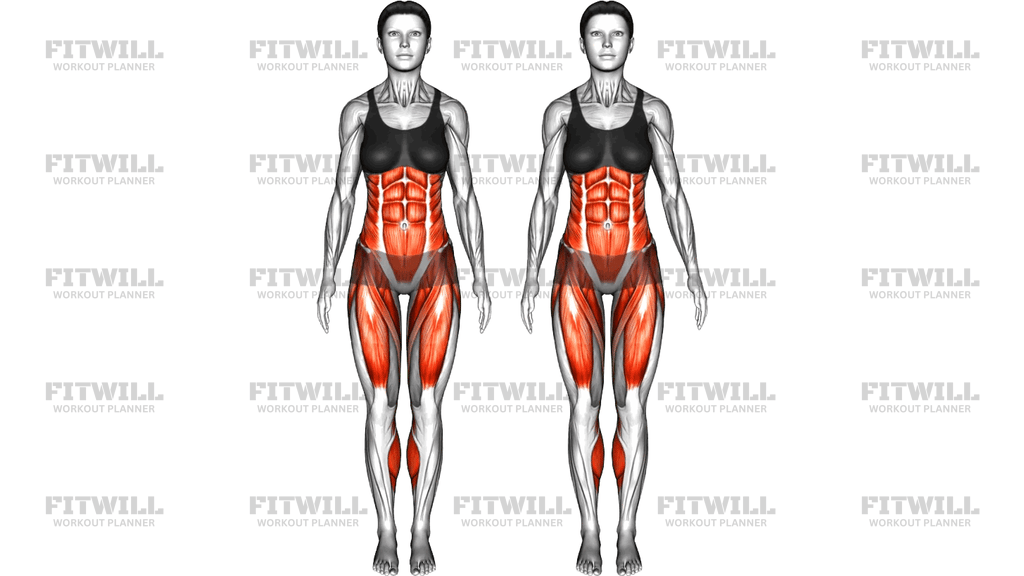
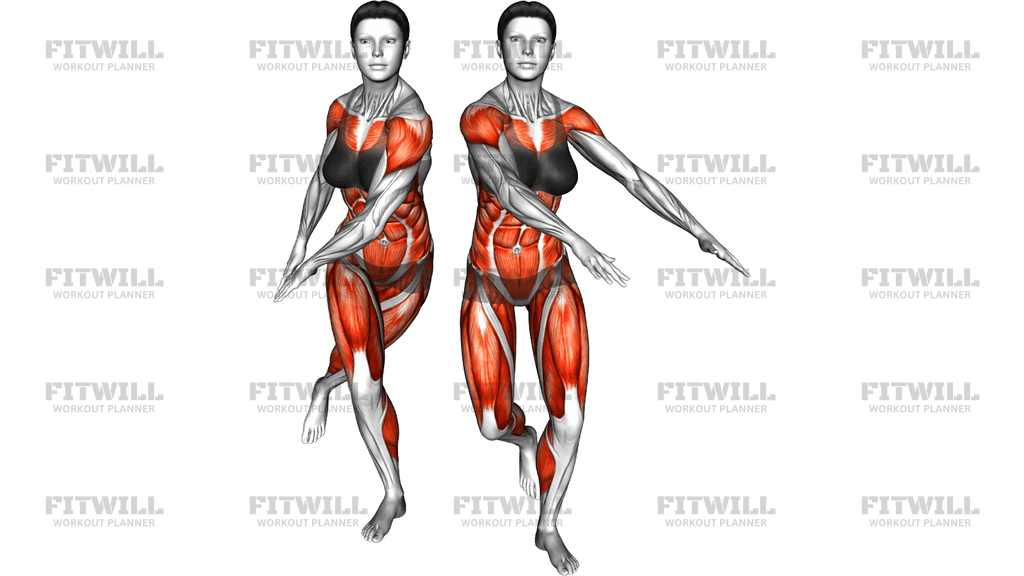
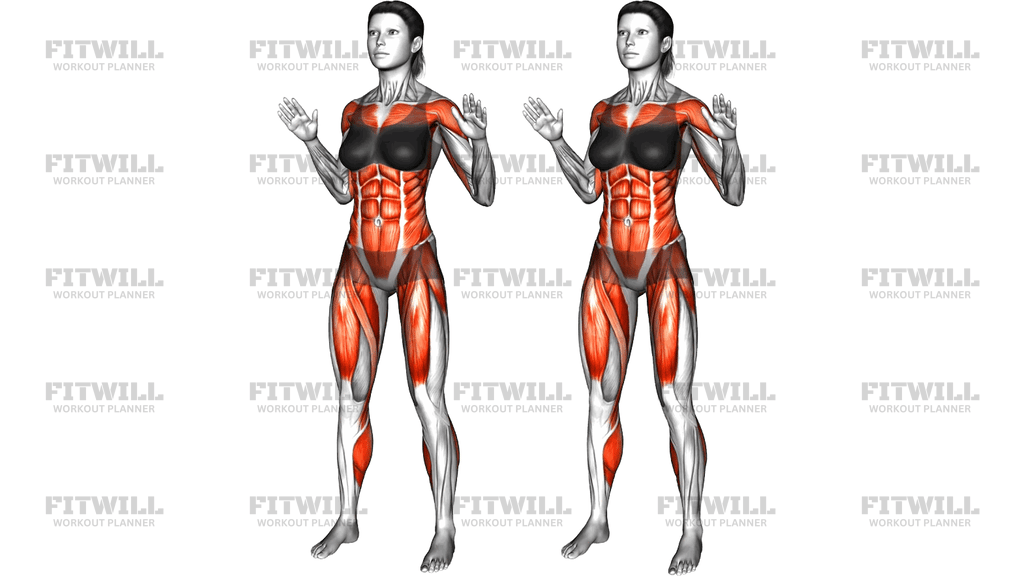
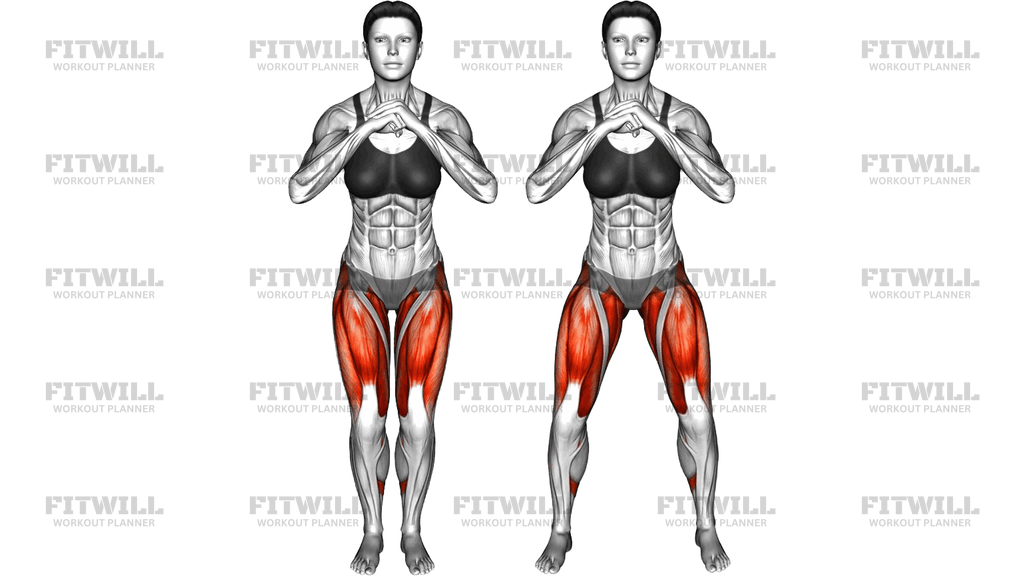
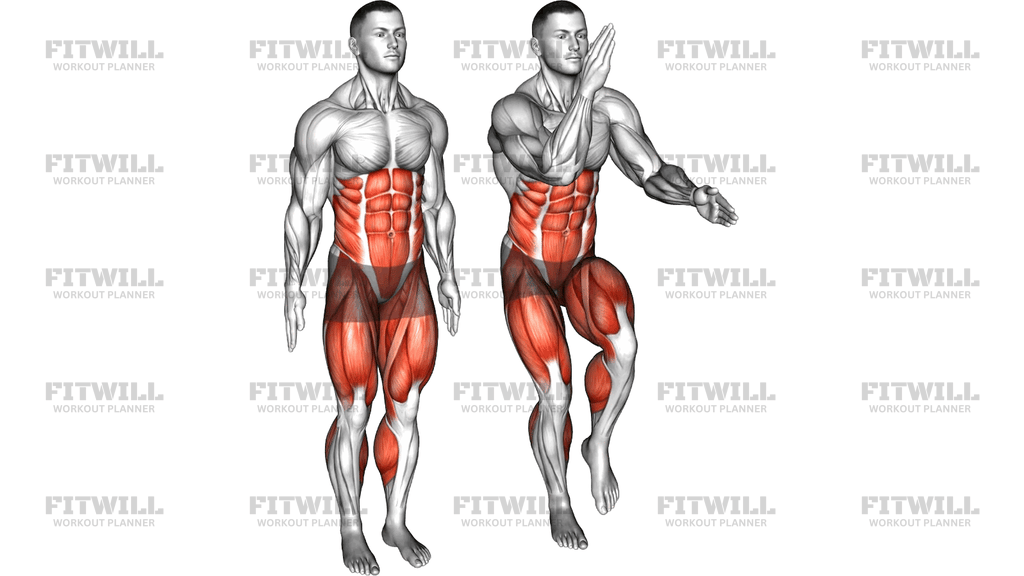
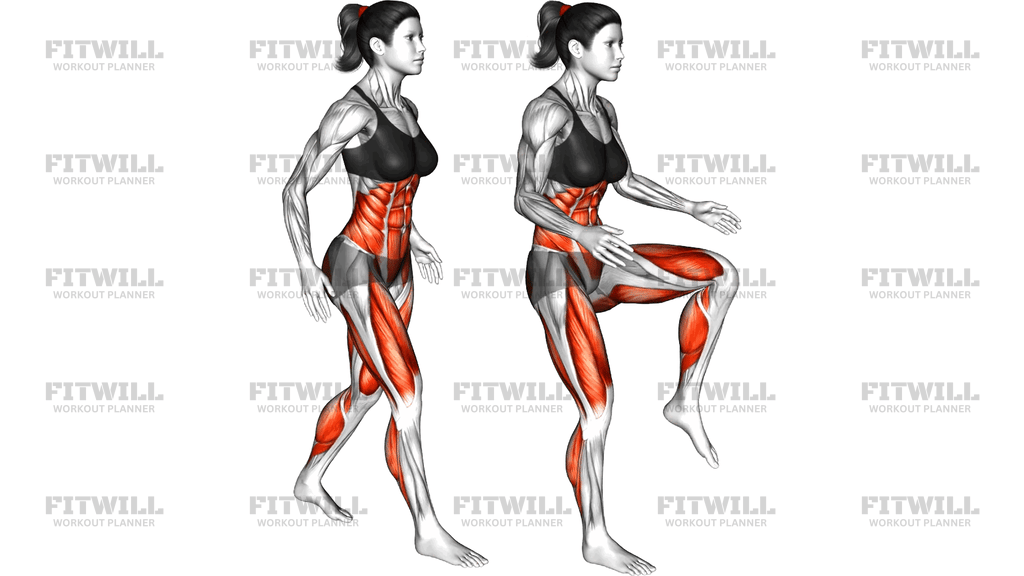
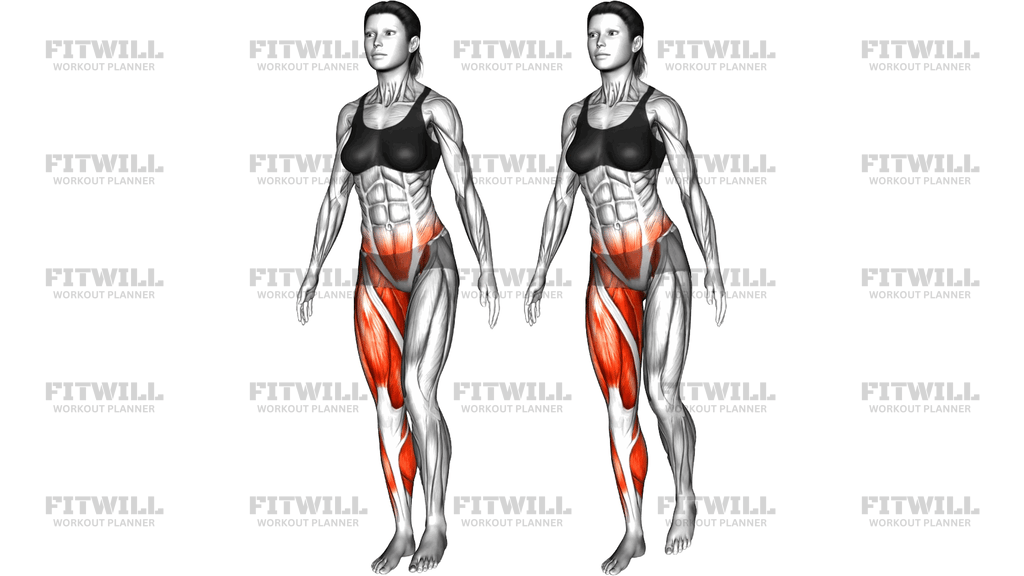
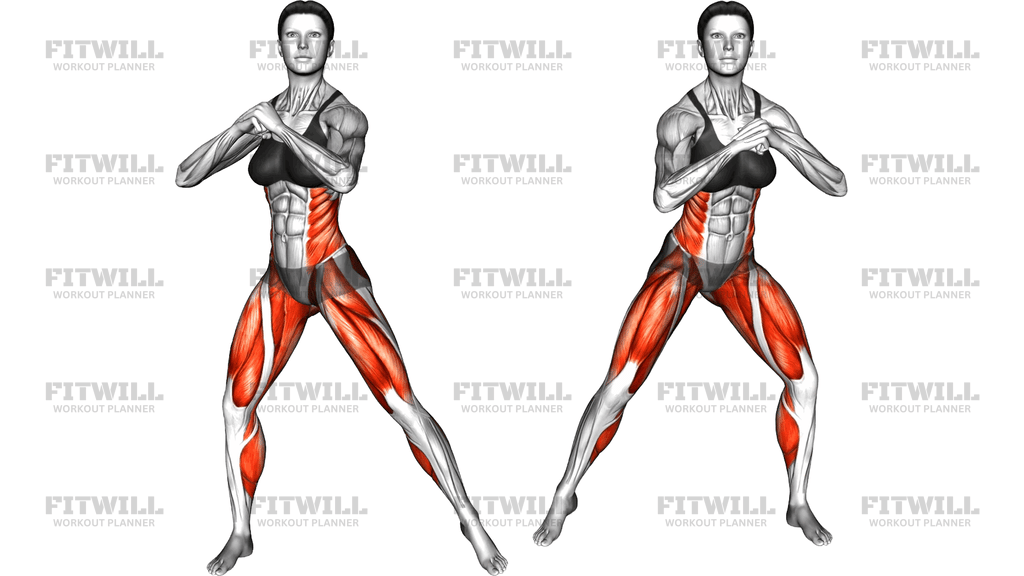
Side Step Walking
Side Step Walking is a bodyweight lateral movement where you travel sideways by stepping one leg out to the side, sinking into a partial squat, then drawing the trailing leg toward it and repeating. Instead of stepping up and down like a normal walk, you move across the floor in a controlled side-to-side rhythm, which places constant tension on the thighs, glutes, and hips in a way forward walking never does.
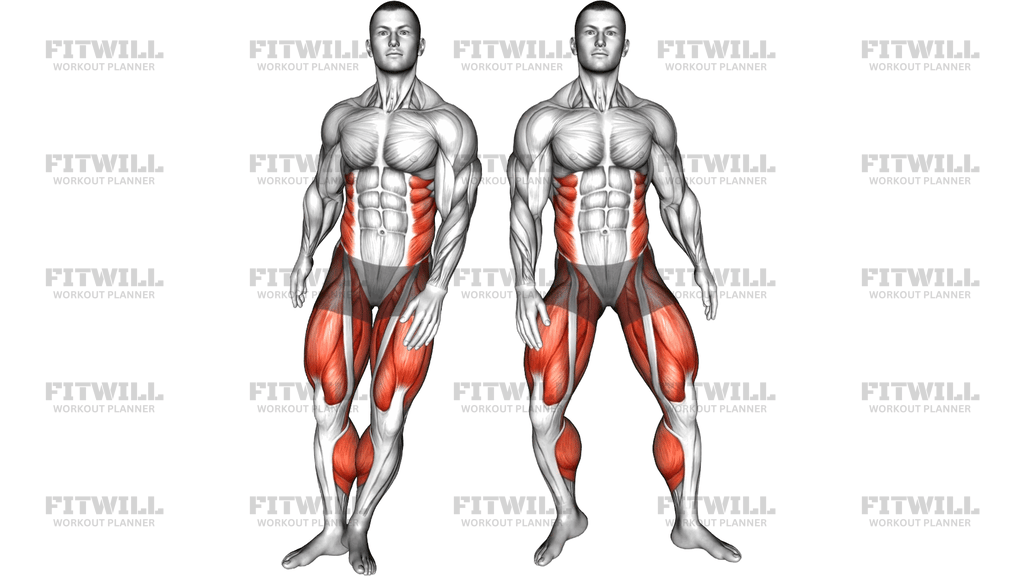
This movement is especially useful for anyone whose training or daily life is dominated by straight-ahead motion. The lateral step challenges the quadriceps as they absorb and control each lowering phase, the glutes and outer hips as they stabilize the pelvis over a single leg, and the obliques as they keep your torso upright while your legs travel in a different direction. It is a low-impact, joint-friendly way to build side-to-side strength and coordination.
Setup matters more than most people expect. Your stance width, the depth of each mini squat, and the direction your toes point all determine whether the work lands on the right muscles or leaks into your knees and lower back. Feet should face forward, weight should stay distributed across the whole foot of the working leg, and the trailing foot should land flat rather than collapsing to its outer edge.
To execute it well, lower your hips slightly before you step and keep that athletic depth for the entire set. Each step out should feel like a controlled reach, and each pull back should feel like your working leg is dragging the floor toward it. The challenge is resisting the urge to stand tall between steps, because standing up removes the continuous tension that makes Side Step Walking effective.
You can use this exercise as a warm-up before lower body lifting, as a stand-alone leg and hip conditioner, or as part of a circuit when you want strength work without equipment. Athletes in cutting and change-of-direction sports benefit from the lateral control, while anyone who sits for long hours gets valuable work for the often-neglected outer hip muscles.
Keep the range modest at first. A shallow, crisp half-squat with smooth steps builds better habits than a deep, wobbly squat with rushed feet. Stop the set when your form drifts forward, your knees pinch inward, or your steps start shortening noticeably, since those are the earliest signs the stabilizing muscles have fatigue.
[ Workout Log & Planner ]
Put your next workout in Fitwill
Keep your plan and training log ready when you are.


Instructions
- Stand tall with your feet hip-width apart, toes pointing forward, and your arms relaxed at your sides or clasped in front of your chest.
- Hinge slightly at the hips and bend both knees to lower into a shallow quarter squat, keeping your chest up and your back flat.
- Brace your core as if preparing for a light push to the stomach, and hold this squat depth for the entire set.
- Step your right leg out to the side about one and a half to two shoulder-widths, planting the whole foot flat with the toes still facing forward.
- Shift your weight smoothly onto the right leg, letting it accept the load while the left leg stays light and extended.
- Pull your left leg in until it is again hip-width from the right, keeping both feet flat and resisting the urge to stand upright between steps.
- Continue walking sideways for the desired number of steps, then reverse direction and lead with the other leg to travel back.
- Exhale as you step out and load the working leg, and inhale as the trailing leg draws in.
- Finish the set by straightening both legs together and standing fully upright before resting or repeating.
Tips & Tricks
- The most common mistake is rising out of the squat between steps. Pick a hip height at the start and hold it there, even if it means fewer steps per set.
- If your knees cave inward as you step, consciously push them out over your little toes. This small correction dramatically increases the work on the outer hip muscles.
- Keep your toes pointing straight ahead. Feet that rotate outward as you travel sideways shift stress away from the quads and toward the knee joint.
- Drive each step through the heel and mid-foot of the working leg rather than pushing off the toes of the trailing foot, or the movement becomes a hop instead of a controlled step.
- Widen your step only as far as you can keep your torso vertical. A deep lean forward with a long step usually means the hips are too tight to control that range.
- Use a smooth, even tempo, roughly one second out and one second in. Rushed steps let momentum do the work the thighs should be doing.
- If you feel this only in your calves, you are likely staying too tall. Sink the hips another inch and push the knees forward over the toes.
- On smooth floors, keep your steps shorter than you think you need. Long, sweeping steps on a slick surface pull you into a split you cannot control.
- Start with 10 to 15 steps in each direction. Because the same muscles work continuously without a rest, this exercise fatigues faster than it feels in the first few steps.
Frequently Asked Questions
Which muscles does Side Step Walking work the most?
The quadriceps handle most of the continuous squatting work, while the glutes and outer hip muscles stabilize the pelvis on every step. The obliques and calves contribute to keeping the torso upright and the feet controlled as you travel sideways.
Is Side Step Walking suitable for beginners?
Yes, because it requires no equipment and the depth is adjustable. A beginner can start with a very shallow squat and short steps, then gradually widen the step and lower the hips as control improves.
How deep should my squat be during Side Step Walking?
A quarter squat where your knees are bent but comfortably above parallel is enough for most people. The key is holding that same depth for the whole set, since standing up between steps removes the tension that makes the exercise effective.
Why do my knees drift inward when I step to the side?
That usually points to weak or untrained outer hip stabilizers. Deliberately push your knees out over your toes as you plant each step, and shorten your stride until you can hold that alignment consistently.
Should my feet stay facing forward the entire time?
Yes. Keeping the toes pointed forward keeps the load on the thigh and hip muscles and protects the knee from twisting stress. If your feet keep rotating as you travel, take smaller steps until you can control the direction.
Can I use a resistance band with Side Step Walking?
Yes, a band looped around the thighs just above the knees is a common progression. It forces the outer hips to work harder on every step, so start with light tension and shorter sets than your bodyweight version.
How is Side Step Walking different from a side lunge?
A side lunge is a single deep repetition with a full shift of weight onto one leg, while Side Step Walking is a continuous, shallower movement that covers distance. The walk keeps constant tension and trains rhythm and control rather than maximum depth.
Where should I feel the exercise if my form is correct?
You should feel a steady burn in the front of your thighs and along the outer hips and glutes, with mild work in the obliques from holding your torso upright. Soreness in the knees or lower back signals that depth or foot direction needs adjusting.
Is Side Step Walking safe for my knees?
When performed with a moderate squat depth, forward-facing feet, and knees tracking over the toes, it is a low-impact, controllable movement. If you have a current knee issue, keep the depth shallow and check with a qualified professional before adding it to your routine.
How many steps should I do per set?
Ten to fifteen steps in each direction is a solid starting point. Because the same muscles stay under tension the entire time, expect fatigue to arrive quickly, and end the set as soon as your depth or knee position starts to slip.