Bodyweight Pulse Goblet Squat
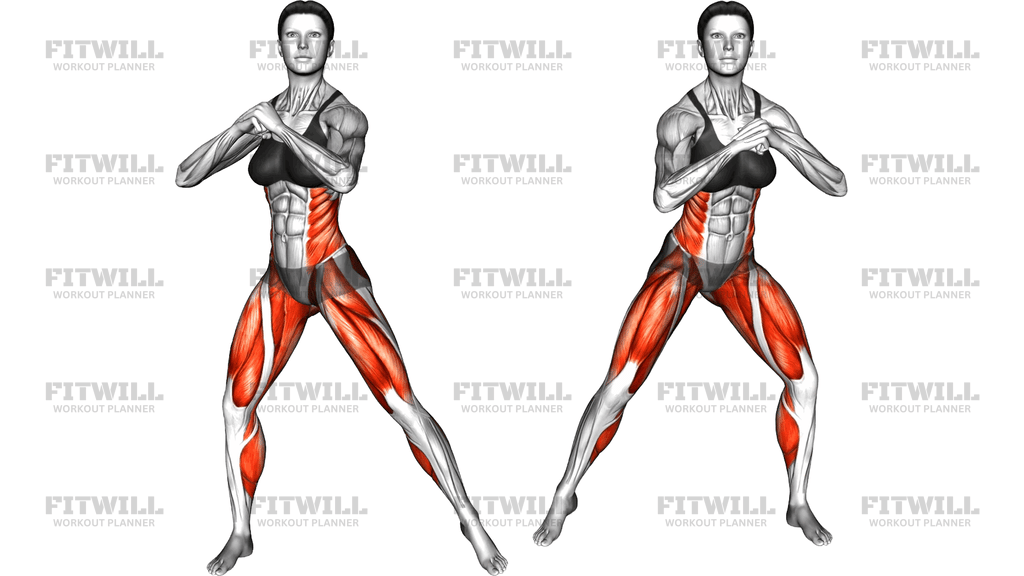
The Bodyweight Pulse Goblet Squat takes the familiar goblet squat position — hands clasped together at chest height as if holding a weight — and adds small, controlled pulses at the deepest point of the squat. Instead of descending, standing all the way up, and repeating, you lower into a full squat and then perform several short up-and-down movements within the bottom third of the range before rising to complete the rep. Because there is no actual load in your hands, the clasped-arm position serves a different purpose: it shifts weight slightly forward, helps you sit straight down between your hips, and gives your torso a reference point so it stays upright.
This exercise suits a wide range of trainees. Beginners use it to learn what a deep, well-aligned squat actually feels like without having to manage external weight. More experienced lifters use it as a warm-up before barbell or dumbbell squat work, or as a high-rep finisher when the quads and glutes are already fatigued. The pulse component is what separates it from a standard bodyweight squat — holding tension in the bottom third of the movement builds time under load in exactly the range where most people are weakest, particularly around parallel.
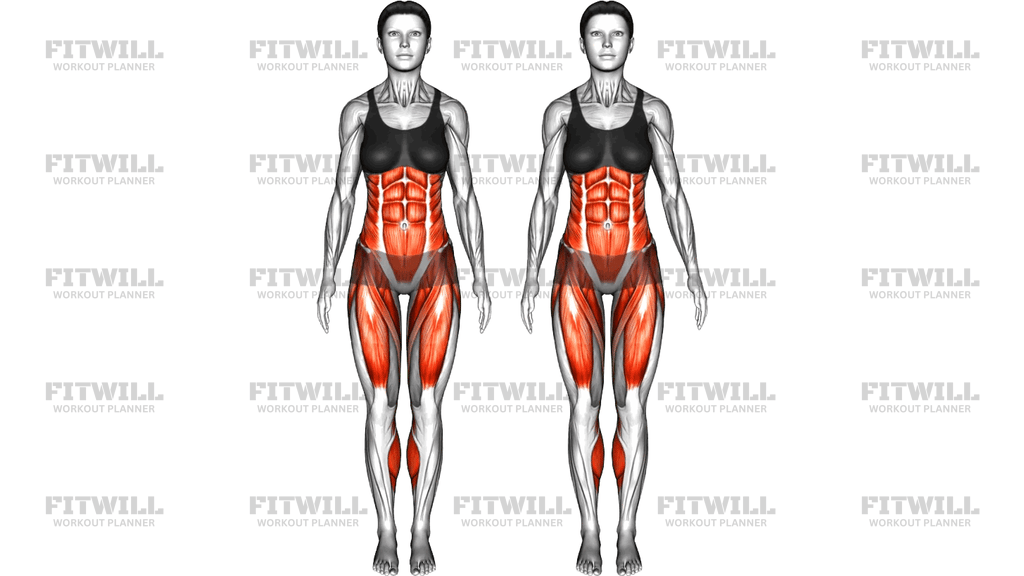
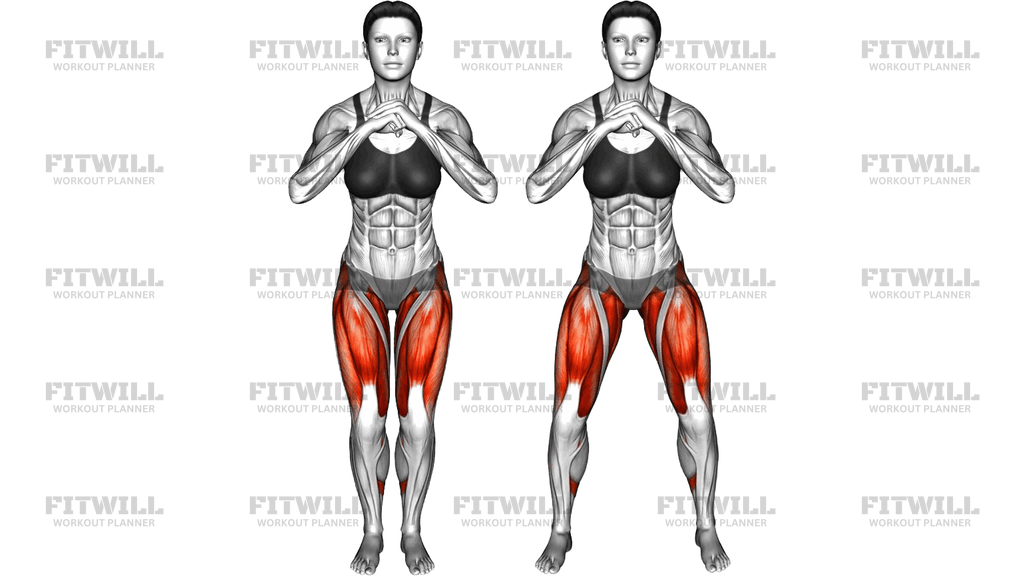
The main work falls on the quadriceps and glutes, with noticeable involvement from the inner thighs as they control your knees tracking outward at depth. The calves and ankle stabilizers work to keep your heels planted, and the core holds your torso upright against the forward-tilted chest position. Because each pulse keeps the muscles under continuous tension, the burn builds quickly even with no added resistance — the demand comes from repeated contractions in a mechanically disadvantaged position rather than from heavy weight.
Setup matters here more than most people expect. Your stance — roughly shoulder-width or slightly wider with toes turned out a little — determines whether you can reach depth without your heels lifting or your knees caving in. The clasped hands at chest height act as a counterbalance: as you descend, let your arms and chest stay tall while your hips travel down and back between your feet. If your setup is off, the pulses will expose it immediately, because small movements at the bottom leave no room to hide a shifting heel or a rounding lower back.
To execute it well, lower until your thighs are at least parallel to the floor, then pulse by rising a few inches and lowering back down with control, keeping tension the entire time. Complete all your pulses for one rep, or treat each pulse as its own rep depending on how you count — either way, never bounce out of the bottom or let the movement get sloppy as fatigue sets in.
The most common mistakes are shallow pulses performed too close to the top of the squat (which turns this into a mini quarter-squat), heels lifting off the floor, and knees collapsing inward as the inner thighs fatigue. Work within a depth where you can keep your whole foot planted and your spine neutral. If deep squatting is uncomfortable at first, slightly widen your stance or elevate your heels on a small wedge, and progress gradually.
[ Workout Log & Planner ]
Put your next workout in Fitwill
Keep your plan and training log ready when you are.


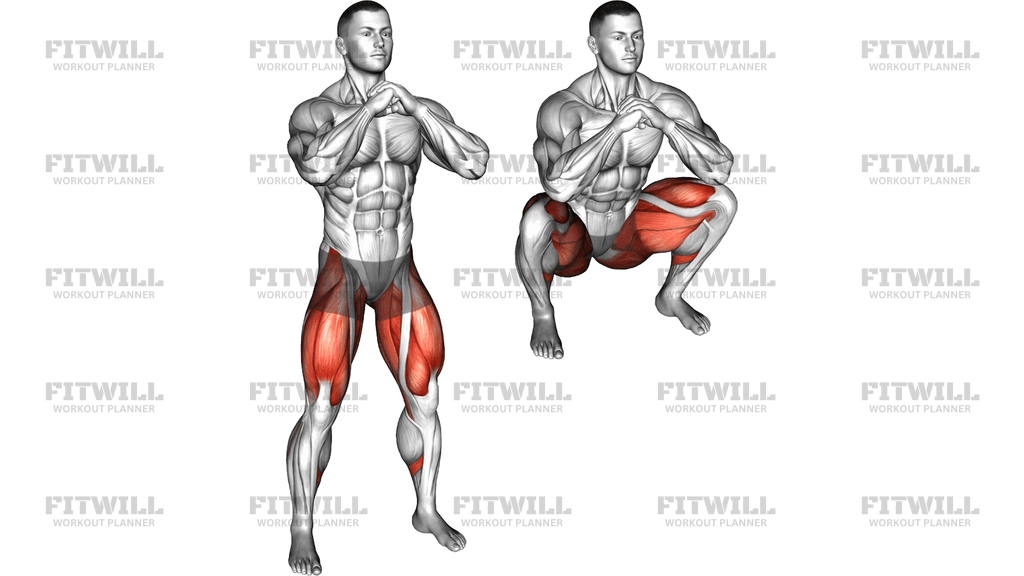
Instructions
- Stand with your feet about shoulder-width apart or slightly wider, toes turned out 10 to 20 degrees.
- Clasp your hands together at chest height with elbows tucked down toward your ribs, mimicking the position of holding a goblet-style weight against your chest.
- Brace your core, pull your shoulders back, and keep your chest lifted with your weight spread across your whole foot.
- Inhale, then push your hips back and down, letting your knees travel outward over your toes as you descend.
- Lower until your thighs are at or just below parallel, keeping your heels flat and your torso upright with hands still clasped at the chest.
- From the bottom position, pulse by driving up a few inches — roughly a quarter to a third of the way toward standing — then lowering straight back down under control.
- Repeat the pulses for the desired number, keeping continuous tension so your quads and glutes never fully relax between pulses.
- After the final pulse, exhale and drive through your whole foot to stand fully upright, squeezing your glutes at the top.
- Reset your stance and brace again before starting the next rep, rather than flowing straight into the descent.
- Breathe steadily throughout the pulses — short inhales and exhales on each small rep — rather than holding your breath through the entire set.
Tips & Tricks
- A common mistake is pulsing near the top of the squat, which turns the exercise into easy quarter-reps. Mark your bottom position mentally and only pulse within a few inches of it.
- If your heels lift at depth, widen your stance slightly and turn your toes out a bit more; if that doesn't fix it, your ankles may need gradual mobility work rather than a forced range.
- Keep your elbows inside your knees at the bottom. Flaring them wide usually means your chest is dropping and your lower back is rounding to compensate.
- Watch for your knees drifting inward during the pulses — this is when the inner thighs fatigue. Deliberately push your knees out over your pinky toes on every pulse.
- Count pulses in a way that keeps you honest: either each pulse is a rep, or a full down-pulse-up cycle is one rep. Mixing the two mid-set makes progress hard to track.
- Slow the pulses down rather than speeding up. Fast bouncing out of the bottom uses momentum and reduces the quad and glute work that makes this exercise worthwhile.
- Use this as a pre-squat warm-up with 1–2 easy sets of 8–12 pulses to groove depth and knee tracking before you add weight.
- If your torso starts tipping forward as you tire, reset to standing instead of grinding sloppy pulses — quality of the bottom position is the whole point.
- Taller lifters or those with longer femurs often need a wider stance for this movement; adjust until you can sit between your hips rather than folding over your knees.
Frequently Asked Questions
What muscles does the Bodyweight Pulse Goblet Squat work?
The quadriceps and glutes do most of the work, with strong support from the inner thighs as they keep your knees tracking outward at depth. The calves, ankle stabilizers, and core also contribute to keeping you balanced and upright through each pulse.
Why are my hands clasped at my chest if there's no weight?
The goblet-style arm position acts as a counterbalance that lets you sit straight down between your hips while keeping your torso upright. It also gives you a consistent reference point — if your hands drift forward or drop, your chest is usually dropping with them.
Is the Bodyweight Pulse Goblet Squat good for beginners?
Yes, it's one of the better squat variations for learning depth and knee tracking without external load. The slow pulses at the bottom teach you where your hips, knees, and feet should be before you ever add a dumbbell or barbell.
How deep should I squat before starting the pulses?
Lower until your thighs are at least parallel to the floor, or slightly below if you can keep your heels flat and your spine neutral. The pulses should happen in the bottom third of your squat, not somewhere near the top.
How many pulses should I do per rep?
Somewhere between 3 and 5 pulses per full rep works well if you're counting the whole down-pulse-up cycle as one rep. If you prefer counting each pulse individually, sets of 10 to 20 pulses are common for conditioning.
Why do my inner thighs burn so much during this exercise?
The adductors work hard to control your knees as they track outward at depth, and the continuous bottom-position tension keeps them from relaxing between pulses. That burn is normal and typically fades as you build strength in the deep squat range.
Can I do the Bodyweight Pulse Goblet Squat every day?
For most people, yes, especially at moderate volumes — it's a low-load movement. That said, the pulses create real muscular fatigue in the quads and glutes, so treat hard, high-rep sets like any other strength work and allow recovery between demanding sessions.
What can I use instead if deep squatting is uncomfortable?
Try a slightly wider stance with more toe-out, elevate your heels on a small wedge or thin book, or pulse in a higher range while you build ankle and hip mobility. Holding an actual light weight in the goblet position can also help you counterbalance at depth.
How is this different from a regular bodyweight squat?
A regular squat cycles through the full range with a brief pause at the top, while the pulse version keeps you loaded continuously in the hardest part of the range. That makes it harder at the same bodyweight, with more emphasis on bottom-position strength and control.
Should my heels stay flat during the pulses?
Yes — if a heel lifts mid-pulse, you've gone deeper than your current ankle mobility allows or your weight has shifted forward. Shorten the pulse range or widen your stance until both feet stay fully planted throughout the set.