Overhead Knee Raise Jack
The Overhead Knee Raise Jack is a standing, body-weight conditioning move that combines the rhythm of a jumping jack with an exaggerated knee drive. Your arms stay extended straight overhead while each knee lifts high toward your chest in an alternating, jack-like tempo. It requires no equipment and very little space, which makes it a go-to option for warm-ups, circuit training, or quick conditioning bursts at home.
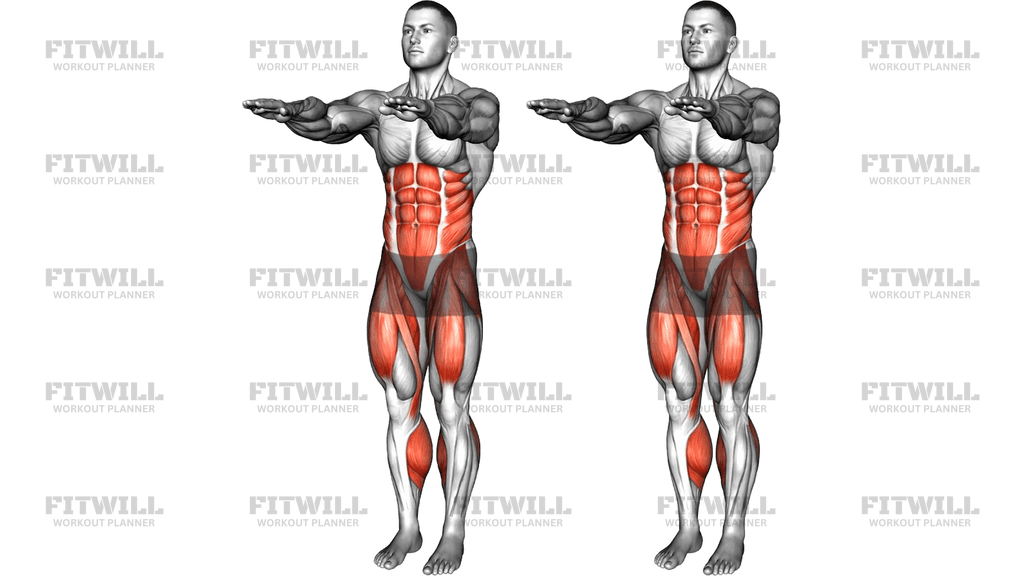
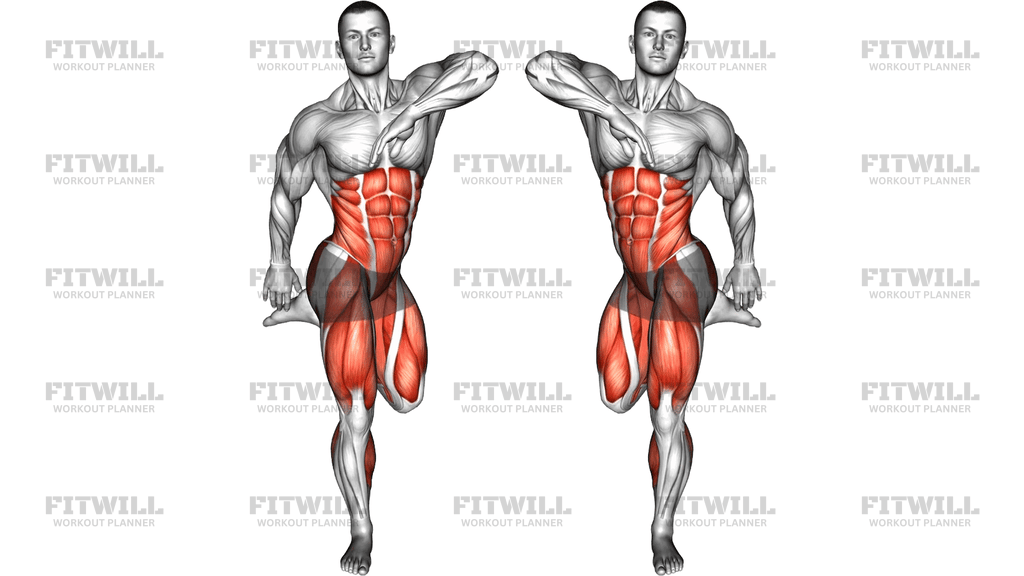
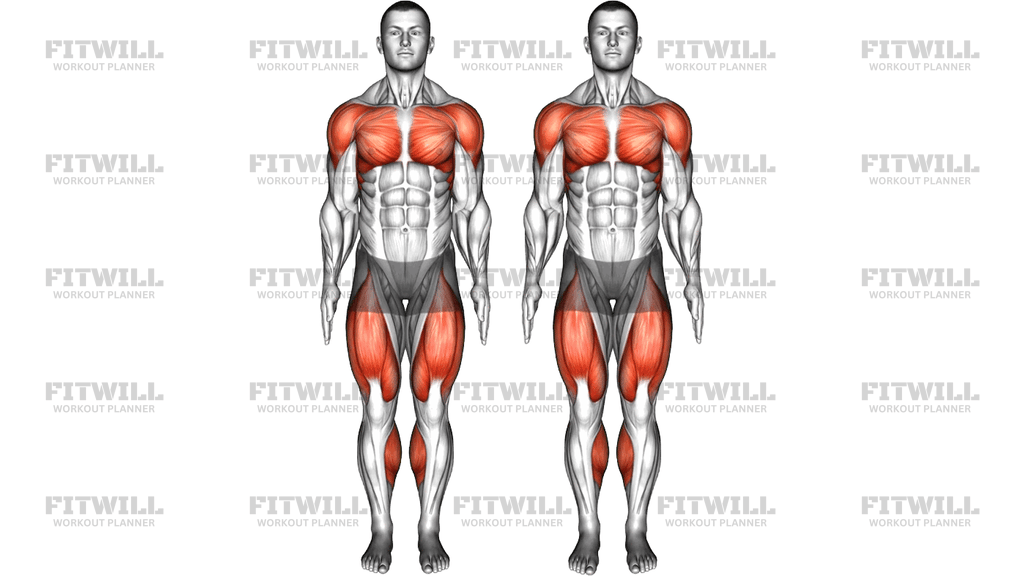
This movement pulls double duty. On the conditioning side, the continuous alternating leg action raises your heart rate quickly and keeps it there, similar to a jumping jack but with a much stronger hip and trunk demand. On the strength and control side, every knee raise asks your abdominals and hip flexors to lift the leg against gravity while your shoulders and upper back hold your arms tall overhead. The highlighted muscle map reflects that front-of-body emphasis: the abdominals, chest, and quadriceps all stay involved from start to finish.
Setup is simple but matters more than most people expect. Stand tall with your feet roughly hip-width apart and your arms pressed up beside your ears. The most common breakdown point is letting the arms drift forward as soon as the legs start working, which turns an honest core and shoulder challenge into a sloppy half-movement. Locking the arms overhead first gives you a stable frame, keeps your ribcage stacked over your pelvis, and forces your trunk to do the lifting work instead of leaning back to cheat the knee up.
To execute well, drive one knee up toward hip height or higher while the opposite arm reaches slightly taller, then switch legs with a springy, controlled rhythm. Think of your torso as an elevator shaft that stays vertical while the legs do the moving. Exhale as each knee rises, inhale as it lowers, and keep your weight over the mid-foot on the standing leg. If balance is tricky at first, a slower tempo with a brief pause between sides builds the pattern before you add speed.
The Overhead Knee Raise Jack fits naturally into dynamic warm-ups, fat-burning circuits, bootcamp-style intervals, and sport conditioning blocks that need hip flexor endurance and trunk stability under fatigue. It also works well as a low-equipment finisher: thirty to forty seconds of continuous reps leaves plenty of people breathing hard without a single piece of gear.
A few practical points keep this safe and effective. Stay on the balls of your feet with soft knees to absorb the rhythm, and stop the set when your arms can no longer stay overhead with good posture, because that is usually the first thing to go. Anyone with shoulder impingement discomfort holding arms overhead, or wrist, hip, or knee issues that react to higher-impact work, should scale to a slower, lower-impact knee raise version instead of pushing through pain.
[ Workout Log & Planner ]
Put your next workout in Fitwill
Keep your plan and training log ready when you are.


Instructions
- Stand with your feet about hip-width apart, weight balanced over the mid-foot, and let your arms hang relaxed at your sides for a moment to set your posture.
- Raise both arms straight overhead until they are fully extended and in line with your ears, palms facing each other, and pull your shoulders down away from your ears so you are not shrugging.
- Brace your abdominal muscles as if bracing for a light push, keeping your ribs stacked over your pelvis so your lower back does not arch excessively.
- Shift your weight slightly onto the balls of your feet and soften your knees so you are ready to move rhythmically.
- Drive one knee up toward hip height or higher while keeping your torso upright and your arms locked overhead.
- Lower that foot back to the floor and immediately drive the opposite knee up, alternating sides in a steady jack-like rhythm.
- Exhale sharply each time a knee rises and inhale as it lowers, keeping the breathing matched to the leg tempo.
- Keep the movement springy but controlled: land quietly on the working foot each rep rather than stomping down.
- Continue for your target time or rep count, then finish by stepping your feet together, lowering your arms slowly, and taking a few breaths before your next set.
Tips & Tricks
- If your arms keep drifting forward mid-set, imagine pressing your wrists lightly against an invisible doorway frame above you; this keeps the overhead position honest.
- Stop the set when your arms can no longer stay tall overhead. Dropping arms forward is the first sign of fatigue here, not the knees slowing down.
- If you catch yourself leaning your torso backward to lift the knee higher, reduce the knee height instead. A vertical trunk with a lower knee beats a leaning trunk with a high knee.
- Land on the ball of the working foot with a soft knee each rep. Heavy heel strikes turn this into a noisy, jarring version of the same movement.
- Keeping your shoulders pulled down while the arms are overhead matters; shrugging toward your ears shifts work to your upper traps and takes tension off the intended position.
- For a cardio-biased set, shorten the pause between knee switches and aim for continuous rhythm; for a core-biased set, pause briefly at the top of each knee raise.
- Beginners should master the pattern at half speed with the hands on the hips first, then add the overhead arms once the alternating knee drive feels stable.
- If your lower back feels strained rather than your abs, you are likely arching as the knee lifts; tighten the brace and think about slightly tucking your pelvis under as each knee rises.
- Use this early in a workout as an activator, or late as a finisher, but avoid doing it as your very first movement if your shoulders and hips feel cold and unprepared.
Frequently Asked Questions
What muscles does the Overhead Knee Raise Jack work?
The primary work comes from the abdominals and hip flexors, which lift each knee against gravity. The quadriceps drive the knee up, the shoulders and chest help hold the arms overhead, and the standing leg stabilizes the whole body.
Is the Overhead Knee Raise Jack cardio or strength training?
It is mainly a conditioning exercise because the continuous alternating knee raises elevate your heart rate quickly. At the same time, it builds trunk control and hip flexor endurance, so it sits comfortably in both categories depending on tempo.
Can beginners do the Overhead Knee Raise Jack?
Yes, but start with a slower tempo, knee height around hip level, and hands on the hips if the overhead arm position feels unstable. Progress to full speed and full overhead arms once you can alternate knees without leaning back.
Why should my arms stay overhead the entire time?
Holding the arms overhead keeps your ribcage and pelvis aligned and forces your trunk and shoulders to stabilize while the legs move. If the arms drop forward, your core gets less work and the movement loses its defining challenge.
How high should I raise each knee?
Aim for hip height or slightly above, as long as your torso stays upright and your lower back does not arch. Height should come from the hip flexors and abs, not from leaning your body backward.
My lower back aches during this exercise. What am I doing wrong?
That usually means your torso is arching backward to help lift the knee, straining the lower back instead of loading the abs. Tighten your brace, slightly tuck the pelvis, and lower the knee height until the ache disappears.
What can I substitute if the impact bothers my knees?
Perform the same alternating knee raise with the arms overhead but step the foot down gently instead of moving with a springy rhythm. This removes most of the impact while keeping the core and hip work intact.
How long should a set of Overhead Knee Raise Jacks last?
Twenty to forty seconds of continuous reps works well for conditioning and warm-ups, while longer sets of sixty seconds or more suit finisher circuits. End the set as soon as your arms or torso position starts to break down.
Where should I put this exercise in my workout?
It works well as a dynamic warm-up to raise your heart rate and wake up the hips, or as a finisher at the end of a session. Avoid placing it immediately before heavy lower-body or overhead pressing work, since pre-fatiguing the hip flexors and shoulders can affect those lifts.
Is it safe to do the Overhead Knee Raise Jack every day?
For most healthy people, short daily bouts are fine because it is a moderate body-weight movement. If your knees, hips, or shoulders feel sore rather than tired, take a rest day or switch to the low-impact stepping version until they settle.