Incline Push Up With Bench
The Incline Push Up With Bench is a bodyweight pressing exercise where you place your hands on a flat bench and perform a push-up with your body angled upward. Because your hands are elevated, the movement shifts a portion of your bodyweight onto your feet, making it noticeably easier than a floor push-up while still training the same pressing pattern. It sits at the beginner-friendly end of the push-up family and is one of the most reliable ways to build pressing strength before progressing to lower surfaces and eventually full push-ups.
The chest does most of the work, with the triceps extending the elbows and the front shoulders assisting the press. Your abs, glutes, and legs stay active the entire time to hold a straight line from head to heels, so the exercise also teaches the rigid body position that every good push-up requires. The higher the bench, the less load the arms carry; the lower the bench, the closer you move toward a full floor push-up.
Setup matters more than most people expect. The bench needs to be stable and heavy enough that it will not slide or tip when you press into it. Placing your hands roughly shoulder-width on the edge of the bench with your fingers wrapped around or resting on it gives you a secure base. Walk your feet back until your body forms one straight diagonal line, with your shoulders stacked directly over your wrists. That alignment protects the shoulders and keeps the load distributed the way it should be.
To perform the movement, brace your midsection, squeeze your glutes, and lower your chest toward the edge of the bench by bending your elbows. Keep the elbows at roughly a 45-degree angle to your torso rather than flaring them straight out. Touch or come close to the bench with your chest, then press back up until your arms are straight again. The descent and the press should both be controlled, with no sagging hips or shrugging shoulders.
This exercise is a staple for beginners who cannot yet complete full push-ups, for anyone returning from a layoff, and as a high-volume finishing movement for experienced lifters. Because the angle reduces the load, it also lets you accumulate pressing volume without excessive joint stress. Once a set of ten to fifteen reps feels comfortable, lower your hand height using a step or low platform and gradually work your way down to the floor.
[ Workout Log & Planner ]
Put your next workout in Fitwill
Keep your plan and training log ready when you are.


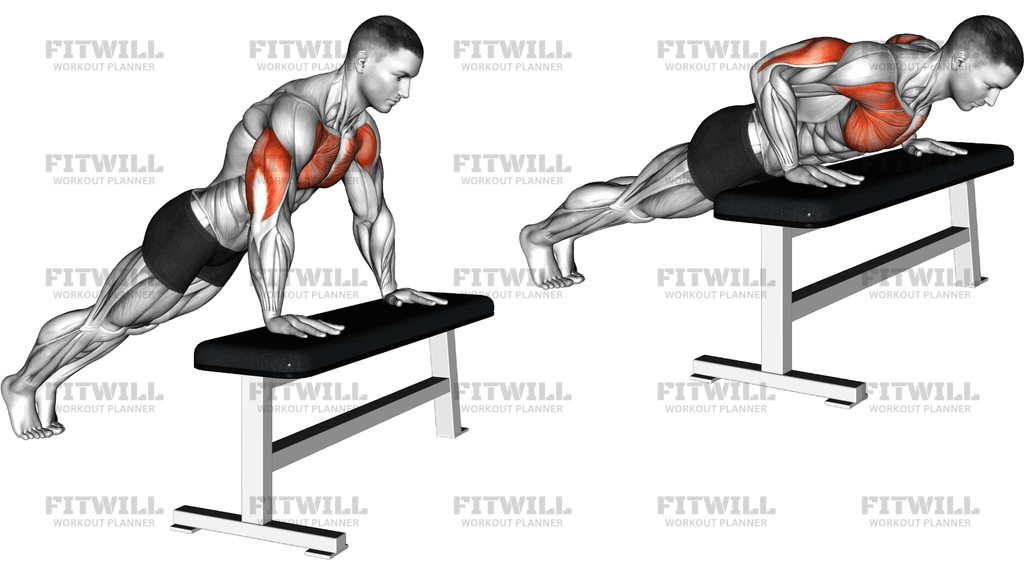
Instructions
- Set a flat bench on a non-slip surface and check that it cannot rock or slide when you press down on it.
- Place both hands on the edge of the bench, slightly wider than shoulder-width, with fingers pointing forward and wrapped around or resting firmly on the edge.
- Step your feet back until your arms are straight and your body forms one straight diagonal line from head to heels, with shoulders stacked directly over your wrists.
- Brace your abdominals, squeeze your glutes, and pull your shoulder blades slightly down and back so you do not sink between them.
- Inhale, then bend your elbows to lower your chest toward the front edge of the bench, keeping elbows around 45 degrees from your torso.
- Stop when your chest lightly touches the bench or your elbows reach about shoulder height behind you.
- Exhale and press through your palms to straighten your arms, pushing the bench away until your elbows are fully extended.
- Keep your hips and neck in line with your spine throughout; do not let the hips drop or the head jut forward.
- Complete your reps with the same controlled tempo, then step your feet forward and stand up to reset between sets.
Tips & Tricks
- If the bench slides forward on each rep, set it against a wall or rack upright; a moving bench breaks your pressing line and wastes effort.
- Hips sagging toward the floor usually means the core has disengaged. Reset into a straight line before continuing rather than grinding through reps with a bent position.
- Keep your neck long by looking at a spot on the floor just ahead of the bench instead of craning up to watch yourself.
- If your wrists ache on the bench edge, grip the edge with your fingers curled over it, or use a bench pad under your palms to reduce extension.
- Do not let your shoulders shrug toward your ears at the top; think about pushing the bench away and broadening across the collarbones.
- Lower yourself with a two-second count instead of dropping quickly. The eccentric portion is where much of the strength benefit for beginners comes from.
- Elbows flaring straight out to the sides stresses the shoulders and reduces chest involvement. Cue them slightly back toward your hips.
- Progress by lowering your hand height over time: bench, then a sturdy step, then a low platform, then the floor.
- If you feel it mostly in your triceps, check that your elbows are not tucking fully behind you; a slightly wider path keeps the chest working.
Frequently Asked Questions
Which muscles does the Incline Push Up With Bench work?
The chest is the primary mover, supported by the triceps and front shoulders. Your abs, glutes, and legs work isometrically to hold the straight plank position throughout the set.
Is the Incline Push Up With Bench good for beginners?
Yes, it is one of the best starting points for push-up training. Elevating the hands on a bench reduces the load on your arms so you can practice full-range pressing with sound technique.
How high should the bench be for this exercise?
A standard flat bench around 40-45 cm high works well for most beginners. The higher the surface, the easier the rep, so choose a height that lets you complete 8-12 controlled reps.
How do I progress from the Incline Push Up With Bench to a full push-up?
Gradually lower your hand height over weeks: move from the bench to a sturdy step, then a low platform, then the floor. Aim for 10-15 clean reps at each height before dropping lower.
Why do my hips sag during Incline Push Ups on a bench?
Sagging hips usually mean your core and glutes have relaxed, turning the movement into a strain on your lower back. Reset before each rep: squeeze your glutes, brace your abs, and hold one straight line from head to heels.
Can I do the Incline Push Up With Bench if I have wrist discomfort?
Gripping the edge of the bench with your fingers wrapped over it, or placing a folded mat under your palms, reduces wrist extension. If discomfort persists, a parallel handle setup on a rack or smith machine is a friendlier option.
How does the bench angle change which muscles are emphasized?
A higher bench shifts more load to your legs and reduces work for the chest and triceps, while a lower bench increases upper-body demand and moves the emphasis closer to a standard floor push-up.
What is the difference between an Incline Push Up and a Decline Push Up?
In an Incline Push Up your hands are elevated on the bench, which makes the movement easier. In a Decline Push Up your feet are elevated, which loads the upper body more heavily than a floor push-up.
How many reps and sets should I do?
Start with 3 sets of 8-12 reps, stopping one or two reps before your form breaks down. As the angle feels easy, either add reps or lower the hand height to keep progressing.
Is it safe to do Incline Push Ups with a bench every day?
Because the load is moderate, frequent practice is generally well tolerated, but your muscles still need recovery to get stronger. Two to four sessions per week with at least one rest day between hard sessions is a sensible rhythm.