Forward Fold Squat Mobilization
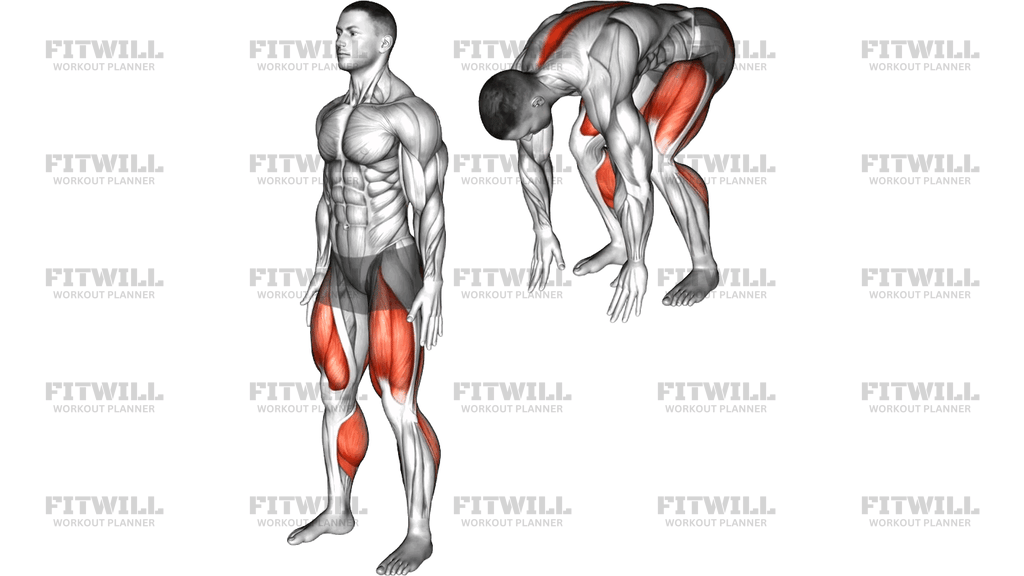
The Forward Fold Squat Mobilization is a flowing body weight drill that moves you between a standing forward fold and a shallow, knee-bent squat without your hands ever leaving contact with the floor. You start tall, hinge and fold until your fingertips reach down toward your feet, then bend your knees to sink into a partial squat while keeping your upper body folded. From there you alternate straightening and bending your legs, letting each transition gently lengthen the hamstrings and lower back while the quads and calves work through their range.
This is one of the most practical warm-up movements you can do before lower body training. Squatters, deadlifters, runners, and anyone who sits for long hours tends to accumulate stiffness through the posterior chain and the hips. Because the drill combines a loaded-lengthened position for the hamstrings with a flexed-spine squat, it prepares the exact joints and tissues that a deep squat or hinge demands, and it takes only a minute or two to feel the difference.
The setup matters more than it looks. Your feet stay roughly hip-width apart and flat on the floor, and your hands stay in contact with your shins, ankles, or the ground throughout. That fixed hand position is what makes the drill work: it anchors your upper body so the opening and closing of the knees drives the stretch into the thighs and hips rather than letting you just bob up and down. If your hands float or you pop back to standing between reps, you lose the whole effect.
To execute it well, think of your legs as the only moving part. Fold first, soften the knees as much as needed to reach, then cycle between bent knees and straighter legs with slow, even tempo. Let your head hang relaxed and let your spine round naturally; this is not a lifted-chest hinge, it is a deliberate fold. Breathe steadily and use each exhale to sink a little further or straighten a little more.
Expect to feel the back of the thighs, the calves, the low back, and a deep fold sensation through the hips. The quadriceps also get work on the squat side of the movement as they control the knee bend. Move within a range that feels like stretch, never sharp pain behind the knee or in the spine, and keep the transitions smooth rather than bouncing.
[ Workout Log & Planner ]
Put your next workout in Fitwill
Keep your plan and training log ready when you are.


Instructions
- Stand tall with your feet about hip-width apart, toes pointing forward, weight spread evenly across both feet.
- Hinge at the hips and fold forward, letting your spine round and your head hang, until your fingertips touch the floor or rest against your shins or ankles.
- Bend your knees as much as needed so your hands stay in contact with the floor or your legs, settling into a folded quarter squat.
- Keep your weight centered over midfoot and relax your neck and shoulders; do not hold tension in your arms.
- Slowly straighten your legs as far as your hamstrings allow while keeping your hands down and your chest folded toward your thighs.
- Bend your knees again to sink back into the folded squat, letting your torso drop closer to your legs as the knees travel forward.
- Continue alternating between straight legs and bent knees for 8 to 12 smooth repetitions, moving with your breath.
- On the final rep, bend the knees, walk your hands up your legs one vertebra at a time, and return to standing.
- Shake out your legs briefly and repeat for a second set if you are using this as a pre-training warm-up.
Tips & Tricks
- If your hands cannot reach the floor, rest them on a stack of books, a low box, or your shins. The contact point matters more than touching the ground.
- The most common mistake is turning this into a bounce stretch. Pulse gently at most; the value comes from the slow opening and closing of the knees.
- Do not lock the knees hard at the top of each straightening phase. Stop just short of full lockout so the hamstrings stay loaded under stretch instead of hanging on the joint.
- Keep your heels down the entire time. If your heels lift as the knees bend, widen your stance slightly or reduce how deep you squat.
- Let the spine round deliberately. Trying to keep a flat, lifted chest turns the drill into a hinge stretch and changes what it mobilizes.
- If you feel a pinch at the front of the hip in the folded squat, narrow your knee travel slightly and cue the knees toward your pinky toes.
- Exhale as you straighten the legs. Most people get an extra few degrees of hamstring range on the exhale that they cannot force.
- Tight calves often limit the folded squat position. Pause in the bent-knee position for a few extra breaths and let the heels sink to work that area.
- Use this before squats, deadlifts, or running rather than after heavy lifting, when fatigued hamstrings are less responsive to mobilization.
Frequently Asked Questions
What does the Forward Fold Squat Mobilization stretch?
It primarily targets the hamstrings and lower back in the folded position, while the bent-knee squat phase mobilizes the quads, calves, and hips. The alternating action covers both the back and front of the thighs in one flow.
Is the Forward Fold Squat Mobilization suitable for beginners?
Yes, because the range is fully self-regulated. Beginners can bend the knees more and rest the hands on the shins instead of the floor, then gradually straighten the legs as flexibility improves.
Why do my heels lift when I bend into the squat portion?
Limited ankle mobility or a stance that is too narrow are the usual causes. Widen your feet slightly, turn the toes out a few degrees, and squat to a shallower depth so the heels stay grounded.
Should my back be flat or rounded during the Forward Fold Squat Mobilization?
Rounded is intentional here. Unlike a conventional hinge stretch, this drill deliberately lets the spine flex to mobilize the whole posterior chain, as long as you move slowly and never bounce at end range.
How is this different from a plain standing forward fold stretch?
A static fold only lengthens the hamstrings and back in one position. Adding the squat cycle opens and closes the knee and hip angles repeatedly, which mobilizes the quads, calves, and hip crease while keeping tension on the posterior chain.
How many reps and sets should I do before training?
One to two sets of 8 to 12 slow cycles is enough as a warm-up. Finish while you still feel loose and responsive, not fatigued, since it is a preparation drill rather than a workout.
Can I substitute this if I cannot reach the floor at all?
Yes. Rest your hands on your shins, knees, or a stable low object like a bench or box. Once the hand contact is secured, the knee-bending cycle works exactly the same way.
When should I avoid the Forward Fold Squat Mobilization?
Skip it if you have acute low back pain, a recent hamstring strain, or knee issues that make deep bending uncomfortable. Move into the fold gradually and stop short of any sharp or radiating sensation.
Should I feel this in my lower back, and is that okay?
A mild stretching sensation across the low back is normal because the spine is flexing. It should feel like a spread, gentle pull, not a pinching or stabbing feeling; if it is sharp, reduce how far you fold and keep more bend in the knees.