Plank Leg Lift Mountain Climber
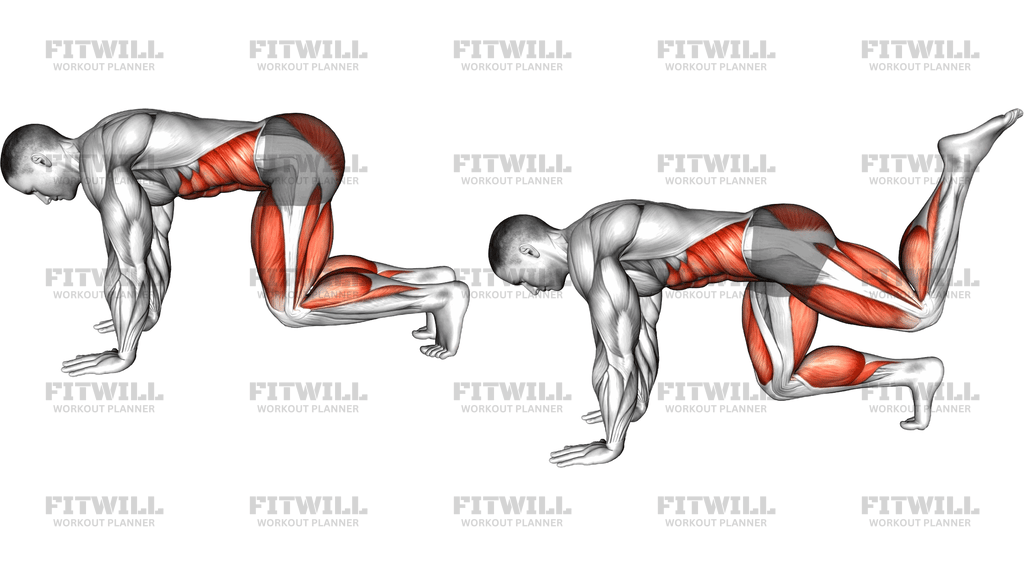
The Plank Leg Lift Mountain Climber blends two of the most reliable bodyweight core drills into one flowing sequence. You hold a solid high plank on straight arms, add a controlled leg lift to wake up the glutes, then drive one knee toward your chest in a mountain climber step. The result is a movement that challenges your abs, hips, and shoulders together instead of isolating a single muscle group.
What makes this combination effective is the constant demand on trunk stability. Every time you lift a leg behind you, your lower back wants to arch and your hips want to rotate. Every time you pull a knee forward, your abs have to shorten against your bodyweight while your shoulders keep your torso propped up. Training both actions in the same set builds the kind of brace that carries over to running, lifting, and any sport where force travels through the midsection.
This exercise suits anyone with a basic plank foundation who wants more from their floor work. Home trainers like it because it needs nothing but floor space, and lifters use it as a warm-up primer or a finishing burnout after heavier training. Because the pace is easy to adjust, it works as a slow, deliberate stability drill or a brisk conditioning move when performed for continuous reps.
Setup details matter more than most people expect. Hands should sit directly under the shoulders with fingers spread, and the body should form one straight line from head through heels before any movement starts. If your hips start high in the air or sag toward the floor, the sequence loses its core focus and starts loading the joints instead of the muscles.
To execute it well, think of your torso as a rigid block with only the legs moving. Lift one leg with the glute doing the work, hold briefly, place it down, then pull that knee under your body toward your chest before returning it to the plank. Alternate sides with even rhythm, keeping the shoulders stacked over the wrists the entire time. Breathe steadily rather than holding your breath, and stop the set as soon as your lower back starts taking over.
Treat quality as the deciding factor for volume. A set of twenty to thirty controlled reps done with a flat torso beats a minute of rushed, hips-bouncing reps every time. If your wrists complain or your plank collapses early, shorten the set or drop to an incline version with your hands on a bench.
[ Workout Log & Planner ]
Put your next workout in Fitwill
Keep your plan and training log ready when you are.


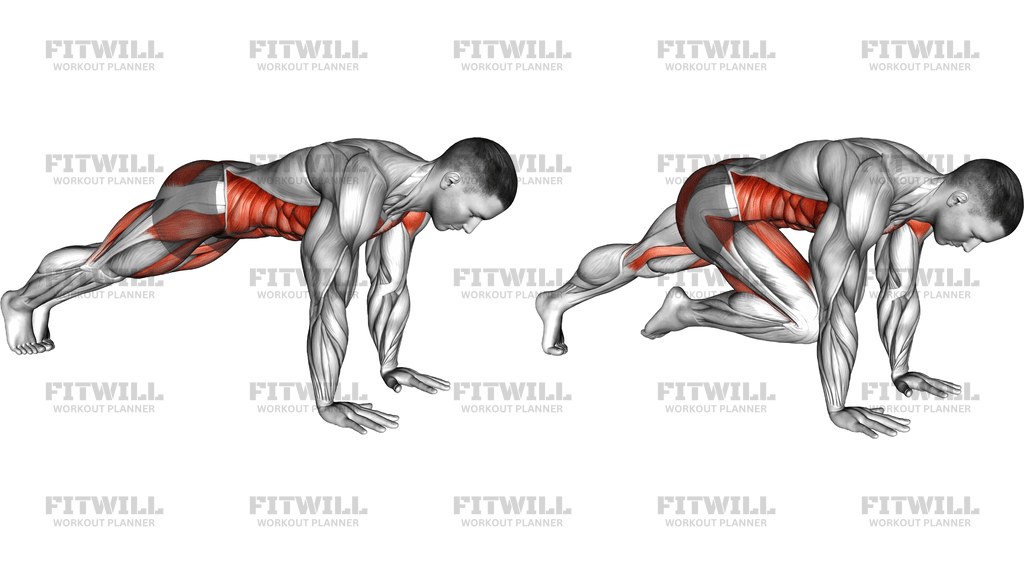
Instructions
- Start on an exercise mat or non-slip floor and set up in a high plank: hands flat under your shoulders, arms straight, fingers spread wide for a stable base.
- Step your feet back until your legs are fully extended and your body forms one straight line from head to heels, resting on the balls of your feet with roughly hip-width or shoulder-width stance.
- Brace your core by pulling your ribs down and tightening your midsection as if bracing for a light tap to the stomach, and keep your neck in line with your spine by looking at the floor just ahead of your hands.
- Keeping the knee straight, lift one leg off the floor by squeezing the glute until the foot rises a few inches above hip height, and pause for a beat without letting your lower back arch.
- Lower the lifted leg back to the plank position under control, then immediately drive that same knee forward toward your chest, rounding your lower abs as the knee approaches.
- Return the knee to the full plank and repeat the lift-and-drive sequence with the opposite leg, alternating sides for each repetition.
- Keep your shoulders stacked directly over your wrists throughout; do not let your torso drift backward as the knee comes forward.
- Exhale as you lift the leg or pull the knee in, and inhale as you return to the plank, maintaining a steady breathing rhythm.
- Continue alternating legs for your target rep count, then step or walk your feet toward your hands to stand up and reset between sets.
Tips & Tricks
- If your hips pike up during the mountain climber portion, you are pushing the floor away with your arms—shift your weight slightly forward over the wrists and re-establish the straight line before continuing.
- The most common failure point is a sagging lower back during the leg lift; squeeze the glute of the lifting leg before the foot leaves the floor to protect the lumbar spine.
- Do not let the driving knee swing outward—track it straight toward the same-side chest so the lower abs, not the hip rotators, do the pulling.
- Keep the lifted leg lift small and controlled; a few inches of hip extension is enough, and cranking the leg higher only arches the back.
- Spread your fingers and grip the floor actively—this eases wrist strain during the long plank hold and steadies the shoulders.
- Slow the knee drive down if your hips bounce side to side; quiet hips are the sign that your obliques are controlling the rotation.
- If your wrists ache, use fists or a pair of light dumbbells as handles to keep them neutral instead of fully extended.
- Place the foot down softly between reps—stomping the ball of the foot into the mat throws off your plank line and wastes energy.
Frequently Asked Questions
What muscles does the Plank Leg Lift Mountain Climber work?
The primary work comes from the core, especially the abs and deep stabilizers that hold the plank and pull the knee in. Your glutes and hip flexors handle the leg actions, while the shoulders, triceps, and forearms support your upper body throughout.
Is the Plank Leg Lift Mountain Climber suitable for beginners?
Yes, as long as you can hold a solid high plank for at least twenty to thirty seconds. Beginners should start with slow, deliberate reps and can shorten the leg lift or perform the knee drive alone before combining both.
Should I lift the leg before or after the knee drive?
Perform the leg lift first and return to the plank before driving the knee forward. Mixing the two actions at the same time turns the drill into a different movement and makes the trunk much harder to control.
Why do my hips sway side to side during this exercise?
Hip sway usually means your obliques and glutes are not controlling the rotation, or your reps are too fast. Slow the tempo, actively squeeze the glute on the moving side, and imagine keeping both hips level with the floor.
My wrists hurt when I do the Plank Leg Lift Mountain Climber—what can I do?
Spread your fingers wide and press through the base of the knuckles to reduce direct wrist extension pressure. You can also make fists or rest your hands on dumbbells for a neutral wrist position.
How is this different from a regular mountain climber?
A regular mountain climber is a continuous running-style knee drive, while this version adds an isolated straight-leg lift from the plank before each knee pull. The added leg lift emphasizes the glutes and raises the anti-rotation demand on your trunk.
Can I substitute the Plank Leg Lift Mountain Climber if I cannot hold a full plank yet?
Yes—perform the same lift-and-drive sequence with your hands elevated on a bench or sturdy chair, or drop to a knee plank. The elevated angle shortens the lever your core must control while keeping the movement pattern intact.
How many reps should I do?
Aim for ten to twenty alternating reps per side with strict form, or work in timed sets of twenty to forty seconds. Stop the set once your hips drop or your lower back starts arching, since that signals the core has fatigued.
Is it safe for my lower back?
When performed with a braced trunk and a modest leg-lift height, the movement is generally low risk. Avoid arching your lower back at the top of the leg lift and keep reps controlled; if you have an existing back condition, check with a qualified professional first.