Stick Sitting Roll Leg
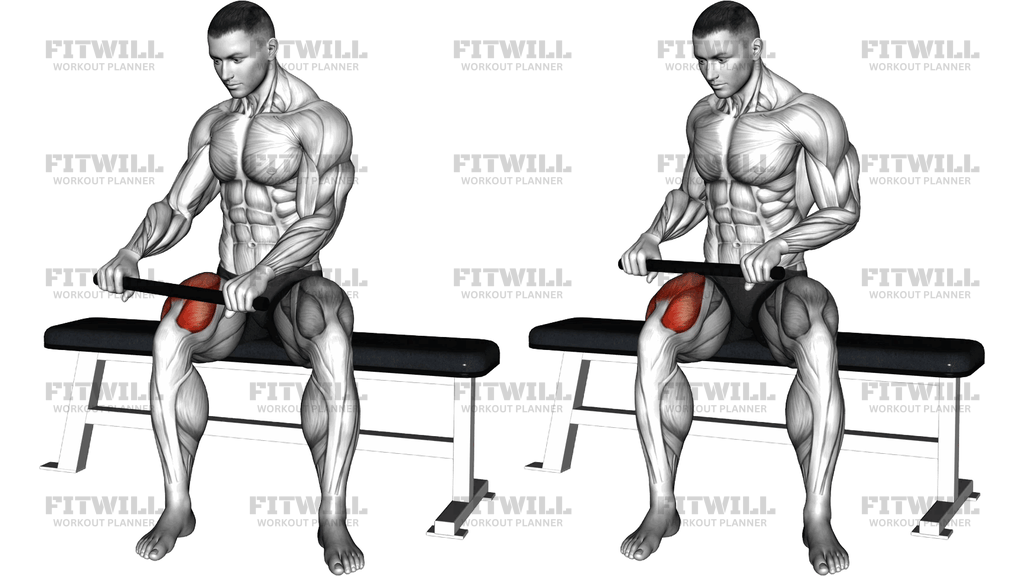
The Stick Sitting Roll Leg is a self-massage recovery exercise performed while seated on a flat bench. You hold a rigid stick with both hands, lay it across the front of one thigh, and roll it slowly up and down the quadriceps by pressing down through the stick and driving it with your arms. The highlighted area is the front of the thigh, where the quadriceps take a beating from running, squatting, cycling, and everyday sitting.
This movement is not a strength builder in the traditional sense. It is a recovery and mobility tool, closer to foam rolling than to lifting. Because you are seated and the stick is narrow, you get more focused pressure than a large foam roller provides, which makes it useful for working through specific tight spots along the thigh rather than treating the whole leg with the same intensity.
The setup matters more than people expect. Sitting on a bench with your feet planted lets you relax the leg completely, and a relaxed muscle accepts pressure far better than a tensed one. If you try this standing or with the leg hovering, the quadriceps stay under tension to hold your position, and the roll turns into a fight between your hands and your own stiffness.
To execute it well, keep the stick level across the thigh, press down with both hands evenly, and move it in slow, short strokes from just above the knee up toward the hip. When you find a tender spot, pause there for a few seconds and let the tissue settle instead of grinding over it. Expect mild discomfort, but never sharp pain. If you are wincing or holding your breath, the pressure is too much.
Practical uses include warming the thighs up before squats or sprints, flushing the legs after a hard run or ride, and easing the deep thigh tightness that builds up from long days at a desk. Runners and cyclists get the most out of it, but anyone who trains legs twice a week or more will notice the difference in how their knees and hips move afterward.
A few safety points: keep the pressure on muscle, not on the kneecap or the bony hip crests at the top of the thigh. If you have a recent thigh bruise, strain, or any acute injury, skip rolling that area until the acute phase has passed. Two to four minutes per leg is plenty. More pressure and more time does not equal more benefit with soft-tissue work.
[ Workout Log & Planner ]
Put your next workout in Fitwill
Keep your plan and training log ready when you are.


Instructions
- Sit sideways on a flat bench with both feet flat on the floor and your knees bent to roughly 90 degrees, so your thighs are level and relaxed.
- Grip a rigid stick with both hands, shoulder-width apart or slightly wider, using an overhand grip.
- Lay the stick across the front of your right thigh, a few fingers' width above the kneecap, keeping it level with the floor.
- Press down through the stick with both hands until you feel firm but tolerable contact with the quadriceps.
- Roll the stick slowly upward along the front of the thigh toward the hip crease, using your arms rather than leaning your whole torso into it.
- When you hit a tender spot, stop and hold the pressure there for 5 to 10 seconds, or make small back-and-forth passes over it.
- Roll back down toward the knee and repeat for 8 to 12 slow passes, covering the full length of the front thigh.
- Exhale steadily as you press and roll; if you catch yourself holding your breath, ease off the pressure.
- Shift the stick slightly to the inner and outer portions of the thigh to cover the whole quad group, then switch legs and repeat.
Tips & Tricks
- The most common mistake is rolling directly over the kneecap. Stop the stroke a few fingers above the patella; bone and rolling sticks do not mix.
- If your quad tenses up every time the stick touches it, you are pressing too hard. Start with light pressure for the first few passes and build gradually.
- Keep the stick parallel to the floor. Tilting it concentrates all the force on one hand's side and turns a broad roll into an uncomfortable pin-point dig.
- Do not rush. A slow pass takes about three to five seconds; flicking the stick quickly up and down does almost nothing for the tissue.
- Bend and straighten the knee slightly while holding pressure on a tight spot. Moving the joint under the stick can release spots that static pressure alone will not touch.
- If both quads are equally tight and time is short, bias the outer quad, which usually carries more tension from running and cycling than the inner portion.
- Wear shorts or thin pants. Rolling over thick sweatpants deadens the feedback and you lose the ability to find specific tight spots.
- Do this before training for a short, brisk 30 to 60 seconds per leg to wake the thighs up, or after training with slower, longer holds for recovery.
Frequently Asked Questions
What does the Stick Sitting Roll Leg actually do?
It applies focused pressure to the quadriceps while you are seated, helping reduce muscle tightness and improve comfort in the front of the thigh. It is a recovery and mobility exercise, not a strength or flexibility exercise in the classic sense.
Which muscles does the Stick Sitting Roll Leg target?
The quadriceps on the front of the thigh are the primary target. By angling the stick slightly inward or outward, you can also reach the inner and outer thigh portions around the quad group.
Is the Stick Sitting Roll Leg suitable for beginners?
Yes, it is one of the easiest recovery drills to learn because you control every variable: pressure, speed, and position. Beginners should simply start with lighter pressure and shorter sessions until they learn what a productive level of discomfort feels like.
Why sit on a bench instead of standing to roll the thigh?
Sitting lets the quadriceps fully relax, which allows the stick to work into the tissue instead of pressing against a muscle that is busy stabilizing your stance. The bench also makes the stroke easier to control with just your arms.
How is a stick different from a foam roller for the quads?
A stick is narrower and hands-controlled, so you can dial pressure up or down instantly and target a tight band with precision. A foam roller covers more area at once but offers less control and usually less intense pressure in a seated setup.
Should the Stick Sitting Roll Leg hurt?
Expect firm, mildly uncomfortable pressure, especially over tight spots, but never sharp, shooting, or lingering pain. If you cannot breathe steadily through it, reduce the pressure you apply through the stick.
Can I roll over a fresh thigh bruise or strain?
No. Avoid rolling any area with a recent contusion, acute strain, or swelling until the acute irritation has settled. When in doubt, get clearance from a qualified professional before pressing on injured tissue.
How long and how often should I do the Stick Sitting Roll Leg?
About two to four minutes per leg is enough, whether that is daily, before workouts, or after hard sessions. Rolling longer than that adds little benefit and can leave the tissue unnecessarily sore.
What can I use if I do not have a stick?
A sturdy broom handle, a PVC pipe, or even a small water bottle works in the same way. Anything rigid with a smooth surface that you can grip with both hands will let you reproduce the same seated rolling motion.