Cable Incline Single Arm Y Raise Wrist Straps With
The Cable Incline Single Arm Y Raise With Wrist Straps is a chest-supported shoulder exercise that combines an incline bench with a low cable pulley and a wrist strap attachment. You sit facing the inclined pad, strap one hand, and raise that arm out and up so the cable travels from a low point behind you to a wide Y position overhead. Because the pad supports your chest and the cable pulls continuously from below, the rear delts and upper back work through a smooth, evenly loaded arc that free weights cannot quite replicate.
This movement earns its place in a program when the rear deltoids, mid traps, and lower traps need focused work without letting the lower back or momentum take over. Chest-supported raises are popular with lifters who find that standing rear delt flyes turn into a full-body heave, and the cable version adds constant tension at the bottom of the rep, which is exactly where a dumbbell gives you almost nothing. The Y-angle also biases the lower trapezius more than a standard rear delt fly, making it useful for shoulder health and scapular control work.
The setup is what makes this exercise work. Straddling the incline bench and pressing your chest into the pad locks your torso in place, so the only moving joint is your shoulder. The wrist strap, rather than a handle, keeps your hand free to stay relaxed and lets the cable pull from the wrist in a straight line, which reduces forearm and grip involvement. Position the bench far enough from the low pulley that the cable stays taut even at the start of the rep, when your arm hangs down beside you.
To execute it well, think of the raise as a long diagonal sweep rather than a straight lift to the ceiling. Your arm travels out to the side and upward at roughly 30 to 45 degrees from vertical, finishing in line with the bench angle so it forms a Y with your torso. Keep a very slight bend in the elbow and let the shoulder blade move with the arm instead of pinning it down. The weight should be modest; this is a small muscle moving a long lever against cable resistance, and the moment your torso twists off the pad or the arm swings, the target muscles stop doing the job.
Common use cases include rear delt and upper back days, accessory work after heavy pressing or rowing, and rehab-adjacent programming where scapular upward rotation and lower trap strength are priorities. The single-arm setup also lets you address side-to-side differences, since each side works alone with identical cable tension. One set of straps and an adjustable bench is all it takes, so most dual pulley or functional trainer setups can be configured in under a minute.
A few practical points keep this safe and effective. Choose a light weight to start, because the cable pulls continuously and the eccentric deserves just as much control as the lift. Keep your neck neutral by looking down at the pad rather than craning up at your hand. If your shoulder pinches at the top, lower the end height slightly or reduce the weight before abandoning the movement.
[ Workout Log & Planner ]
Put your next workout in Fitwill
Keep your plan and training log ready when you are.


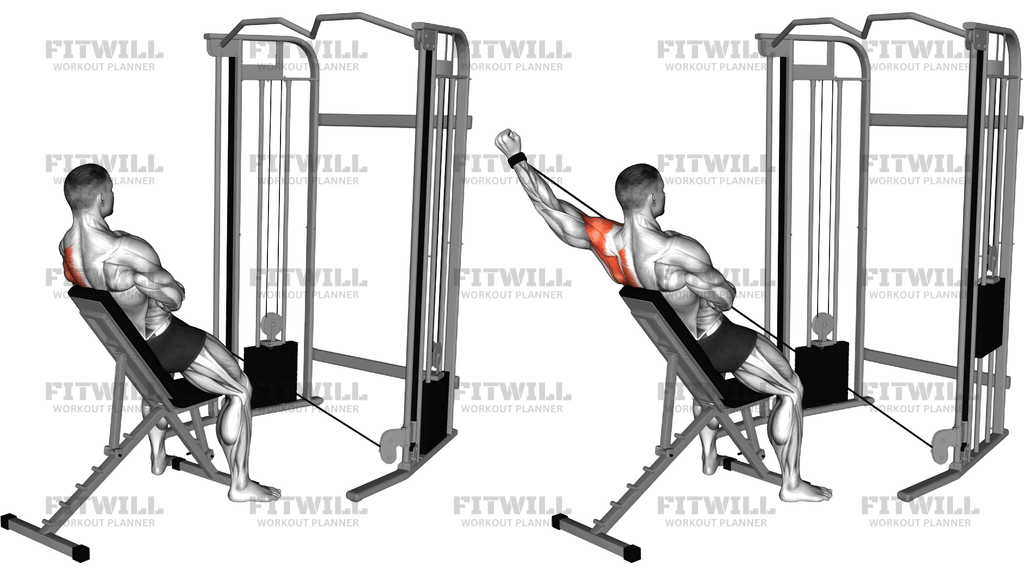
Instructions
- Set an adjustable bench to a 30-45 degree incline and position it a step or two in front of the low pulley of a cable machine, facing the pad so your chest will rest against it.
- Attach a wrist strap to one hand and clip it to the low pulley cable, then straddle the bench and lean your chest firmly into the incline pad with your feet planted on the floor on either side.
- Let the strapped arm hang down and slightly out beside the bench, and scoot the bench back or forward until the cable is taut at this starting point with no slack.
- Brace your core lightly, press your chest and the side of your torso into the pad, and keep your opposite arm wrapped around the pad or braced on the bench for stability.
- Raise your arm out to the side and up in a wide diagonal arc, keeping a slight bend in the elbow, until your hand is at or just above head height and forms a Y with your torso.
- At the top, your palm faces forward or neutral, the cable runs in a straight line from the pulley to your wrist, and your shoulder blade has rotated upward rather than shrugging toward your ear.
- Pause briefly at the top, then lower the arm along the same diagonal path over two to three seconds until the shoulder is back at the start without the cable going slack.
- Exhale as you raise the arm and inhale as you lower it, keeping your breathing steady and your chest in contact with the pad throughout.
- Complete all repetitions on one side, then unbuckle the strap, switch it to the other wrist, and match the reps on the second arm.
- Step the weight stack back gently between sets and reset your chest position on the pad before each new set.
Tips & Tricks
- Start with roughly a quarter to a third of what you would use for a dumbbell rear delt fly; the continuous cable tension makes even light stacks feel heavy by rep ten.
- The most common fault is shrugging the working shoulder toward the ear as fatigue sets in; if you see the trap bunching, drop the weight and focus on letting the shoulder blade rotate instead of elevating.
- If your torso rotates off the pad as you lift, that is a sign the weight is too heavy or the cable angle is too far behind you; nudge the bench slightly forward so the pull feels more like a side-and-up sweep.
- Keep the hand open and relaxed inside the wrist strap; gripping hard shifts tension into the forearms and biceps and dulls the feeling in the rear delt.
- Aim the finish of the rep wide, not straight overhead; ending with your hand in front of your head turns this into a front raise and shifts work away from the rear delts and lower traps.
- Slight elbow bend is fine, but if the elbow bends more as you lift, the movement becomes a partial upright row; cue yourself to raise with the shoulder, not the hand.
- Rest your forehead or cheek lightly toward the pad if your neck fatigues; looking up at your working hand for every rep strains the neck over a full set.
- Use a two-to-three second lowering phase; dropping the arm quickly lets the stack yank your shoulder down and wastes the eccentric portion where much of the trap work happens.
- Check the cable path before your first rep on each side; it should clear the bench frame and your body without rubbing, since a dragging cable changes the resistance mid-rep.
Frequently Asked Questions
Which muscles does the Cable Incline Single Arm Y Raise With Wrist Straps work?
The rear deltoid is the primary mover, with strong contributions from the mid and lower trapezius and the rhomboids as the shoulder blade rotates upward. The rotator cuff and small stabilizers around the shoulder joint also stay active throughout the arc.
Why use a wrist strap instead of a handle for this raise?
The strap lets your hand stay open and relaxed, so the cable pulls directly from the wrist without forcing your forearm into a fixed angle. This keeps grip and forearm fatigue out of the equation and lets the rear delt and traps do the work.
Is the incline bench position necessary, or can I do this standing?
The chest support is the main benefit of this version; it removes momentum and lower back strain, which are common problems in standing cable raises. Standing versions are valid but harder to keep strict at any meaningful weight.
How high should my arm go at the top of the Cable Incline Single Arm Y Raise With Wrist Straps?
Raise until your hand is around head height or slightly above and forms a wide Y with your torso. If the top position causes pinching in the shoulder, stop just below that point and stay in a comfortable range.
Is this exercise suitable for beginners?
Yes, as long as the weight is kept very light at first. The chest support makes it easier to learn than standing raises, but beginners should spend a few sets feeling the rear delt work before adding load.
Why does my upper trap take over instead of my rear delt?
Shrugging is the most common substitution, especially when the weight is too heavy or the arm drifts too far forward. Lighten the load, keep the sweep wide, and think about rotating the shoulder blade rather than lifting the shoulder toward the ear.
What can I substitute if my gym has no wrist straps or low pulley?
A single cable handle attached to the low pulley works with a neutral grip, or you can perform an incline dumbbell Y raise with light dumbbells. Resistance bands anchored low behind the bench offer a similar constant-tension feel at home.
How many sets and reps should I use for this movement?
Because it targets small muscles with continuous tension, two to four sets of 10 to 15 controlled reps per side works well. It fits best as an accessory after your main rows or presses rather than as a first exercise.
Should both arms be trained in the same set, or one at a time?
This setup trains one arm at a time, which lets you match reps and load exactly between sides and focus fully on each shoulder. Alternating arms with a short rest between sides is the intended way to use the single strap.
Is it safe for someone with shoulder discomfort?
The chest-supported, low-load nature of the movement makes it shoulder-friendly for many people, but anyone with a current shoulder issue should get clearance from a qualified professional first. Staying below painful ranges and keeping the weight minimal are sensible precautions.