Cable Lying Bench Cross Lateral Raise
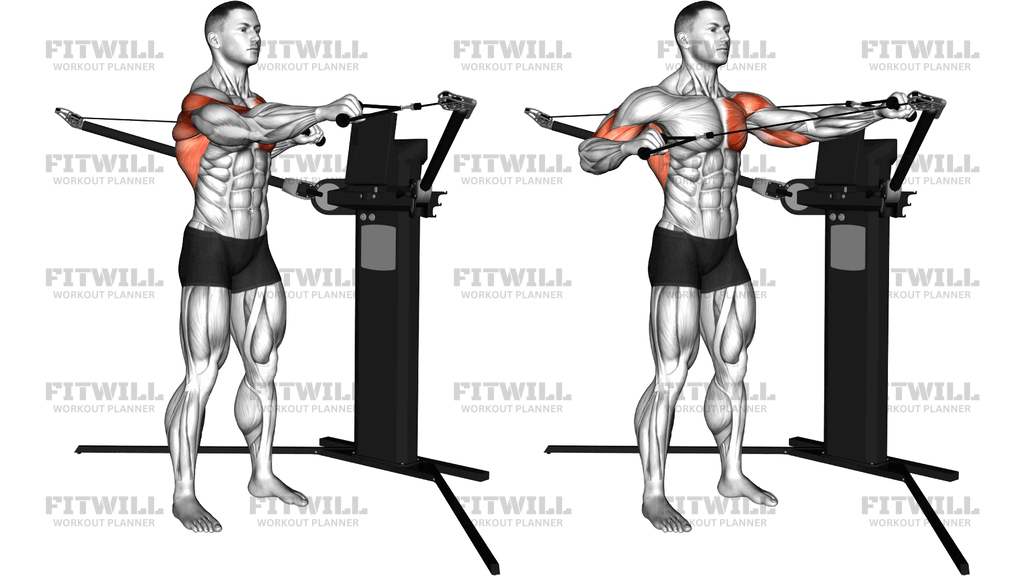
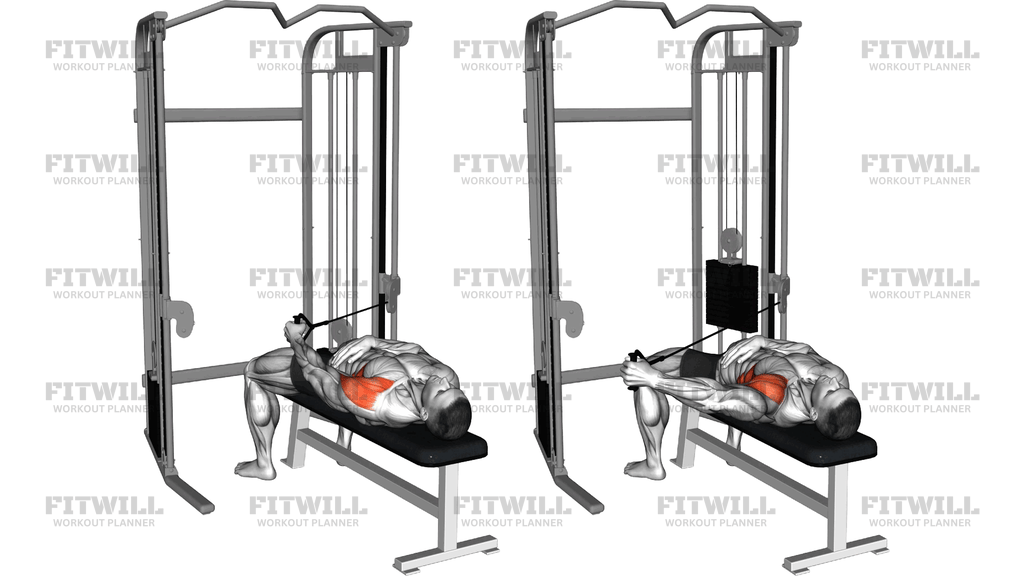
The Cable Lying Bench Cross Lateral Raise is a chest isolation exercise performed on a flat bench set between the pulleys of a dual cable station. Unlike a standard lying cable fly, the cables cross over your body before you grab them, so each hand works against the pulley on the opposite side. You lie back with the handles together above your chest, then open your arms out wide to the sides in a controlled arc, fighting the pull of the cables the entire way.
Because the cables cross at the midline, the tension angle is slightly different from a regular fly, and the resistance stays on the chest through the full range, including the stretched position where dumbbells lose most of their load. That makes this version particularly good for building the mid and lower pec fibers and for learning to control the arms as they travel away from the body.
This movement suits lifters who already have some pressing experience and want a dedicated stretch-and-squeeze exercise for the chest. It pairs well with presses in the same session: presses load the chest heavily in a shortened range, while this cross-cable fly emphasizes the lengthened position with constant tension. It is also a useful option for people whose shoulders tolerate cables better than heavy dumbbell flys, since the cable path can be adjusted and the load is easier to modulate.
Setup matters more here than in most chest work. The bench should sit centered between the pulleys so the cable pull is symmetric, and the pulleys are typically set near the top or middle of the towers. Your feet stay planted on the floor on either side of the bench, your head rests on the bench, and your shoulder blades stay pulled gently back and down. If the bench drifts off-center, one side of your chest will take more load than the other.
To execute it well, start with the handles crossed above your chest, elbows softly bent and fixed. Open your arms in a wide arc until your upper arms reach roughly bench level and you feel a stretch across the pecs, then pull the handles back together along the same arc, crossing slightly at the top for a fuller contraction. Keep the elbow angle locked in; if it changes, the triceps start working and the chest stimulus drops.
Work in the moderate rep range, roughly 10 to 15, and treat this as a finishing movement rather than a max-effort lift. The stretched position under tension is the demanding part, so a lighter weight with a full, smooth arc beats a heavy weight that turns into a half-rep squeeze.
[ Workout Log & Planner ]
Put your next workout in Fitwill
Keep your plan and training log ready when you are.


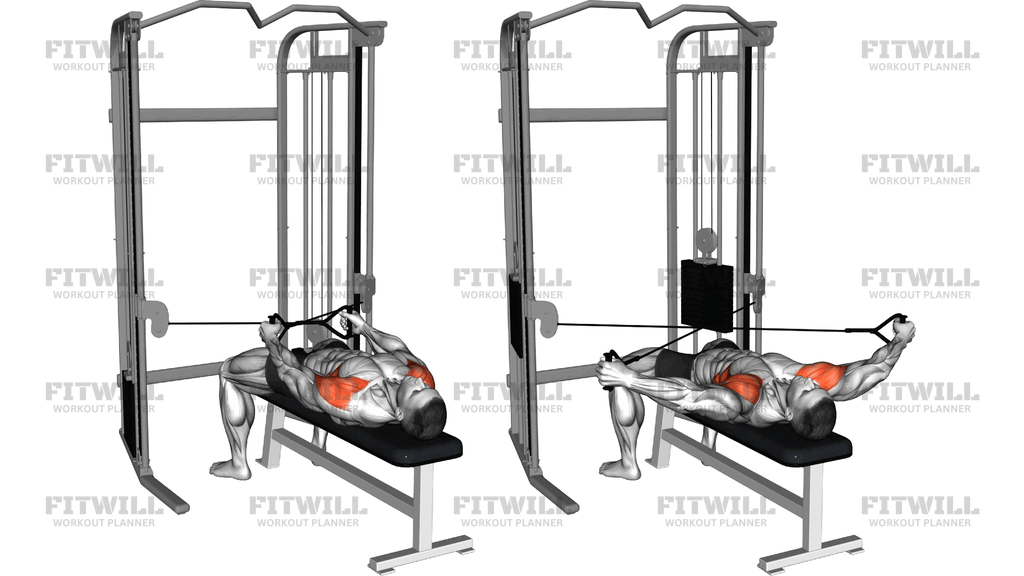
Instructions
- Place a flat bench lengthwise between the pulleys of a dual cable crossover machine, centered so both cables cross evenly over your torso.
- Set both pulleys to the same height, attach a stirrup handle to each cable, then grab the handle from the opposite side so the cables form an X over your chest.
- Lie back on the bench, plant your feet flat on the floor on either side of it, and press your shoulder blades into the bench with your chest lifted slightly.
- Start with both handles together above your lower chest, elbows bent about 15 to 20 degrees and held at that angle.
- Brace your core and breathe in before each rep.
- Open your arms out wide to the sides in a smooth arc, lowering until your upper arms are roughly level with the bench and you feel a stretch across your chest.
- Pause briefly at the widest point without letting the weights stack slam together or your shoulders roll forward.
- Exhale as you sweep the handles back up along the same arc, bringing them together above your chest and letting one hand cross slightly past the other.
- Squeeze your pecs for a moment at the top, then begin the next rep from that crossed position.
- After your final rep, set the handles down one at a time while seated up, then release the cables carefully so the stacks lower without jerking.
Tips & Tricks
- If one arm feels more loaded than the other, the bench has drifted off-center between the pulleys; recheck your alignment before adding weight.
- Do not let the elbows flare and straighten as the arms open, which is the most common breakdown in this exercise; imagine your elbow angle is set in plaster.
- Stop the stretch at the point where your upper arms reach bench level. Dropping deeper usually shifts stress onto the shoulder capsule instead of the chest.
- Because the cables cross over your face and chest, keep your grip firm and your hands above your torso at all times; never let a handle slip out mid-rep.
- If the weights stack touches down between reps, the tension disappears; choose a weight you can control through the full arc, or shorten the range slightly.
- Keep your lower back in contact with the bench. Arching to lift the handles together means the weight is too heavy for a clean contraction.
- Squeeze at the top with the handles nearly touching rather than just bringing them close, since the crossing setup lets you extend slightly past the midline for extra pec contraction.
- Start lighter than you would for a dumbbell fly. The cable tension at the stretched position surprises most people on their first few sessions.
Frequently Asked Questions
Which muscles does the Cable Lying Bench Cross Lateral Raise work?
The sternal head of the pectoralis major does most of the work, with the clavicular head and front delts assisting. The crossing cable path keeps tension on the chest through both the stretched and squeezed positions.
Why cross the cables instead of holding the handle from the same side?
Crossing changes the resistance angle so each arm pulls against the opposite pulley, letting you bring the hands past the midline for a stronger peak contraction. It also alters the tension curve slightly compared with a standard lying fly.
How high should the pulleys be set?
Set both pulleys at the same height, usually around the top or upper-middle of the towers, so the cables form a symmetric X over your chest. Matching heights are essential, or one side will load unevenly.
Is this exercise suitable for beginners?
It can be, but it is best learned after basic pressing movements. Start with a very light weight to feel the arc and keep the elbow angle fixed, since beginners often lose chest tension by bending and straightening the elbows.
What is the most common mistake with the Cable Lying Bench Cross Lateral Raise?
Opening the arms too far and letting the shoulders roll forward at the bottom. Stop when your upper arms reach bench level and you feel a pec stretch, not a strain in the shoulder joint.
Can I substitute dumbbell flys for this exercise?
Dumbbell flys are a reasonable substitute, but they lose most of their resistance at the top and bottom of the arc. The cable version keeps constant tension, which is the main reason to choose it when a crossover station is available.
How many sets and reps should I do?
Two to four sets of 10 to 15 controlled reps works well as a chest finisher after presses. Because the stretched position is heavily loaded, avoid turning it into a low-rep strength test.
Should my feet stay on the floor during the movement?
Yes, keep both feet planted on either side of the bench. This stabilizes your torso and stops you from twisting sideways as the cables pull your arms outward.
Is the Cable Lying Bench Cross Lateral Raise safe for the shoulders?
For healthy shoulders it is generally well tolerated because the bench supports the torso and the cable path is smooth. If you have a history of shoulder irritation, use a lighter weight, limit the stretch to a comfortable range, and stop if you feel pinching.