Fly March
Fly March is a standing body-weight drill that combines a high-knee march with the arms held up in a flexed, goalpost-style position. From a tall stance, you lift one knee toward hip height while keeping the elbows bent and the fists up, then lower the foot and switch legs. Because the arms stay elevated the entire time, the shoulders and upper back work continuously to hold the position while the legs drive the marching rhythm underneath.
The biggest challenge of the Fly March is not the knee lift itself but everything that has to stay quiet while one leg is off the floor. The standing leg rises onto the ball of the foot with each step, which recruits the calf and ankle stabilizers, and the trunk has to brace against the pull of the lifted knee so your ribs do not flare and your lower back does not arch. This makes it a useful single exercise for tying shoulder endurance, hip flexor strength, and standing balance into one coordinated pattern.
This movement fits well into warm-ups, low-impact conditioning circuits, and home routines where no equipment is available. Beginners can use it to build the hip and trunk control needed for harder single-leg work, while more experienced trainees often use it as a shoulder-fatigue finisher or as an active recovery drill between heavier sets. Because one foot is always leaving and returning to the floor, it also raises the heart rate more than a static hold without any jumping or impact.
Setup matters more than it looks. A wide, stable base, a lifted chest, and arms locked into position before the first march all prevent the two most common breakdowns: shoulders rolling forward as they tire, and the torso leaning back as the knees come up. If the arms drift or the ribs pop forward, the work shifts away from the shoulders and hip flexors and starts loading the lower back unnecessarily.
To execute it well, march with intent rather than speed. Lift each knee to roughly hip height, pause briefly at the top so the standing leg must stabilize, and place the foot back down under control before the other knee rises. Keep the neck relaxed and the shoulders pressed slightly down away from the ears even though the arms are up. A controlled tempo of one knee every second or two is plenty; this drill rewards quality reps far more than a fast, sloppy pace.
The main safety point is to respect fatigue in the shoulders and the standing ankle. When the arms start sagging or the standing heel slams down, either shorten the set, reduce the knee height, or rest and reset. Stay near a wall or sturdy support if balance on the ball of the foot feels uncertain, and stop if you feel any pinching in the shoulder or hip rather than working through it.
Fitwill
Log Workouts, Track Progress & Build Strength.
Achieve more with Fitwill: explore over 9600 exercises with images and videos, access built-in and custom workouts, perfect for both gym and home sessions, and see real results.
Start your journey. Download today!




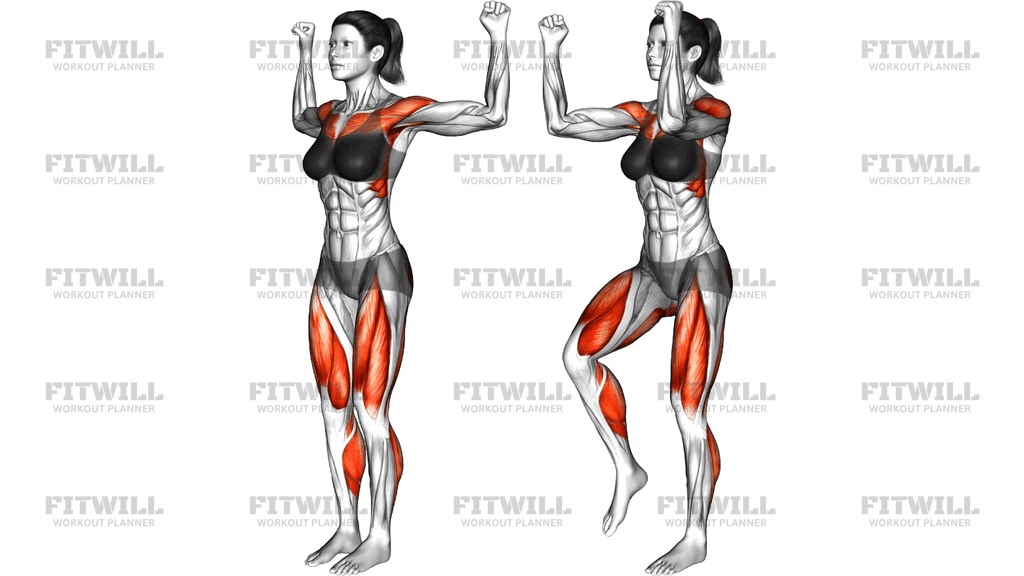
Instructions
- Stand with your feet about hip-width apart, weight spread evenly across both feet, and your spine tall from heels to the top of your head.
- Raise both arms into a flexed position with the elbows bent, upper arms roughly parallel to the floor, and fists up near shoulder height; keep the shoulders pulled gently down away from your ears.
- Brace your abdominal wall lightly and tuck the ribs down so your lower back is not already arched before you start moving.
- Shift your weight onto one leg and rise slightly onto the ball of that foot as you drive the opposite knee up toward hip height.
- Pause for a beat at the top of the knee lift, keeping the arms in the raised position and your torso upright rather than leaning back.
- Lower the lifted foot back to the floor with control, placing it under your body instead of letting it drop.
- Immediately march the opposite knee up while the other leg becomes the supporting leg, continuing to alternate with a steady rhythm.
- Exhale as each knee drives up and inhale as the foot returns to the floor, keeping the breathing continuous rather than holding it.
- Complete your planned reps or time, then bring both feet flat, lower the arms slowly, and reset your posture before the next set.
- If your balance wavers, stand near a wall and keep one hand lightly available for support while you practice the knee lifts.
Tips & Tricks
- If your elbows sink as the set goes on, that is the shoulder fatigue showing; lower the knee height slightly before you let the arms drop, since the arm position is the point of the exercise.
- A common mistake is leaning the chest backward as the knee rises, usually to make the hip flexor lift easier; watch yourself sideways or film a set and keep the torso stacked over the standing hip.
- Keep the lifted foot's toes pulled up slightly as the knee comes up; a limp foot usually means the knee is being swung up with momentum rather than lifted by the hip.
- Rise onto the ball of the standing foot deliberately each rep instead of bouncing; the calf and ankle should control the rise, not the floor's rebound.
- If your lower back feels the work, you are probably arching as the knee lifts; exhale harder at the top of each march and think about pulling the lifted knee in with the lower abs, not just the hip.
- Start with a slower tempo than feels necessary, roughly one knee every two seconds, and only speed up once you can hold the arm position for the full set without the shoulders creeping toward your ears.
- For a harder version, hold the knee up for two to three seconds at the top of each march; this turns it into a single-leg balance challenge as well.
- If the goalpost arm position causes shoulder pinching, widen the elbows slightly or lower the upper arms a few degrees rather than forcing a strict angle.
- Avoid locking the knees on the supporting leg; a small amount of bend in the standing knee keeps the hip stable and protects the joint as you rise onto the toes.
Frequently Asked Questions
What muscles does the Fly March work?
The front shoulders and upper back hold the raised arm position throughout, while the hip flexors and quads drive each knee lift. The calves, ankle stabilizers, and core handle the support-side work as you rise onto the ball of the standing foot.
Why are the arms held up during the Fly March instead of swinging?
Keeping the elbows bent and fists up turns the exercise into a continuous shoulder-endurance hold on top of the marching. If the arms swing, the shoulders get a break and the drill becomes a plain high-knee march.
Is the Fly March suitable for beginners?
Yes. Start with a lower knee lift, around shin to knee height, and keep the tempo slow. If balancing on the ball of the foot is difficult at first, stand beside a wall and keep one hand nearby for light support.
How high should I lift my knee in the Fly March?
Aim for roughly hip height as your standard, but only as high as you can go without your torso leaning back or your ribs flaring. A controlled lift to mid-thigh is better than a jerky pull to the chest.
What is the most common mistake in the Fly March?
Leaning the torso backward as each knee comes up, which shifts work from the hip flexors to the lower back. Brace the abs, keep the ribs down, and shorten the knee lift if you catch yourself arching.
How long should a set of Fly March last?
Start with 20 to 30 seconds or about 10 to 20 total knee lifts per set. Because the shoulders hold a static position the whole time, quality tends to drop quickly once you pass the point where you can no longer keep the elbows up.
Can I substitute the Fly March if I cannot stand on one leg comfortably?
You can perform it while holding a sturdy chair or wall for balance, or march without rising onto the ball of the foot. Both keep the arm hold and knee-lift pattern while reducing the balance demand.
Does the Fly March count as cardio or strength work?
It sits between the two. The held arm position and single-leg control give it a strength element, while the continuous alternating march raises the heart rate enough to serve as low-impact conditioning.
Is it safe to do Fly March every day?
For most people, yes, since it is a low-load body-weight drill. If your shoulders or calves feel sore from previous sessions, reduce the hold time or knee height, and stop if you feel joint pinching rather than muscle effort.
Should my standing heel stay down or rise during the Fly March?
Rising onto the ball of the standing foot with each march is the intended pattern, as it adds calf and ankle stability work. If that feels unstable, keep the heel lower and focus first on controlling the knee lift.