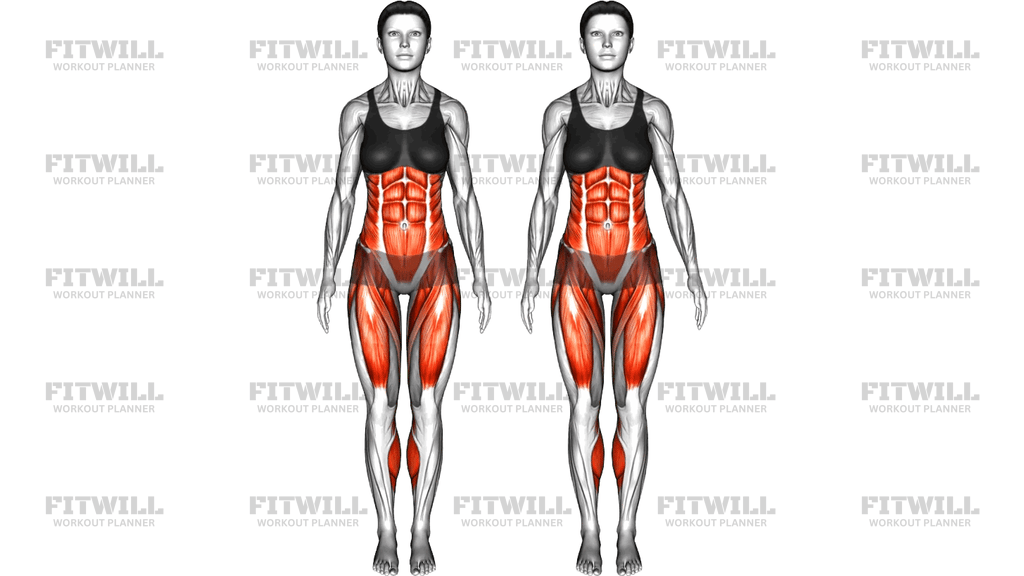
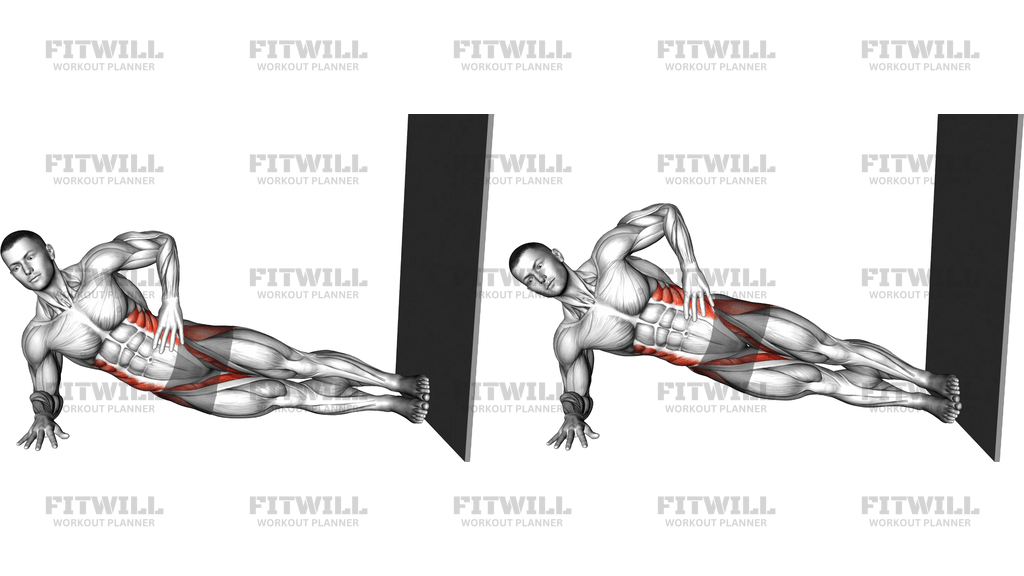
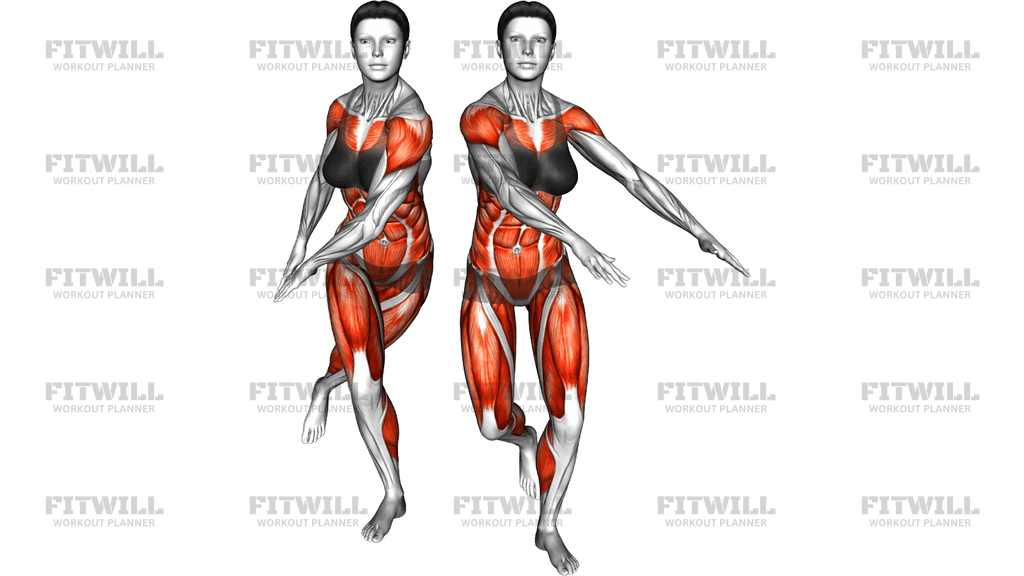
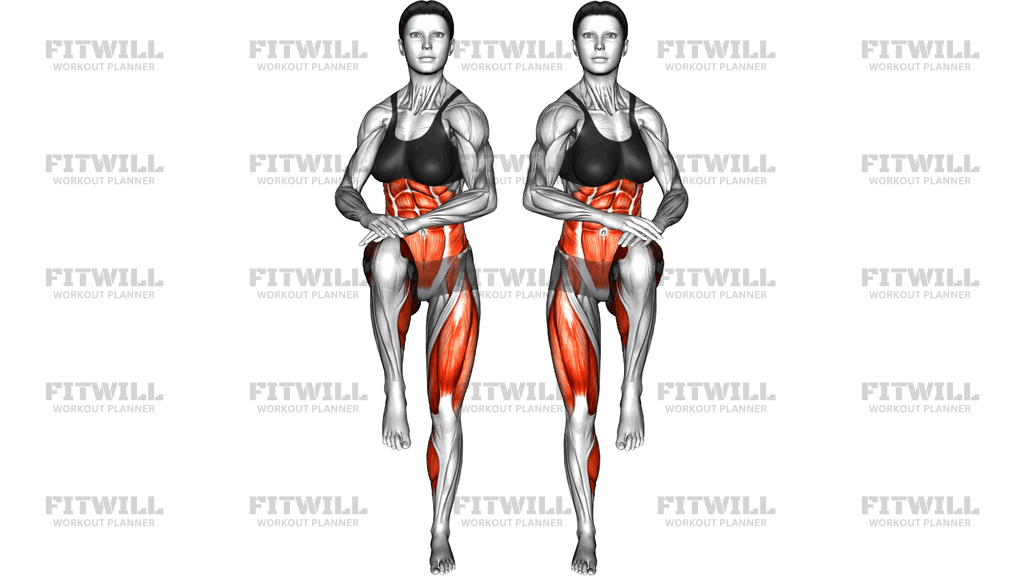
Alternate Side Lunge Wall Supported
The Alternate Side Lunge Wall Supported is a body weight lateral lunge variation performed with your hands placed against a wall for balance and light support. From a wide stance, you shift your hips sideways over one leg, bending that knee while the opposite leg stays straight, then push back to center and repeat on the other side. The wall contact lets you control the side-to-side shift without worrying about tipping over, which makes the movement much easier to learn than a freestanding side lunge.
This exercise is especially useful for beginners, anyone returning from time off, and people who feel unsteady when moving sideways. Lateral movement is often missing from training routines built entirely around forward-and-back exercises like squats and lunges, yet it is how your legs actually work in daily life—stepping around furniture, getting out of a car, or changing direction on a walk. The wide stance also puts a noticeable stretch on the inner thigh of the straight leg, which many people feel immediately on their first few repetitions.
The main muscles working are the glutes and quadriceps of the bending leg, while the adductors of the straight leg work hard to control the stretch and help pull you back to center. The calves and ankle stabilizers of the straight leg stay active throughout, and your core works to keep your torso upright as your hips travel side to side. Because the wall only provides light fingertip or palm contact, your legs still have to do the real work of lowering and lifting your body weight.
Setup matters here because the wall position determines how much assistance you get and whether your knees track safely. Stand far enough from the wall that your arms are nearly extended with a soft elbow bend, and keep your feet much wider than hip width for the entire set. If your stance narrows between repetitions, the lunge turns into a shallow squat and you lose the inner-thigh benefit that makes this variation worthwhile.
To execute the movement well, think of pushing your hips sideways rather than dipping straight down. Let the bending knee travel out over your toes, keep the opposite leg straight with the foot flat, and lower only as far as you can keep both heels glued to the floor. Alternate sides with a brief pause at center each rep so you are not just swinging side to side on momentum. A common use case is as a warm-up before lower body strength work, as a stand-alone leg exercise at home, or as a gentle reintroduction to lunging for anyone rebuilding confidence in their knees and hips.
For safety, keep the bending knee pointing in the same direction as your toes and never let it cave inward toward the straight leg. Move slowly enough that you could stop at any point in the descent, and reduce your depth before you reduce your stance width if the movement feels awkward.
[ Workout Log & Planner ]
Put your next workout in Fitwill
Keep your plan and training log ready when you are.


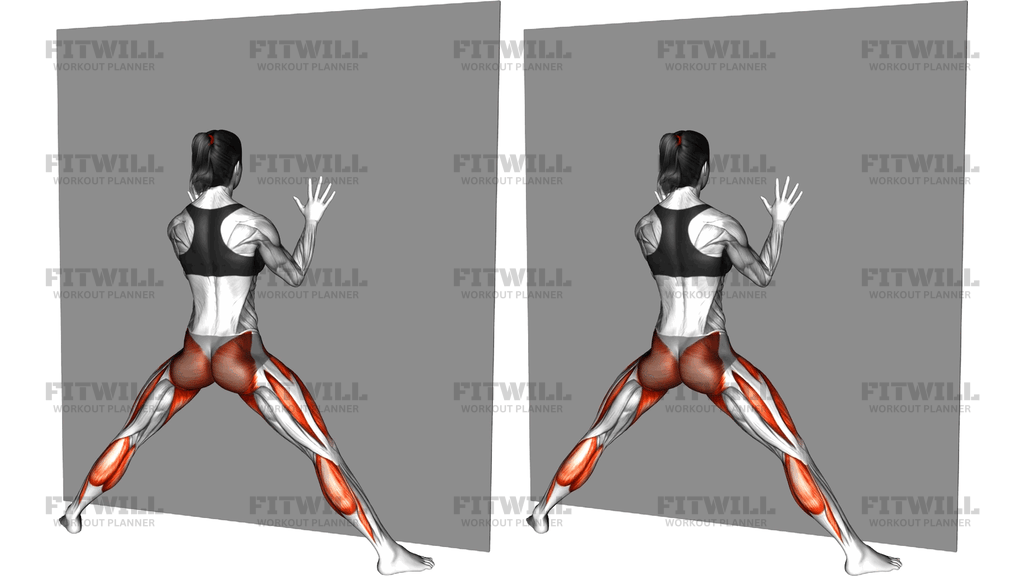
Instructions
- Stand facing a clear section of wall and place both palms flat against it at roughly chest height, arms extended with a soft bend in the elbows so you can lean slightly into your hands.
- Step both feet out to a stance much wider than your shoulders, toes angled slightly outward, and keep this wide stance for the entire set.
- Brace your core lightly and stand tall with your chest up and shoulders relaxed away from your ears.
- Shift your hips to the right and begin bending your right knee, sitting back into the right hip as if reaching for something just outside your right foot.
- Keep your left leg completely straight with the left foot flat on the floor, and let your left inner thigh feel a stretch as you descend.
- Lower until your right thigh is near parallel to the floor or as deep as you can manage with both heels down and the knee tracking over the toes.
- Press through the right heel and the whole left foot to pull yourself back to the center of your wide stance.
- Without pausing longer than a breath, repeat the same lowering action to the left side.
- Exhale as you press back to center after each side, and inhale as you lower into the next lunge.
- Complete your planned reps alternating sides, then bring your feet back to hip width before stepping away from the wall.
Tips & Tricks
- If your heels lift as you sink into the lunge, you are going too deep for your current ankle mobility—shave a few inches off the depth instead of letting the heel pop up.
- Watch that the bending knee travels out over the little-toe side of the foot; if it dips inward toward the straight leg, consciously drive the knee outward on the next rep.
- Keep only light pressure on the wall with your palms. If you find yourself heavily leaning or pushing off the wall to stand up, step your feet in slightly and rebuild the depth gradually.
- Do not let your stance creep narrower as the set gets tiring—reset your foot position at center if you notice your feet drifting together.
- Keep your torso leaning slightly forward from the hips rather than rounding your lower back; hinge at the hips to reach toward the bending side instead of collapsing your chest.
- Pause for a full second at center between sides. Rushing the transition turns the exercise into a side-to-side swing and cheats the inner thigh of the working leg.
- Keep the straight leg truly straight—softening the straight knee turns the movement into a straddle squat and removes the adductor stretch.
- Point your toes slightly outward and match the knee direction to the toes on both legs; this usually feels more comfortable for the hips than a perfectly forward-facing stance.
- If your inner thighs cramp, which is common at first, shorten the hold at the bottom and build up hold time over a few sessions.
Frequently Asked Questions
Which muscles does the Alternate Side Lunge Wall Supported work the most?
The glutes and quadriceps of the bending leg do most of the lifting, while the adductors of the straight leg work to control the stretch and assist the return. The calves and ankle stabilizers stay active on both legs throughout the set.
Why does the Alternate Side Lunge Wall Supported use a wall for support?
The wall gives you a reference point and light balance assistance while your hips travel side to side, which is the trickiest part of lateral lunging. It lets you focus on knee tracking and depth instead of worrying about tipping over.
Is the Alternate Side Lunge Wall Supported good for beginners?
Yes, it is one of the best ways to learn the side lunge pattern because the wall removes most of the balance demand. Once you can perform it with light fingertip contact, progressing to a freestanding side lunge is usually straightforward.
How far should I stand from the wall?
Far enough that your arms are nearly straight with a soft elbow bend when your palms touch the wall at chest height. This gives you light support without turning the exercise into an upper-body push.
How wide should my feet be during the Alternate Side Lunge Wall Supported?
Much wider than your shoulders—wide enough that when you bend one knee, the other leg can stay completely straight with the foot flat. If the straight knee has to bend for you to reach depth, widen your stance.
Why do I feel a stretch in my inner thigh on the straight leg?
That is the adductor muscles lengthening under load as your hips shift away, and it is one of the main benefits of the wide-stance lateral lunge. A mild stretch is expected; sharp pain means you should reduce your depth.
What is the most common mistake in this exercise?
Letting the bending knee collapse inward toward the straight leg, which usually happens when someone goes deeper than their hips and ankles can control. Deliberately steering the knee out over the toes fixes it for most people.
Can I substitute the Alternate Side Lunge Wall Supported with something else?
A freestanding side lunge is the natural progression, and a supported curtsy lunge or a lateral step-out against the wall works if side lunging bothers your knees. Holding a doorway frame instead of a wall is a fine substitute when no open wall space is available.
Should my heels stay on the floor during the Alternate Side Lunge Wall Supported?
Yes, both heels should stay flat for the entire repetition. A lifting heel means your stance is too wide or your depth is too great for your current ankle mobility, so adjust one of those before continuing.
How many repetitions should I do per side?
Start with 8 to 10 controlled reps per leg, alternating sides, for 2 to 3 sets. Because this is a body weight movement focused on control and mobility, prioritize depth and knee tracking over adding volume quickly.