Cable Lying Reverse Fly
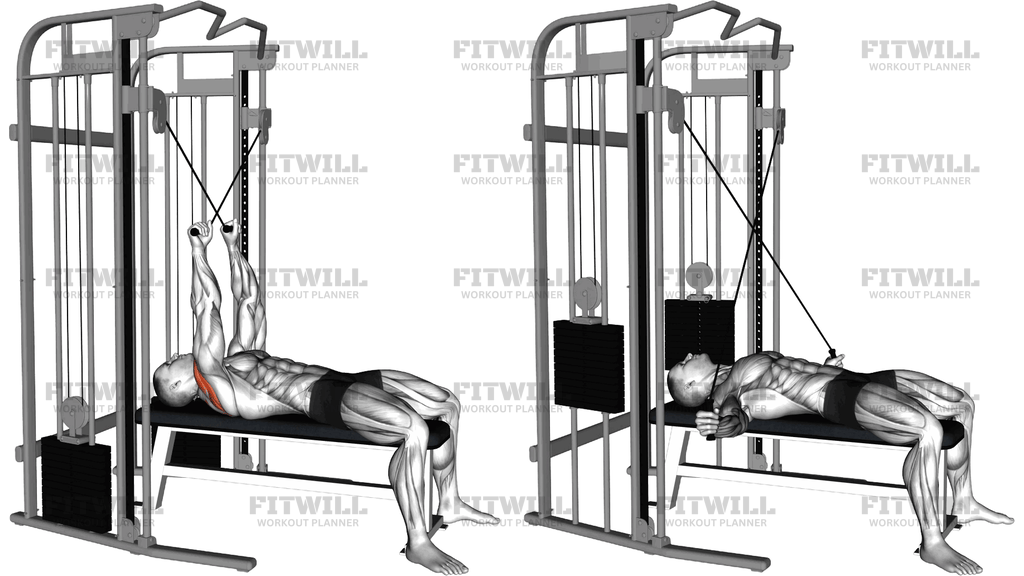
The Cable Lying Reverse Fly is a rear-shoulder and upper-back isolation exercise performed on a dual-cable station while you lie face up on a flat bench. With the pulleys set high, you hold the left handle in your right hand and the right handle in your left hand so the cables form an X above your torso. From that crossed position, you open your arms out wide against the resistance, then bring them back together under control. Because the cables pull forward and inward toward the stack, your rear delts have to work through the entire range rather than only at one angle.
This movement fills a real gap in most training programs. Pressing and most cable work emphasize the front of the shoulders and the chest, while the rear delts and the muscles between the shoulder blades get far less direct stimulus. Lying on your back removes the ability to cheat with body English, which is a persistent problem with standing reverse fly variations, and it also unloads the lower back entirely. That makes this version a good choice for anyone who wants honest rear-shoulder work without needing to stabilize a bent-over torso.
The crossed-handle setup is what makes the exercise work. When your arms start crossed over your chest, each handle's line of pull comes from the opposite side, so opening your arms sweeps them through a wide arc across the front of your body. This gives your rear delts a loaded stretch at the start and a strong contraction as your arms reach shoulder height and slightly beyond. Your rhomboids and mid traps assist as your shoulder blades come together near the end of the rep.
Execution quality comes down to three things: a slight, fixed bend in the elbows, a slow tempo on the way back, and keeping your shoulders pressed into the bench. If your elbows flare and straighten, the movement turns into a press; if you rush the return, the crossed cables will snap your arms back together and you lose half the workload. Keep the weight modest. This is a small muscle group moving light load, and it responds better to strict form and higher repetitions than to heavy stacks.
Use the Cable Lying Reverse Fly as an accessory on shoulder or upper-back days, typically for 2 to 4 sets of 10 to 15 controlled reps. It pairs well with rows and pulls, and it is also a sensible option for lifters whose shoulders feel uncomfortable in bent-over dumbbell fly positions. Set the bench so your head is supported and the cables clear your shoulders, and check that the handles cannot slip out of your grip before you load the stack.
[ Workout Log & Planner ]
Put your next workout in Fitwill
Keep your plan and training log ready when you are.


Instructions
- Set both pulleys of a dual-cable station to the highest position and attach a single stirrup handle to each cable.
- Place a flat bench lengthwise between the pulleys and select a light weight on each stack, making sure both sides are set evenly.
- Lie face up on the bench with your head and upper back supported, feet flat on the floor, and grab the left handle with your right hand and the right handle with your left hand so your arms are crossed above your chest.
- Extend your arms toward the ceiling with a slight bend in the elbows, and keep that elbow angle fixed for the whole set.
- Brace your core lightly and press your shoulders and upper back into the bench so your torso stays still.
- Open your arms out wide in a smooth arc until your hands are roughly in line with your shoulders or slightly below, feeling your shoulder blades draw together.
- Pause briefly at the widest point without letting the cables or your hands drift behind your torso.
- Slowly bring your arms back along the same arc until your hands cross over your chest again, resisting the pull of the cables the whole way.
- Exhale as you open your arms, inhale as you return to the crossed position.
- Complete your reps, then release one handle at a time with control before sitting up.
Tips & Tricks
- The most common mistake is turning this into a chest press by straightening the elbows. Lock in a soft elbow bend before your first rep and check it again on every repetition.
- Do not let your hands travel behind the bench plane at the widest point. Pulling too far back shifts tension away from the rear delts and toward the joint capsule, so stop where your arms are level with your shoulders.
- Because the cables are crossed, an uneven stack will drag one arm faster than the other. Confirm both weight stacks are set to the same plate before you lie down.
- If the handles rotate or strain your wrists, grip them with your palms facing forward and adjust the angle slightly until your wrists stay neutral.
- Keep your head on the bench. Craning forward to watch your hands rounds the neck and takes work away from the upper back.
- Use a 2 to 3 second return. The crossed cables pull your arms back together quickly, and letting them do the work cuts the loaded time under tension roughly in half.
- Choose a weight you can open for 12 to 15 clean reps. If your arms shake or your torso twists to finish a rep, the load is too heavy for this setup.
- If the cables catch on your arms or shoulders, shift the bench slightly forward or back so the lines of pull pass cleanly over your torso.
Frequently Asked Questions
Which muscles does the Cable Lying Reverse Fly work?
The rear delts do most of the work, with the rhomboids and mid traps assisting as your shoulder blades squeeze together near the end of the arc. The crossed-cable setup keeps tension on the rear shoulders through nearly the whole range.
Why do I cross my arms and use the opposite handle in this exercise?
Holding the left handle in your right hand and vice versa makes the cables form an X above your chest. This lets your arms sweep through a wide, fully loaded arc as you open them, which a parallel grip would not allow.
Is the Cable Lying Reverse Fly good for beginners?
Yes, as long as the weight is kept light. The bench supports your torso and removes momentum, so a beginner can learn what a rear-delt contraction feels like more easily than in a standing or bent-over version.
How is this different from a bent-over dumbbell reverse fly?
Lying on your back eliminates lower-back fatigue and body-English cheating, and the cable resistance pulls forward and inward, loading the rear delts at angles dumbbells cannot match. Dumbbell versions challenge stability more, while this version isolates better.
How many sets and reps should I do?
Two to four sets of 10 to 15 controlled reps works well, either at the end of a shoulder day or after your main pulls on a back day. Because the rear delts are small, prioritize tempo and range over load.
Should my elbows stay bent during the movement?
Yes, keep a small, constant bend in the elbows as if your arms were slightly unlocked. Straightening the elbows mid-rep turns the fly into a pressing motion and shifts work toward the triceps and chest.
What should I do if one arm feels stronger than the other?
Make sure both weight stacks are set to the same plate, then slow down and match the arc of your weaker arm with your stronger one. If the difference persists, add a few extra single-arm sets on the weaker side using a unilateral version of the same setup.
Can I substitute another exercise if my gym has no dual-cable station?
Bent-over dumbbell reverse flies or band pull-aparts train the same muscles. Neither gives the exact crossed-cable resistance path, but both are effective ways to build the rear delts and upper back.
Is it safe to release the handles at the end of a set?
No, let go one handle at a time while keeping tension in the other arm. Releasing both at once lets the crossed cables snap back to the stacks, which can pull the handles into your body or the machine.