Cable Lying Incline Side Leg Raise
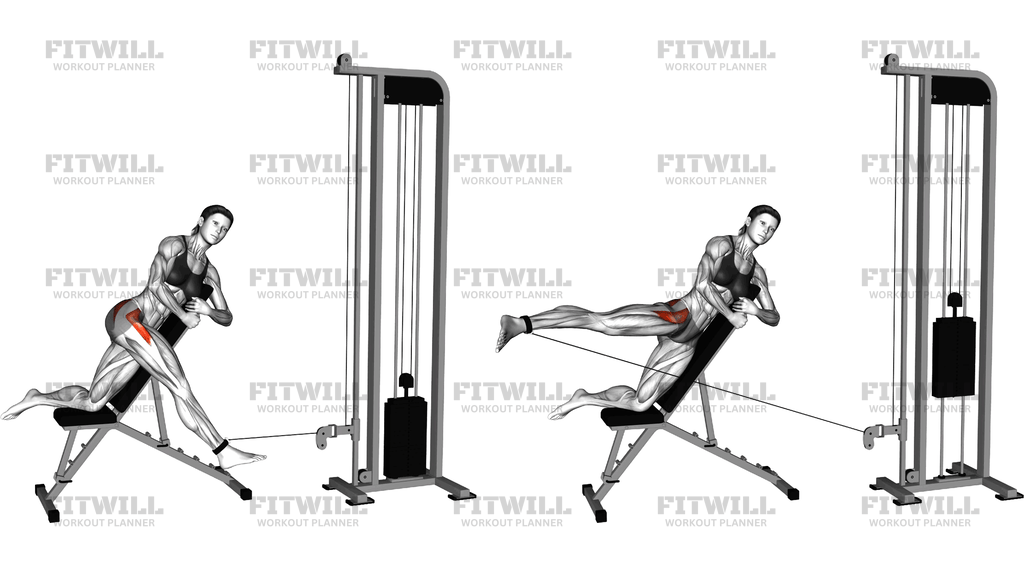
The Cable Lying Incline Side Leg Raise is a hip abduction exercise performed side-lying on an incline bench with an ankle strap attached to your top leg and connected to a low pulley. Because the cable pulls the working leg down and back toward the machine, your hip muscles have to work through a smooth, constant resistance curve that is hard to replicate with bodyweight side leg raises. The incline bench supports your torso and pelvis, which keeps the movement honest: the only thing that should move is your top leg lifting and lowering.
This exercise primarily targets the gluteus medius and the muscles of the outer hip, with supporting work from the upper glute fibers and the obliques, which brace to stop your torso from rolling backward as the leg travels up. The gluteus medius is often undertrained compared to the larger gluteus maximus, yet it plays a major role in stabilizing your pelvis during walking, running, squats, and lunges. Strengthening it can improve how steady you feel in single-leg positions.
The setup matters more here than in most leg exercises. The angle of the bench, the position of the pulley, and where the cable crosses your body all change the direction of resistance. You want the pulley set low and positioned behind your legs so the strap pulls the top leg down and slightly back. If the cable crosses over your bottom leg or presses into your working thigh, adjust your distance from the machine before adding weight.
To perform it well, lie on your side along the incline bench with your bottom leg bent for stability and your top leg roughly straight, wearing the ankle strap just above the ankle bone. From there, lift the top leg up and slightly back in an arc, keeping your toes pointing forward rather than rolling the hip open, then lower under control until the strap tension is still active. Think of the lift coming from the side of your hip, not from swinging the torso.
This movement is popular in glute-focused sessions, rehabilitation-style training for hip stability, and warm-up blocks before squats or deadlifts. It is also a useful alternative for anyone who finds standing cable hip abduction awkward, since the bench removes the balance demand entirely.
Keep the weight modest at first. Because you are side-lying, you cannot use your bodyweight to cheat, which is a good thing, but it also means a load that is too heavy will pull your spine into a side bend or yank your leg down on the return. Stop each set before your form breaks, and progress by adding small increments once you can complete all reps with a quiet, controlled torso.
[ Workout Log & Planner ]
Put your next workout in Fitwill
Keep your plan and training log ready when you are.


Instructions
- Set the pulley of the cable machine to its lowest position and attach an ankle strap to the cuff, then fasten the strap securely around your top ankle.
- Place an incline bench in front of the machine with the high end away from the pulley, then lie on your side along the bench so your torso is supported and your hips are roughly at the edge, facing away from the cable.
- Bend your bottom leg and rest it on the floor for stability, and grip the top edge of the bench with your lower arm while your upper hand steadies your torso or the bench.
- Let the top leg hang in line with your body and take up the strap tension so the cable gently pulls that leg down toward the machine before you start.
- Brace your core and slightly tighten your side waist so your torso stays stacked and does not roll backward during the lift.
- Raise the top leg up and slightly behind you in a smooth arc, keeping the leg nearly straight and the toes pointing forward, until the hip has abducted as far as you can control without tilting the pelvis.
- Pause briefly at the top and squeeze the side of the working hip rather than pushing the range higher by rolling your body open.
- Lower the leg slowly back toward the starting point, stopping while the strap is still taut instead of letting the stack slam down and remove the tension.
- Exhale as you lift the leg and inhale as you lower it, keeping the breath steady throughout the set.
- Complete all reps on one side, then reposition on the bench with the strap on the opposite ankle and match the work on the other leg.
Tips & Tricks
- If the cable rubs against your bottom leg or drags across your working thigh, you are standing too far from the machine or the pulley is on the wrong side; move the bench so the strap travels in a clear line below your hips.
- A common mistake is lifting the leg straight up toward the ceiling while rolling the pelvis back, which turns the exercise into a torso twist. Keep your shoulders and hips stacked and let the leg travel in its own arc slightly behind your body.
- Watch the ankle strap position: a cuff placed on the foot or too low on the ankle can slip during the lift and changes the pull direction. Fasten it snugly just above the ankle bone.
- Do not let the weight stack pull your leg down quickly between reps. The lowering phase is where the outer hip does a lot of its work, so take a full second or two on the way down.
- Keep the knee of the working leg soft but not bent. Fully locking the knee can strain the joint, while heavily bending it shortens the lever and lets the leg drift forward out of the cable's line.
- If your side waist cramps or your lower back complains, you are likely side-bending to help the leg up. Reduce the weight and exaggerate bracing the trunk until the lift feels isolated to the hip.
- Point your toes forward instead of turning the foot toward the ceiling. Rotating the leg outward shifts effort away from the gluteus medius and toward the front of the hip.
- Because you are anchored on a bench, use it: press your lower arm and ribs into the pad lightly to keep the torso quiet, and treat any upper-body movement as a sign the load is too heavy.
- Start with a light single leg or two at low weight to feel where the resistance pulls before committing to a working set on each side.
Frequently Asked Questions
Which muscles does the Cable Lying Incline Side Leg Raise work?
The main movers are the gluteus medius and the outer hip muscles, with the upper glute fibers assisting in the lift. Your obliques and deep core also work isometrically to keep your torso from rolling as the leg rises.
Why use an incline bench instead of lying on the floor for side leg raises?
The bench supports your torso at a slight angle and keeps your hips clear of the ground, giving the leg a longer, unobstructed arc against the cable. It also removes the balance requirement of standing cable abduction variations.
Is the Cable Lying Incline Side Leg Raise suitable for beginners?
Yes, as long as the weight is kept light and the cable path is set up correctly. Beginners often benefit most from it because the bench makes it easy to feel the outer hip working without worrying about stability.
How high should I lift my top leg during the Cable Lying Incline Side Leg Raise?
Lift only as far as you can while keeping your hips stacked and your torso still, which for most people is roughly 30 to 45 degrees of abduction. Going higher usually means the pelvis is rolling open rather than the hip working harder.
What is the most common mistake in this exercise?
Rolling the torso and pelvis backward to swing the leg higher, usually because the cable weight is too heavy. Fix it by reducing the load, bracing the side waist, and making the lift come purely from the hip joint.
Where exactly should the ankle strap be fastened?
Secure it snugly around the working ankle, just above the ankle bone, with the cuff centered on the side of the ankle facing the pulley. A strap placed on the foot or left loose will slide and alter the direction of pull.
Can I substitute another exercise if I have no incline bench?
Yes. A side-lying cable leg raise on a flat bench or exercise mat with the same low pulley setup works well, and a standing cable hip abduction with the strap on the outside ankle is a reasonable alternative.
How should I breathe during the Cable Lying Incline Side Leg Raise?
Exhale as you raise the leg and inhale as you lower it under control. Because your torso is braced against the bench, avoid holding your breath for long stretches, especially as the sets get harder.
How many sets and reps should I do?
Two to four sets of 10 to 15 controlled reps per side is a practical range for strength and endurance of the outer hips. Prioritize a slow lowering phase and a still torso over chasing a heavier stack.
Is it safe if I feel a pinch at the front of my hip?
A pinch at the front of the hip often means the leg is drifting forward or the foot is rotating outward, taking the lift out of the intended path. Bring the leg back in line with your torso and point the toes forward; if the pinching persists, reduce the range or consult a qualified professional before continuing.