Weighted Plate Squat
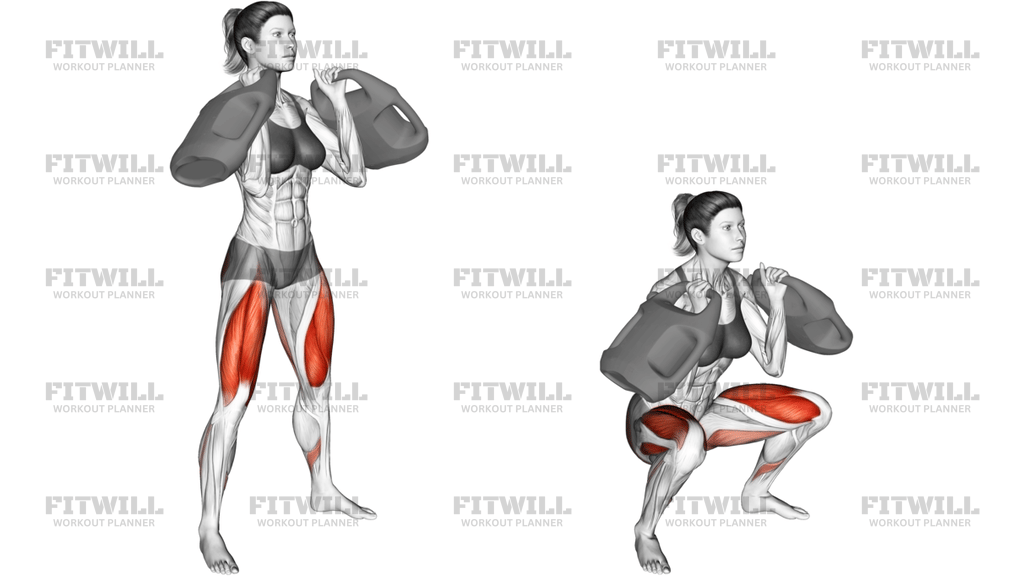
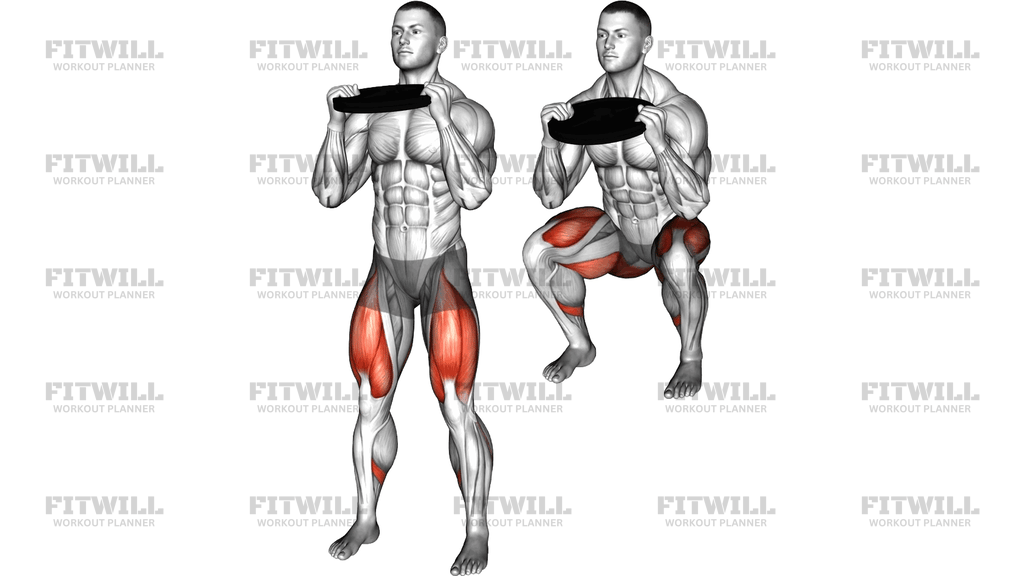
The Weighted Plate Squat is a front-loaded squat variation where you hold a weight plate against your chest with both hands, elbows tucked down beneath the plate, and squat between your legs. Because the load sits high on the front of your torso, it forces you to stay upright through the spine and demands constant core tension to keep the plate from pulling you forward. The highlighted work in this movement comes from the quadriceps, glutes, and inner thighs, with the deep core stabilizing the trunk the entire time.
This setup works well for a wide range of lifters. Beginners use it to learn what an upright, well-balanced squat feels like without fighting a barbell on the back, while more experienced trainees use it as a high-rep burner, a warm-up primer, or a way to load the legs when a rack or barbell is not available. Since you only need a single plate, it is also a practical choice for small gyms, garage training, or hotel workouts where equipment is limited.
The front-loaded position is what separates this from a back squat. With the plate held at collarbone height, your torso stays nearly vertical, which shifts emphasis toward the quads and upper thigh while still recruiting the glutes and adductors as you drive out of the bottom. If you let the elbows drift up or the chest collapse, the plate pulls you forward and the rep quality falls apart fast, so torso control is a real training effect here, not just a form detail.
To execute it well, set your feet about shoulder-width apart with toes turned out slightly, grip the plate at its sides, and pin it against your upper chest. Squat down until your thighs reach at least parallel, letting your knees travel forward and out over your toes, then drive through your whole foot back to a full stand. Exhale on the way up, keep the plate welded to your chest, and reset your breath at the top before the next rep. If your heels lift or your knees cave inward as fatigue builds, that is your signal to end the set or reduce the plate size.
[ Workout Log & Planner ]
Put your next workout in Fitwill
Keep your plan and training log ready when you are.


Instructions
- Stand with your feet roughly shoulder-width apart, toes turned out about 15 to 30 degrees, and set a weight plate on the floor in front of you.
- Grip the plate at its sides with both hands, lift it to your upper chest, and rest it flat against your collarbone area with your elbows pointing down and tucked close to your ribcage.
- Stack your ribs over your hips, brace your abs as if preparing for a light punch, and pull your shoulder blades gently back so your chest stays tall.
- Push your hips back slightly and bend your knees, sinking straight down between your feet while keeping the plate pressed firmly against your chest.
- Descend until your thighs are at least parallel to the floor, letting your knees travel forward and outward in line with your toes.
- Drive through your heels and mid-foot to stand back up, squeezing your glutes at the top without leaning backward.
- Exhale as you rise, then take a fresh breath at the top and re-brace before starting the next repetition.
- Keep your elbows from flaring upward as you tire, since raised elbows let the plate drift forward and round your upper back.
- After finishing your set, bend at the hips and knees to set the plate back on the floor with control rather than dropping it.
Tips & Tricks
- If the plate pulls you forward onto your toes, your elbows have crept up; actively pull them down toward your sides so the plate stays stacked over your hips.
- Choose a plate size you can hold flat against your chest for the whole set. A large 45-pound plate is awkward to grip, and a bumper plate's rim is often easier to control than a thin iron plate.
- Actively spread the floor with your feet so your knees track over your toes. Knee cave is the most common breakdown in this squat, especially on the last few reps.
- Do not rush the bottom. Pause for a beat at full depth to feel your quads and adductors load, then drive up with intent instead of bouncing out of the stretch.
- If your heels rise off the floor, widen your stance slightly and focus on sitting between your legs rather than folding over them.
- Keep your neck neutral by looking at a fixed point on the wall roughly eye-level. Craning up to keep the plate from falling usually arches the lower back instead.
- Start with a lighter plate and higher reps before adding load. The front-loaded position taxes your upper back and core, and that endurance often lags behind your leg strength.
- Count tempo on the way down, roughly two seconds, to stop yourself from diving into the bottom and losing chest position.
Frequently Asked Questions
What muscles does the Weighted Plate Squat work?
The quadriceps are the primary movers, with strong contributions from the glutes and adductors as you stand up out of the deep position. Your core and upper back work isometrically to hold the plate against your chest without letting your torso round forward.
How is the Weighted Plate Squat different from a goblet squat?
The mechanics are very similar, but a goblet squat uses a dumbbell or kettlebell held at the chest, while this version uses a flat plate. A plate spreads the load across both hands and sits flat against the torso, which some lifters find more comfortable, though it can be harder to grip at heavier weights.
Is the Weighted Plate Squat good for beginners?
Yes, it is one of the best ways to learn squatting mechanics. Holding the plate at your chest acts as a counterbalance, letting you sit back and reach full depth while staying upright, which is exactly the posture you want to carry into barbell squatting later.
How deep should I squat with a plate held at my chest?
Aim to lower until your thighs are at least parallel to the floor, provided you can keep your heels down and the plate against your chest. If depth forces your torso to collapse or your heels to lift, squat to the deepest point you can control and work lower over time.
Why do my elbows keep drifting up during the Weighted Plate Squat?
Elbow drift usually means the plate is too heavy, your grip is loose, or your upper back is fatiguing. Actively pull your elbows down and squeeze the plate against your sternum; if you cannot hold that position for the whole set, use a lighter plate.
What can I use instead of a weight plate?
A kettlebell or dumbbell held at your chest in goblet style is the closest substitute, and a medicine ball works in a pinch. The key is keeping the load high on the front of your torso so the squat stays upright and quad-focused.
How heavy should the plate be for this exercise?
Pick a weight that lets you complete your target reps while keeping the plate flat against your chest and your heels planted. Because the front-loaded position challenges your core and upper back, most lifters handle less load here than in a back squat, and that is expected.
Should my knees go past my toes in the Weighted Plate Squat?
Some forward knee travel is normal and safe in a deep squat, especially with an upright torso like this one. What matters more is that your knees track in line with your toes and your heels stay firmly on the floor throughout the rep.
Can I use the Weighted Plate Squat as a warm-up?
Absolutely. A light plate for one or two sets of 10 to 15 reps raises your core temperature, primes your quads and glutes, and rehearses the upright squat pattern before heavier leg work.
Is it safe for people with knee issues?
Front-loaded squats are generally knee-friendly because the upright torso and counterbalance reduce shear stress, but individual situations vary. If you have an existing knee concern, work within a pain-free range and check with a qualified professional before loading the movement.