Landmine Standing Side Bend (Version 2)
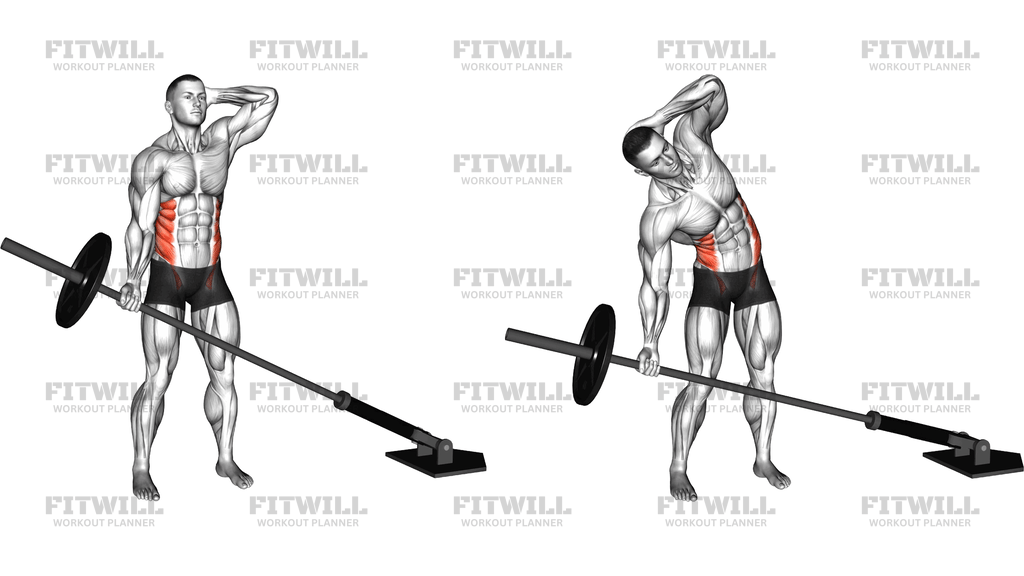
The Landmine Standing Side Bend (Version 2) is a unilateral core exercise performed with a barbell set at an angle — one end anchored in a landmine attachment or wedged into a corner, the loaded end held in one hand at your side. From a tall standing position, you bend sideways away from the anchor and pull yourself back upright using the muscles along the side of your trunk. Placing your free hand behind your head helps you keep your chest open and makes any unwanted twisting or leaning forward easy to feel and correct.
What separates this version from a dumbbell side bend is the angled loading. Because the barbell sleeve runs diagonally, the resistance has a slight horizontal pull in addition to the vertical load, which challenges your obliques and deep trunk stabilizers to control both side bending and rotation. The landmine setup also removes the plates from your hand, so the weight sits closer to your body and the movement feels smoother at the top and bottom of each rep.
This exercise primarily targets the obliques on the side you are bending away from, with the quadratus lumborum, rectus abdominis, and erector spinae working to keep your spine controlled throughout. Your grip, forearms, and shoulder on the working arm hold the bar steady, while your legs and hips stay braced to keep your torso from drifting forward or backward.
It is a solid choice for lifters who want stronger, more resilient lateral core strength — useful for martial arts, throwing sports, strongman-style training, and everyday tasks that involve carrying load on one side. It is also easier on the lower back than many rotational drills because the spine bends in a single plane with the hips squared forward.
Setup matters more than most people expect. Stand close enough to the anchor that the bar tracks vertically beside your hip, keep your feet about hip width, and brace your trunk before you bend. The bend itself should come from your waist, not from your hips swinging sideways or your shoulder dropping. Move slowly in both directions and stop at a range where you feel the side of your waist working hard without any pinching in your lower back.
A practical safety note: keep the load moderate and the tempo controlled. The obliques respond well to steady tension, and the end range of a side bend is where form tends to break down. Complete all reps on one side, then switch hands and match the work on the other side.
[ Workout Log & Planner ]
Put your next workout in Fitwill
Keep your plan and training log ready when you are.


Instructions
- Set one end of a barbell in a landmine attachment (or securely wedged into a corner) and load a moderate plate onto the free end.
- Stand beside the bar with the anchor on your working side, feet about hip width apart, and grip the sleeve just below the plate with one hand in an overhand grip, letting it hang at your side.
- Place your free hand behind your head with the elbow flared out, and stand tall with your hips level and squared toward the anchor.
- Brace your core and keep a slight bend in your knees so your legs stay engaged and your torso does not sway forward.
- Bend sideways at the waist, lowering the plate along the outside of your thigh toward your knee until you feel a stretch along the opposite side of your trunk.
- Pause briefly at the bottom, then pull your torso back to vertical by contracting the obliques on the far side, keeping the bar path straight up and down beside your hip.
- Exhale as you bend down, inhale at the bottom, and exhale again as you return to standing.
- Complete all repetitions on one side, then re-grip with the other hand and perform the same number of reps on the opposite side.
- Between sets, set the plate down under control before releasing your grip so the bar does not slide or drop.
Tips & Tricks
- The most common mistake is bending forward as you lean — the hand behind your head is there to catch this, so if your elbow drifts toward the mirror or drops down, reset your torso to vertical.
- Do not chase depth. Bending past the point where the bar passes your knee usually comes from hip shift rather than spinal side bend, and it takes tension off the obliques.
- Keep the plate close to your thigh. If the bar swings away from your body, the load lengthens into your shoulder and grip instead of your waist.
- Avoid rotating your shoulders toward the floor. Your chest should stay facing forward for the entire rep; any twist turns this into a different exercise.
- If your working shoulder fatigues before your waist, you are likely shrugging or hanging off the bar — actively press the sleeve down and keep a small space between your ear and shoulder.
- Match reps and load exactly on both sides rather than letting your stronger side do more work.
- Start with a small plate or even an empty sleeve for your first session; the angled landmine pull feels heavier than a comparable dumbbell.
- Move through the bottom third of the range slowly. Letting gravity drop you into the stretch is where the lower back takes unnecessary stress.
- Keep your feet flat and knees softly bent — locking the knees and shifting your hips sideways is a common compensation that removes oblique tension.
Frequently Asked Questions
Which muscles does the Landmine Standing Side Bend (Version 2) work?
The obliques on the side opposite the bar do most of the work as they pull your torso back upright. The quadratus lumborum, rectus abdominis, and erector spinae assist, while the grip and shoulder of the working arm hold the sleeve steady.
Why use a landmine instead of a dumbbell for side bends?
The angled bar creates a slight pulling force away from the anchor that your trunk has to resist, adding an anti-rotation element a dumbbell does not provide. The load also sits in a smoother arc next to your hip rather than hanging straight from your hand.
Is the Landmine Standing Side Bend (Version 2) suitable for beginners?
Yes, provided you start with light loading and a short range. Beginners should focus on keeping the hips level and the chest facing forward before adding plates.
How far should I bend during the Landmine Standing Side Bend (Version 2)?
Bend until you feel a clear stretch along the opposite side of your waist, generally as the plate passes mid-thigh toward your knee. Going deeper usually involves hip shifting rather than extra oblique work.
What is the purpose of the free hand behind the head?
It opens the chest, discourages forward leaning, and gives you immediate feedback if your torso starts to rotate or collapse during the rep.
What should I do if I do not have a landmine attachment?
You can wedge the empty end of the barbell securely into a corner with a towel to protect the wall, or substitute a single dumbbell side bend, accepting the loss of the angled resistance.
Should I do both sides in the same set or one side at a time?
Finish all reps on one side, then switch hands so you can keep your grip and set position consistent. Matching volume exactly on both sides helps prevent side-to-side strength differences from growing.
Can this exercise aggravate the lower back?
It can if you use excessive range, heavy load, or let momentum drop you into the bottom position. Keeping the weight moderate, bracing before each rep, and controlling the descent keeps the work on the obliques.
How many reps and sets work best for the Landmine Standing Side Bend (Version 2)?
Two to four sets of 10 to 15 controlled reps per side works well for most lifters. The obliques respond better to steady tempo and full control than to maximum load.