Lying Supine Abdominal Breathing
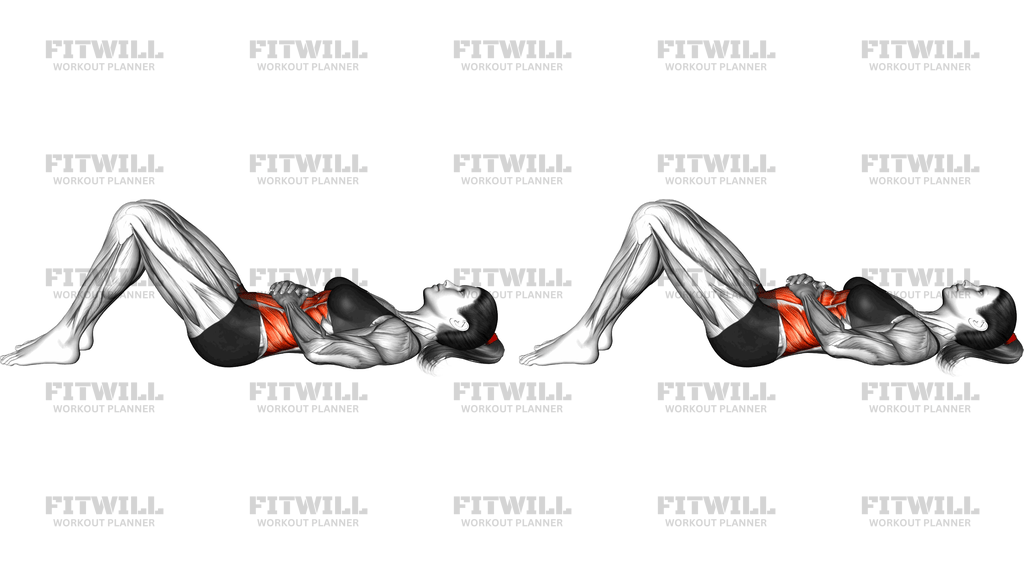
Lying Supine Abdominal Breathing is a foundational breathing drill performed on your back with the knees bent and feet flat on the floor. You rest one or both hands over your belly, then practice directing each breath into the abdomen so the belly rises as you inhale and gently falls as you exhale. It looks deceptively simple, but it trains one of the most overlooked skills in training: breathing with the diaphragm instead of defaulting to shallow chest breathing.
This drill is useful for almost anyone. Beginners use it to learn how to engage the deep core before progressing to planks, dead bugs, and heavier lifting. People recovering from back discomfort often start here because it teaches the abdominal wall to support the spine without bracing hard. It is also a staple in yoga, Pilates, and post-partum core retraining, where re-establishing a connection to the deep abdominal muscles matters more than intensity.
Physiologically, the exercise emphasizes the diaphragm and the transverse abdominis, the deep corset-like muscle that wraps around your midsection. As the diaphragm descends on each inhale, the abdominal contents push outward and the deep core responds on the exhale. Over repeated breaths, this coordination between breathing and abdominal control improves, which carries over to better trunk stability in squats, deadlifts, and everyday movement.
The supine setup matters because lying on your back removes the demand of fighting gravity while standing, letting you feel the belly expand without compensation. Bending the knees flattens the lower back toward the floor and relaxes the hip flexors, so the abdomen can move freely. Placing your hands on the belly gives you immediate tactile feedback - you can literally feel whether the breath is going where you intend.
To get the most from the drill, keep the exhale slow and slightly longer than the inhale, and resist the urge to force the belly outward. The movement should feel like the breath is filling you from the bottom up, with the chest and shoulders staying quiet. There is no rushing this exercise; five to ten minutes of unhurried breathing typically produces more benefit than a longer, distracted session.
The only safety consideration is comfort. If lying flat causes dizziness or lower back discomfort, place a cushion under the knees or slightly elevate the head. Never strain to hold the breath or push the abdomen aggressively - the entire point is relaxed, controlled breathing.
[ Workout Log & Planner ]
Put your next workout in Fitwill
Keep your plan and training log ready when you are.


Instructions
- Lie on your back on an exercise mat or firm floor with your knees bent and feet flat, about hip-width apart.
- Let your arms rest at your sides, then place both hands flat on your lower abdomen with the fingertips lightly touching.
- Relax your shoulders, let the back of your head rest heavy on the floor, and allow your lower back to settle into a neutral position.
- Inhale slowly through your nose for about four seconds, directing the air down into your belly so your hands rise while your chest stays relatively still.
- Pause briefly at the top of the inhale without straining or holding the breath tensely.
- Exhale slowly through your mouth or nose for five to six seconds, feeling your hands sink as the abdomen gently falls back toward the spine.
- Keep your neck, jaw, and shoulders relaxed throughout each breath cycle - the only part moving should be the abdomen.
- Continue for eight to twelve full breaths, or two to five minutes, keeping each cycle smooth and even.
- When finished, take one normal breath, gently lower your hands to your sides, and roll onto your side before pushing up to stand.
Tips & Tricks
- If your chest and shoulders lift on every inhale, place a small book on your belly instead of your hands - the book should rise while the book-free chest stays quiet.
- Do not force the belly outward by pushing with the abdominal muscles; the expansion should come from the breath descending, not from muscular effort.
- If your hands drift apart or press down hard, lighten the touch - fingertips resting on the abdomen give better feedback than firm pressure.
- Counting the exhale one or two seconds longer than the inhale helps downshift the nervous system, which is why this drill works well before sleep.
- If your lower back arches or feels strained, tuck a cushion under your knees to bring the hips into a more neutral position.
- Avoid swallowing air or breathing loudly and hurriedly; if you feel lightheaded, return to normal breathing for a few cycles before resuming.
- Practice this drill before core workouts so the diaphragm-deep core coordination carries into exercises like planks and dead bugs.
- Nasal inhales tend to produce a deeper, calmer breath than mouth inhales - save mouth exhales for the slow release phase.
Frequently Asked Questions
What muscles does Lying Supine Abdominal Breathing work?
The primary focus is the diaphragm working together with the transverse abdominis, the deepest abdominal muscle. The rectus abdominis and obliques assist gently as the belly rises and falls, but this is a control drill rather than a strength exercise.
Is Lying Supine Abdominal Breathing good for beginners?
Yes, it is one of the best starting points for core training because it requires no equipment and teaches the breath-to-abdomen connection that later exercises build on. Beginners can practice it daily without fatigue.
Why are the knees bent in Lying Supine Abdominal Breathing?
Bent knees flatten the lower back toward the floor and switch off tension in the hip flexors, which makes it easier for the abdomen to expand freely. Lying with straight legs tends to create lower back arch and hip tension that interferes with the breath.
How do I know if I am breathing correctly during Lying Supine Abdominal Breathing?
Your hands on the belly should rise on the inhale and sink on the exhale while your chest and shoulders stay mostly still. If your shoulders climb toward your ears, the breath is shifting into the chest and you should slow down and soften the effort.
How long should I practice Lying Supine Abdominal Breathing?
Two to five minutes of continuous, relaxed breathing is enough for most people. More time is not necessarily better - quality and calmness of each breath cycle matter more than duration.
Can Lying Supine Abdominal Breathing help before heavy lifting?
Yes, it is often used as a warm-up primer to establish diaphragmatic breathing before bracing drills. Learning to inhale into the abdomen makes it easier to create stable intra-abdominal pressure during squats and deadlifts.
What is the most common mistake in Lying Supine Abdominal Breathing?
The most common mistake is forcing the belly to expand by actively pushing the abdominal wall out instead of letting the breath do it. Another frequent error is breathing too fast, which turns a relaxing drill into a stressful one.
Can I do Lying Supine Abdominal Breathing on a bed instead of the floor?
A firm surface is preferable because a soft mattress lets the hips and spine sink, which changes pelvic position and reduces feedback. If the floor is uncomfortable, an exercise mat or a folded blanket is a better substitute than a bed.
Is it safe to do Lying Supine Abdominal Breathing every day?
For most people, yes - it is a low-effort breathing drill with no load on the joints. If lying flat causes dizziness, shortness of breath, or persistent discomfort, stop and practice in a semi-reclined position instead.
How is Lying Supine Abdominal Breathing different from a regular deep breath while standing?
Lying on your back removes the postural demand of holding yourself upright, so the deep abdominal muscles can relax and respond to the breath without compensation. This makes the supine position the easiest place to learn the pattern before practicing it seated or standing.