Push-Up On Stability Ball
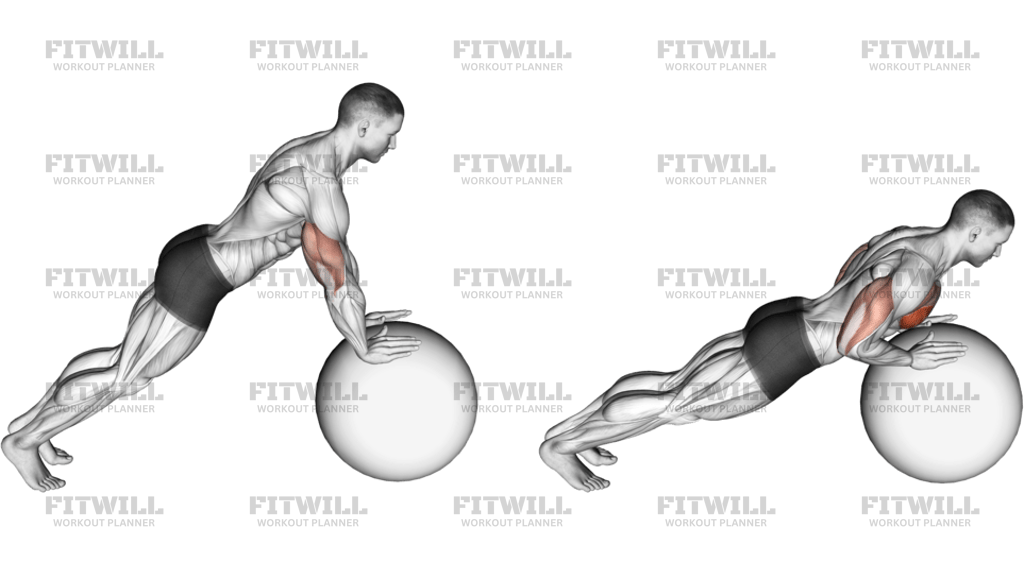
Push-Up on Stability Ball is a chest-focused pressing exercise performed with both hands on an unstable ball and the feet on the floor. The moving platform forces you to stabilize the shoulders, elbows, wrists, and trunk while the chest does the main work, so the exercise feels more demanding than a standard floor push-up even when the external load is just bodyweight. It is a useful way to train pressing strength, body control, and coordination in the same rep.
The setup matters because the ball changes the line of force and can expose poor shoulder position quickly. Place the hands about shoulder-width apart on top of the ball, keep the fingers spread, and set the body in one long plank from head to heels. The ribs should stay down, the glutes should stay tight, and the hips should not sag toward the floor. When the starting position is solid, the chest can drive the movement instead of the lower back or shoulders chasing balance.
Lower under control by bending the elbows and letting the chest travel toward the ball, not the head. A slight elbow tuck is usually the cleanest pattern, especially when the ball starts to wobble, because it keeps the press path strong and protects the shoulders from flaring too far. At the bottom, the chest should come close to the ball without collapsing through the midline. Press the ball away by squeezing the chest and triceps together and finish each rep back in a straight, braced plank.
This exercise fits well as accessory chest work, a shoulder-stability drill, or a bodyweight strength option when you want more challenge than a floor push-up but less load than a weighted press. It can be scaled by shortening the stance, using a larger ball, or reducing range of motion if balance is the limiting factor. If the wrists, shoulders, or low back take over, the rep quality is gone; the goal is a clean, repeatable push that stays controlled from the first rep to the last.
Fitwill
Log Workouts, Track Progress & Build Strength.
Achieve more with Fitwill: explore over 9600 exercises with images and videos, access built-in and custom workouts, perfect for both gym and home sessions, and see real results.
Start your journey. Download today!




Instructions
- Place the stability ball on the floor and get into a high plank with both hands on top of the ball, wrists stacked under your shoulders.
- Spread your fingers and press evenly into the ball so it stays centered under your chest instead of rolling side to side.
- Step your feet back until your body forms a straight line from head to heels, then tighten your glutes and abs.
- Keep your neck long and your gaze slightly ahead of the ball before you start the first rep.
- Bend your elbows and lower your chest toward the ball in a smooth arc.
- Keep your elbows slightly tucked, about 30 to 45 degrees from your torso, as you descend.
- Touch or nearly touch the ball with your chest without letting your hips sag or your shoulders shrug up.
- Press through both palms and drive the ball away until your arms are straight again and your body returns to plank.
Tips & Tricks
- A wider foot stance makes the ball easier to control; narrow your stance only after you can keep the torso still.
- If the ball drifts toward your face, shift it slightly farther down toward the chest line before the next rep.
- Keep the wrists directly under the shoulders at the top; reaching too far forward turns the set into a shaky incline plank.
- Lower for control rather than speed, because the unstable hand position makes a fast descent harder to stop cleanly.
- Keep the elbows from flaring wide or the front of the shoulder will take over quickly.
- Think about squeezing the chest to the ball on the way up instead of just straightening the elbows.
- If the low back starts to arch, shorten the set or move to a floor push-up before the form breaks down.
- Stop one or two reps before the ball starts to wobble uncontrollably; quality matters more than extra reps here.
Frequently Asked Questions
What muscles does the Push-Up on Stability Ball work most?
The chest is the main driver, with the front delts, triceps, and core helping stabilize the movement.
Is the stability ball version harder than a regular push-up?
Usually yes, because the hands have to stabilize on an unstable surface while the body stays in a rigid plank.
Where should my hands sit on the ball?
Place both hands about shoulder-width apart on the top of the ball with the wrists stacked under the shoulders.
How do I keep the ball from rolling away?
Press evenly through both palms, widen your feet for a bigger base, and keep your ribs and hips locked into a straight plank.
Should my elbows flare out during the descent?
No. A slight tuck is usually better, because it keeps the press path cleaner and reduces stress on the shoulders.
Can a beginner use this exercise?
Yes, but only if they already control a solid floor push-up. Otherwise, start on the floor or with the hands elevated.
What should I do if my wrists hurt on the ball?
Use a lower rep count, keep the hands more centered, or switch to a floor push-up or push-up handles if the wrist angle is the limiter.
How low should I go on each rep?
Lower until the chest nearly touches the ball without the hips dropping or the shoulders collapsing forward.