Smith Rear Lunge Version 2
Smith Rear Lunge Version 2 is a Smith-machine lunge variation that lets you load a unilateral lower-body pattern with more stability than a free-bar lunge. Because the bar travels on a fixed track, you can focus on stance, hip position, and how each leg shares the work instead of fighting bar balance. It is a good choice when you want glute-heavy leg work with a clear, repeatable setup.
The main driver is the glute on the front leg, with help from the quads, hamstrings, adductors, and trunk. The rear leg mostly acts as a support and balance leg, so most of the work should come from the front foot pressing into the floor. When the step length is right, you can shift the emphasis toward glutes by keeping the torso slightly inclined and controlling the descent.
Set the bar across the upper traps and rear delts, not on the neck, and stand under the Smith machine with a stance that lets the front shin travel naturally without forcing the bar forward. A rear lunge needs enough room behind you for the back leg to travel back and down, but not so much that you lose tension at the bottom. The safest setup is one where the front foot stays flat, the heel stays planted, and the bar remains stacked over the working leg through the entire rep.
Lower under control until the rear knee comes close to the floor or until your front hip and ankle stop moving cleanly. Drive up through the front heel and midfoot and finish tall without leaning back, keeping the pelvis level so the glutes finish the rep instead of the lower back. The Smith path helps consistency, but it also makes it easier to set up too close or too far forward, so a small stance adjustment can change the feel a lot.
Smith Rear Lunge Version 2 fits well in lower-body strength blocks, hypertrophy sessions, or accessory work when you want unilateral leg training without needing as much balance as a free-weight lunge. It is also useful for lifters who want to bias one side at a time and notice side-to-side differences in hip control. Keep the rep clean, stop short of a knee-dirty bounce, and use a depth you can repeat without twisting the hips or drifting onto the toes.
[ Workout Log & Planner ]
Put your next workout in Fitwill
Keep your plan and training log ready when you are.


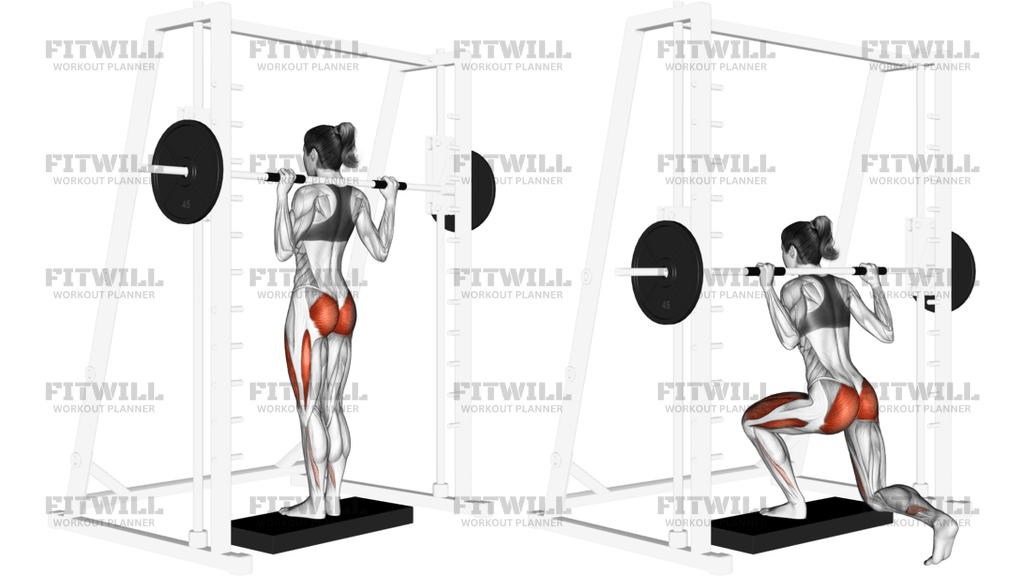
Instructions
- Set the bar across your upper traps and rear delts, grip it slightly wider than shoulder width, and stand under the Smith machine with your feet about hip-width apart.
- Place your front foot a comfortable step forward so the bar stays centered over your working leg when you lunge.
- Step the other leg back into a long split stance and stay on the ball of the rear foot.
- Brace your torso, keep your ribs stacked over your pelvis, and square your hips and shoulders to the machine.
- Bend both knees and lower straight down, letting the rear knee travel toward the floor while the front knee tracks in line with the toes.
- Keep most of your weight over the front heel and midfoot as you descend, with only light pressure through the rear foot.
- Lower until the front thigh is near parallel or the rear knee is just above the floor without losing balance or pelvic control.
- Drive through the front heel and midfoot to stand, squeeze the front glute, and finish tall without leaning back.
- Reset the stance for the next rep or carefully step the rear foot in before releasing the bar.
Tips & Tricks
- If the front knee feels crowded at the bottom, move the front foot slightly farther forward before the set starts.
- A longer step back usually shifts more work into the front glute; a shorter stance turns the rep into a more quad-dominant lunge.
- Keep the bar on the traps and rear delts, not on the neck, or the shoulders will get irritated fast.
- Let the rear heel stay lifted; pushing off the back leg makes the rep sloppy and reduces the loading on the front side.
- Use a slow 2-3 second descent to keep tension on the front leg instead of dropping into the bottom position.
- Stop the rep if your front arch collapses or the pelvis twists toward the stepping leg.
- Set the Smith safety stops before your work set so a missed rep does not turn into a scramble.
- If you feel the lower back more than the legs, shorten the torso angle slightly and re-brace before each descent.
Frequently Asked Questions
What muscles does Smith Rear Lunge Version 2 work most?
It mainly trains the glutes and thighs, with the quads, hamstrings, adductors, and core helping stabilize each rep.
Is Smith Rear Lunge Version 2 good for beginners?
Yes, the Smith path reduces balance demands. Start light and learn the stance before adding load.
Where should the bar sit on Smith Rear Lunge Version 2?
Rest it across the upper traps and rear delts, the same way you would for a back squat. Do not let it sit on the neck.
How far back should I step in Smith Rear Lunge Version 2?
Step back far enough that your front heel stays down and the front knee can bend without the torso collapsing forward. If the front knee feels jammed, take a slightly longer step.
Should my front knee go past my toes?
A small amount is fine if the heel stays planted and the knee tracks over the toes. The real mistake is letting the heel lift or the knee cave inward.
Why do I feel Smith Rear Lunge Version 2 in my quads instead of my glutes?
Your stance is probably too short or too upright. Take a slightly longer step back and keep a mild forward torso angle so the front hip does more of the work.
Is Smith Rear Lunge Version 2 the same as a Smith split squat?
No. A rear lunge usually has the back leg move back and reset each rep, while a split squat keeps the feet planted between reps.
Can I use Smith Rear Lunge Version 2 instead of a free-weight reverse lunge?
Yes, especially if you want less balance demand and a more repeatable bar path. It is a good option for loading one leg hard while keeping the setup consistent.