Finger Pinch
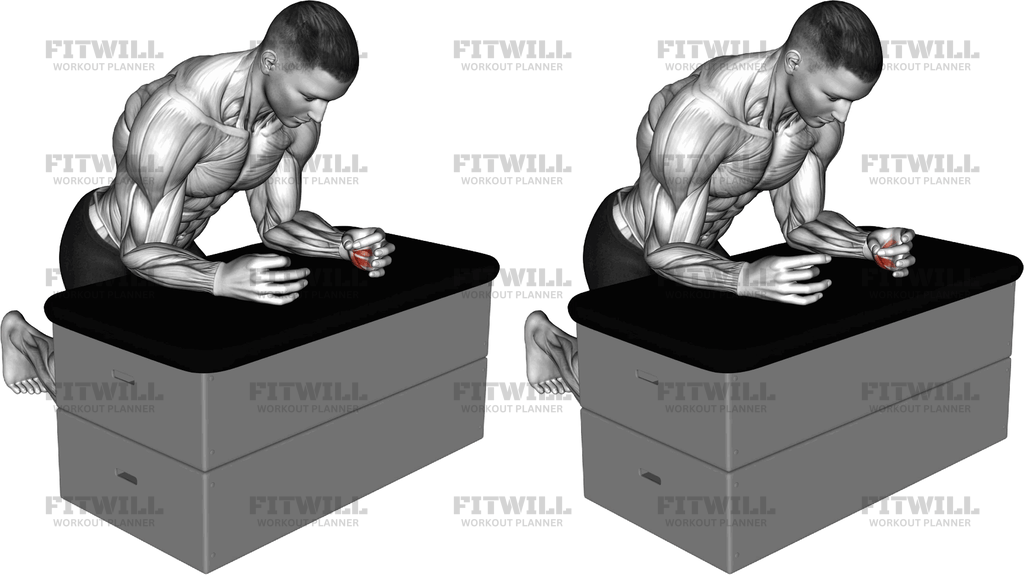
The Finger Pinch is a dedicated grip exercise that trains your ability to squeeze an object between your fingertips and thumb, rather than wrapping your whole hand around it. In the standard setup you kneel beside a bench, rest your forearm on the padded surface, and pinch a small weight plate between the pads of your fingers and thumb so the smooth edge of the plate faces outward. Because the object cannot be hooked with the fingers, the thumb has to work as an active press against the fingers, which is exactly what most regular grip training leaves out.
This movement is especially useful for climbers, wrestlers, baseball and tennis players, and anyone whose training or work depends on strong hands. It also carries over surprisingly well to barbell lifting: a stronger pinch means better control of dumbbells, barbells, and any implement you hold for time. If your grip usually gives out before your back or arms do during rows, deadlifts, or carries, targeted pinch work is one of the most direct ways to close that gap.
The main muscles at work are the intrinsic muscles of the hand and the forearm flexors, which power the squeeze and stabilize the wrist. The thumb musculature does a large share of the job here, which is what separates a pinch from a crushing grip. Because your forearm is supported on the bench, the shoulders and upper arms stay relaxed and out of the way, letting you focus all your attention on the hand itself.
Setup matters more than it looks. Kneel with your forearm flat on the bench and your wrist neutral, then place the plate so you can pinch it near its edge without bending your wrist sideways. If your wrist collapses backward or your knuckles roll under, the load shifts into the wrong structures and the exercise loses its point. A flat, supported forearm gives you a stable base so the effort stays in the fingers, thumb, and forearm.
To execute the movement, apply steady pressure through the fingertips and thumb to lift the plate a small distance off the bench, or simply hold it pinned in place for time. Keep the squeeze deliberate rather than explosive, breathe normally, and release the plate under control instead of letting it drop. Short, focused sets work best: most people get more out of several crisp 10 to 20 second holds than from one long struggle where the pinch slowly slips.
A few practical points will keep this productive. Start with a light plate until you can hold it confidently for the target time, since pinch grip strength tends to improve steadily but responds badly to ego loading. Keep the skin on your fingertips dry, stop the set the moment the plate starts to slide, and never pinch plates with cracked or chipped edges. Done consistently, this is one of the simplest and most effective tools for building real-world hand strength.
[ Workout Log & Planner ]
Put your next workout in Fitwill
Keep your plan and training log ready when you are.


Instructions
- Kneel on the floor beside a padded bench with your knees under your hips and your torso leaning slightly forward.
- Rest one forearm flat on the bench so your wrist hangs in a neutral line, hand open with fingers relaxed.
- Stand a small weight plate on its edge on the bench and place your fingertips on one flat face with your thumb pressing the opposite face.
- Brace your shoulder gently so your arm does not drift, and keep the back of your wrist flat rather than bent.
- Squeeze the plate firmly between your fingertips and thumb, then lift it a few centimeters off the bench, or hold it pinned in place for time.
- Keep the pinch at the pads of your fingers and thumb, not in the fingernails or the crook of the fingers.
- Hold for the target time while breathing normally; do not hold your breath as the squeeze intensifies.
- Lower the plate back to the bench under control and open your hand fully to release the tension.
- Reset your hand position on the plate before starting the next rep or hold, and switch to the other hand.
Tips & Tricks
- If the plate keeps slipping, the problem is usually thumb position: press the pad of your thumb closer to the center of the plate face instead of pinching at the very edge.
- Chalk or dry your fingertips before the set. Sweaty skin makes the plate rotate out of the pinch long before your flexors are actually tired.
- Watch for the wrist trick of bending backward to steal leverage. If the back of your hand rises toward your forearm, flatten the wrist and reduce the plate size.
- Do not let your shoulder creep up toward your ear as the set gets hard; drop your shoulder blade down and keep the arm passive.
- Time your holds instead of guessing. When you can no longer complete the target time with clean form, use a lighter plate rather than fighting a slipping one.
- Alternate hand positions between sessions, pinching the plate at different widths, so the thumb adapts to more than one angle.
- Stop the set the instant the plate begins to rotate or slide. Catching a falling plate reflexively strains the fingers far more than the exercise itself.
- Warm up your hands first with a few gentle squeezes or wrist circles; cold fingertip pads have poor sensitivity and grip quality.
- Keep the effort in the fingertips and thumb. If you notice your forearm rotating or your elbow digging into the bench, you are compensating instead of pinching.
Frequently Asked Questions
Which muscles does the Finger Pinch work?
The Finger Pinch primarily targets the intrinsic muscles of the hand and thumb along with the forearm flexors that drive the squeeze. The wrist stabilizers work isometrically to keep the joint neutral while you hold the plate.
Can beginners do the Finger Pinch safely?
Yes, it is one of the safest grip exercises because the load is small and the forearm is supported on a bench. Beginners should start with a light plate and short 10 second holds, focusing on a flat wrist and clean thumb pressure.
Why pinch a plate with the fingertips instead of gripping it normally?
A normal grip lets the fingers hook around the object, which largely bypasses the thumb. Pinching forces the thumb to press actively against the fingertips, training a type of hand strength that regular gripping does not develop.
Should I lift the plate or just hold it in place?
Both versions work. Lifting the plate a few centimeters adds a dynamic element, while timed holds emphasize sustained squeeze strength, so you can alternate between them across sessions.
How long should each Finger Pinch hold last?
Most people progress well with holds of 10 to 30 seconds per set. If you cannot hold the plate cleanly for at least 10 seconds, switch to a lighter plate or a wider, easier pinching surface.
What is the most common mistake in the Finger Pinch?
Letting the wrist bend backward and the fingers roll toward the fingertips' nails to steal leverage. Keep the forearm flat on the bench and the wrist neutral so the tension stays in the hand and forearm flexors.
What can I use if I do not have a weight plate?
Any flat, smooth, pinchable object works, such as two smooth stones, a stack of books, or dedicated pinch blocks. The key is that the object cannot be hooked with the fingers and must be held by thumb-and-finger pressure alone.
How does the Finger Pinch carry over to other lifts?
A stronger pinch improves your control of dumbbells, barbells, and rows because hand strength often limits these lifts before the target muscles do. It is also directly valuable for climbing and any sport that demands secure hand contact.
Is it safe to train the Finger Pinch every day?
Daily light practice is usually fine because the hands recover quickly, but heavy timed holds respond better to two or three focused sessions per week. Stop immediately if you feel sharp finger or thumb joint pain rather than muscular fatigue.
Why does my forearm burn more than my hand during the Finger Pinch?
That is normal, since the forearm flexors generate most of the squeezing force for the small hand muscles. The burn should feel spread through the forearm and thumb pad, not concentrated in the finger joints.