Landmine Banded Press
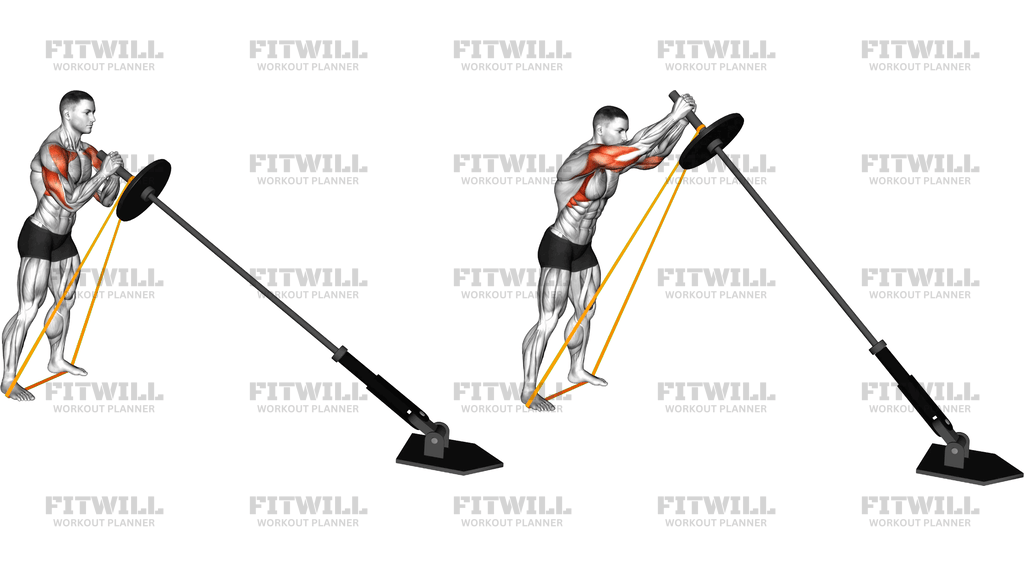
The Landmine Banded Press is a standing landmine press with a resistance band looped around the bar and anchored under your feet. The landmine setup gives the bar a fixed diagonal path, so your shoulder travels forward and up at an angle instead of straight overhead, which is friendlier to the shoulder joint for many lifters. The band changes the feel of the set entirely: it is slack at chest height and pulls hardest at the top, so the press gets more demanding the closer you get to lockout.
This exercise primarily trains the front delts and upper chest, with strong contributions from the triceps as you extend to lockout. Because you are standing and driving the bar along an angled path, your core works hard to stop your torso from leaning back and your legs stay engaged for balance. The added band tension at the top also demands more from the serratus and upper traps as you reach the bar fully forward.
The setup matters more here than in a standard landmine press. Your feet must actually pin the band to the floor; if the band slips off a toe mid-press, the bar can jump toward you. Load the sleeve with a plate and place the band under the midfoot, not the toes, so it stays put through every rep.
To perform it well, stand far enough back from the anchor that the bar rests near your shoulder at the start. Grip the sleeve with both hands stacked or side by side, brace your ribs down over your hips, and press the bar up and forward along the natural diagonal until the arm is extended and the band is fully stretched. Lower under control rather than letting the band snap the bar back down.
This variation suits lifters who want extra lockout drive on their landmine press, anyone whose shoulders dislike straight barbell overhead pressing, and athletes who need pressing power at an upward angle, which carries over well to sport-specific pushing. It also works nicely as a finisher, since the band keeps tension high even with a light plate on the bar.
For safety, start with a lighter band than you think you need and confirm the band is secure under both feet before your first rep. Keep the working-side ribs from flaring as you press, and if you cannot reach full extension without leaning back, reduce the band tension or plate load.
[ Workout Log & Planner ]
Put your next workout in Fitwill
Keep your plan and training log ready when you are.


Instructions
- Set one end of a barbell in a landmine attachment (or wedge it securely into a corner) and slide a plate onto the free end.
- Loop a resistance band over the bar just below the plate, then step both feet onto the band so it is pinned under your midfoot and runs up to the bar.
- Stand in a split or staggered stance facing the anchor, far enough back that the bar sits at shoulder height with the band already slightly taut.
- Grip the bar sleeve with both hands, one stacked over the other, and pull the elbow in so the bar rests near the front of your shoulder.
- Brace your core and keep your ribs stacked over your pelvis so you are not arching your lower back before you even press.
- Press the bar up and forward along the diagonal path of the landmine until your arm is fully extended and the band is stretched hard at the top.
- Hold the lockout for a beat with the shoulder blade reaching forward, keeping your head in line with your arm rather than jutting the chin under the bar.
- Lower the bar slowly back to the shoulder, resisting the band's pull instead of letting it drop the last few inches.
- Exhale as you press, inhale as you lower, and complete all reps on one side before switching stance, grip, and pressing arm.
- Reset your stance and confirm the band is still pinned under both feet before every set.
Tips & Tricks
- If the bar drifts toward the anchor as you press, you are standing too far forward; step back until the starting bar path feels vertical to your shoulder.
- The most common failure point is the lower back arching at the top when the band pulls hardest. Squeeze the glutes of your rear leg to lock the pelvis in place.
- Do not let the band sit on your toes. If it rolls off mid-set, the bar will whip back toward your face, so keep it under the arch of the foot.
- Choose a band that lets you reach full elbow extension. If you stall halfway up, the band is too heavy and your triceps will do the compensating.
- Keep the elbow slightly in front of the ribcage at the bottom rather than flared straight out to the side, which keeps the shoulder in a stronger pressing position.
- A wider staggered stance gives you a more stable base for heavy band tension, but keep your weight balanced between both feet instead of dumping it on the back leg.
- If your wrist bends back at lockout, reposition your grip so the bar sits along the base of the palm in line with your forearm.
- Use the band's resistance curve deliberately: pause one second at the top where the tension peaks instead of bouncing through the lockout.
- On your last rep, guide the bar all the way down to the floor before stepping off the band, never release your grip while the band is stretched.
Frequently Asked Questions
Which muscles does the Landmine Banded Press work?
The front delts and upper chest do most of the pressing, with the triceps extending the elbow to lockout. Your core, glutes, and legs stabilize the standing position, and the band's peak tension at the top adds extra demand on the serratus and upper traps.
Why add a band to a landmine press at all?
The band makes the press harder at the top, where a plain landmine press actually gets easier as the bar angle improves. This builds stronger lockout strength and keeps constant tension through the whole range.
Is the Landmine Banded Press suitable for beginners?
Beginners should first learn the standard standing landmine press without a band, since the added tension at the top requires good trunk control. Once you can press with a stable, non-arching torso, a light band is a reasonable addition.
Should I stand in a split stance or a parallel stance?
A split stance with the same-side foot back as the pressing arm is the most common and stable option. A parallel stance works too, but it demands more core control because you have less base against the band's backward pull.
How far should I stand from the landmine anchor?
Stand far enough back that the bar rests at roughly shoulder height at your starting position. Too close and you will fight an overly steep angle at the bottom; too far and the band plus leverage make the start unreasonably heavy.
Can I replace the band with more plates on the bar?
You can, but you lose the resistance profile that makes this variation distinct. Plates load the bottom of the range evenly, while the band targets the lockout, so if lockout strength is the goal, the band is doing the specific work.
Why does my lower back ache when pressing overhead on this exercise?
It usually means the ribs are flaring and the pelvis is tilting forward as the band pulls hardest at the top. Squeeze your glutes, exhale through the press, and reduce the band tension until you can keep your torso stacked.
Is the Landmine Banded Press safer than a barbell overhead press?
The angled path and shoulder-blade movement at the top are gentler on many shoulders than pressing a straight bar directly overhead, which is why it is often used as a substitute. Comfort still varies by individual, so ease in with a light load.
How do I safely end a set with the band under my feet?
Lower the bar with control to the floor along the landmine path before you step off the band, keeping both hands on the sleeve until the band goes slack. Stepping off under tension lets the bar recoil toward you.
Do I need to train both sides?
Yes. Because the setup is asymmetric, complete all reps on one arm, then switch your stance and grip so the other side presses first on the following set to keep development even.