Single Leg Down To Upward Dog
The Single Leg Down To Upward Dog is a bodyweight flow that links two classic yoga positions while keeping one foot off the floor the entire time. You start in a three-legged downward dog, shift your weight forward over your hands, sweep your hips down and through, and press up into an upward dog with the top leg still lifted. Then you reverse the whole path back to the starting position. Because one leg never touches the ground, the working side has to produce and control force on its own, which makes this a much sharper test than the standard two-legged version.
The main demand lands on the glute of the lifted leg, which has to stay engaged to keep the leg elevated and the hips level as your body weight travels forward and back. The shoulders, triceps, and chest handle the pressing and weight-shifting work, while the core and lower back stabilize your spine as your torso changes angle dramatically from an inverted V to an arched, chest-up position. The standing leg's calf, hamstring, and hip also work overtime because they are supporting your full load alone.
This movement suits people who already own a comfortable downward dog and upward dog and want a harder, more balance-demanding progression. It shows up in vinyasa-style training, warm-ups for pressing days, and mobility circuits where you want the shoulders, hips, and spine moving through a large arc under load. Lifters who spend most of their time on symmetric, two-footed exercises often find the single-leg version exposes a big difference between their left and right sides.
Setup matters more here than in the standard flow. Your hands need to sit slightly wider than shoulder-width with fingers spread, and your wrists should be stacked directly under your shoulders when the weight moves forward. If your hands are too far forward or too narrow, the transition into upward dog will collapse through the shoulders or dump stress into the lower back. Keeping the lifted leg's hips square to the floor from the first step is what separates a clean rep from a twisty, momentum-driven one.
To execute it well, move slowly through the middle of the range. Shift forward until your shoulders stack over or slightly past your wrists, let your hips sink toward the floor, and press the chest up through the arms into upward dog while the top leg stays active and hovering. Pause briefly at the top, then reverse the arc, drawing the hips back up and the lifted leg toward the ceiling until you return to three-legged downward dog. Complete all reps on one side before switching legs.
A few practical safety points: warm up the wrists and shoulders before your first set, keep the lower back's arch in upward dog coming from the hip extension rather than lumbar compression, and skip the movement if you have an acute wrist, shoulder, or lower back issue. Slow tempo is your friend here; the moment you rush the transition, the lifted leg drops and the movement loses its point.
[ Workout Log & Planner ]
Put your next workout in Fitwill
Keep your plan and training log ready when you are.


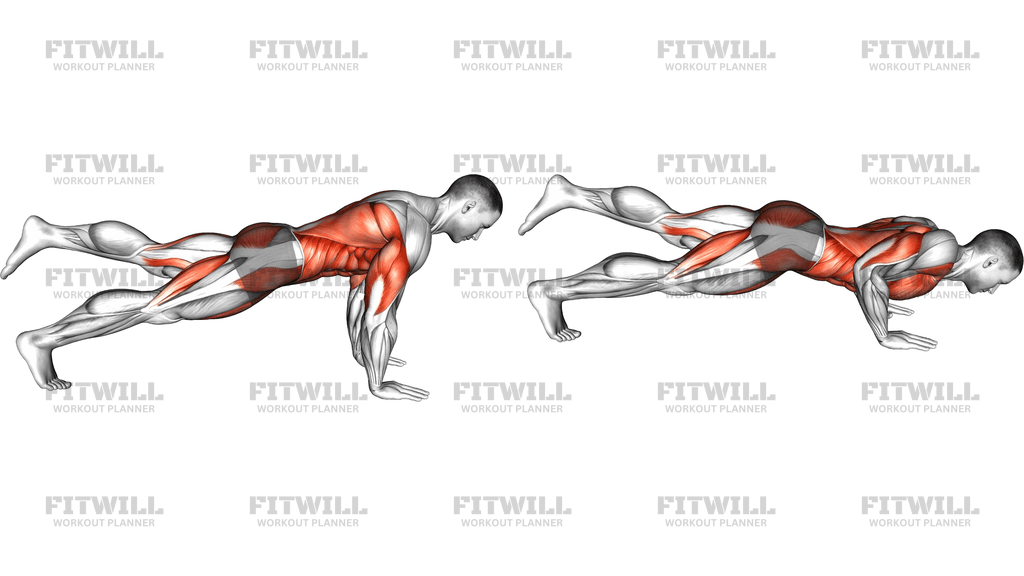
Instructions
- Place an exercise mat on the floor and set your hands slightly wider than shoulder-width, fingers spread and index fingers pointing forward.
- Push back into a downward dog with both feet, then lift one leg straight back and up toward the ceiling so you are balanced on two hands and one foot.
- Square the hips of the lifted leg down toward the floor and squeeze that glute to keep the leg active before you move.
- Shift your body weight forward over your wrists, letting your shoulders travel past your hands as the heel of the standing foot lifts.
- Continue the forward arc by lowering the hips toward the floor and sweeping the chest through between the arms, keeping the lifted leg off the ground.
- Press firmly through the palms to straighten the arms and lift the chest up and forward into upward dog, with the tops of the standing foot's toes pressed into the mat and the top leg still hovering.
- Hold the upward dog position for a breath, keeping the glute of the lifted leg tight and the shoulders drawn back rather than shrugged toward the ears.
- Reverse the path in reverse order: lower the chest forward and down, draw the hips back up under you, and reach the lifted leg back toward the ceiling until you are back in three-legged downward dog.
- Exhale as you press up into upward dog and inhale as you return to downward dog.
- Finish all repetitions on one leg, then lower the foot, reset your hand position if needed, and switch sides.
Tips & Tricks
- The most common failure is the lifted leg slowly sinking toward the floor during the forward shift. Squeeze that glute hard from the first second and think about lengthening the leg back, not just holding it up.
- If your hips twist open as you move into upward dog, the lifted side is rotating instead of staying square. Point the lifted knee and toes straight down at the mat to lock the pelvis in place.
- Watch the lower back at the top of upward dog. The arch should come from pushing the hips forward and squeezing the glute of the standing leg, not from hanging loose on the lumbar spine.
- If your wrists ache during the forward shift, spend more time with weight shifted only halfway before committing to the full range, and actively grip the mat with your fingertips to unload the heel of the hand.
- Rushing the transition turns this into a swinging, momentum-driven movement where the leg barely stays up. Count two seconds forward and two seconds back on every rep.
- Avoid shrugging your shoulders up to your ears in upward dog. Draw the shoulder blades down the back as you press the chest forward to keep the press strong and the neck long.
- If you cannot straighten the arms at the top, your hands are probably too far forward relative to your hips. Recheck that the wrists sit under the shoulders when the weight moves over them.
- Keep the standing leg's heel high as you shift forward. Dropping it early shortens the arc and makes the hips drag on the way into upward dog.
- On a slick floor or worn mat, hands can slide outward during the press. Spread the fingers wide and screw the palms into the mat to anchor them before the first rep.
Frequently Asked Questions
What muscles does the Single Leg Down To Upward Dog work?
The glute of the lifted leg works hardest, since it must hold the leg off the floor through the entire arc. The shoulders, triceps, and chest handle the pressing and weight shift, while the core and lower back stabilize the spine between the two positions.
Is the Single Leg Down To Upward Dog suitable for beginners?
It is best treated as a progression for people who already move comfortably between standard downward dog and upward dog. Beginners should master the two-legged flow first, then practice holding a steady three-legged downward dog before linking the two positions.
How does the Single Leg Down To Upward Dog differ from the standard version?
Keeping one foot off the floor removes half of your base of support, so the standing leg, lifted-leg glute, and hip stabilizers all work much harder. It also demands more balance and makes it harder to hide side-to-side differences.
Why does my lifted leg keep dropping during the movement?
This usually means the glute of that leg is not engaged, or you are moving too fast through the forward shift. Squeeze the glute before you start, move on a slow count, and think about reaching the leg long rather than just holding it up.
My wrists hurt when I shift forward. What should I change?
Grip the mat with your fingertips to take load off the heel of the hand, and make sure the wrists stack directly under the shoulders at the deepest point of the shift. Building up gradually with partial-range reps also helps the wrists adapt.
Can I substitute the Single Leg Down To Upward Dog with an easier exercise?
Yes. The standard two-legged down-to-upward dog flow is the closest substitute, and a single-leg downward dog hold without the forward transition is a good intermediate step before linking the full movement.
How many reps should I do per side?
Start with 5-8 controlled repetitions per leg, completing one side fully before switching. Because the tempo is slow, quality matters more than volume, and two rounds per side is plenty in most sessions.
Should my hips stay square during the Single Leg Down To Upward Dog?
Yes. Keeping both hips level and facing the floor is what forces the lifted leg's glute to work and prevents the movement from turning into a twisting swing. Pointing the lifted knee and toes straight down helps lock the pelvis in place.
Is this movement safe for the lower back?
When performed with the arch in upward dog coming from hip extension and a glute squeeze rather than passive lumbar sag, it is generally well tolerated. If you currently have lower back pain, work on the standard two-legged version or get cleared by a professional before adding the single-leg demand.
Do I need any equipment for the Single Leg Down To Upward Dog?
No equipment is required beyond an exercise mat or non-slip surface to protect your hands, knees of the toes in upward dog, and give you grip during the forward shift.