Standing Hands Up Twist
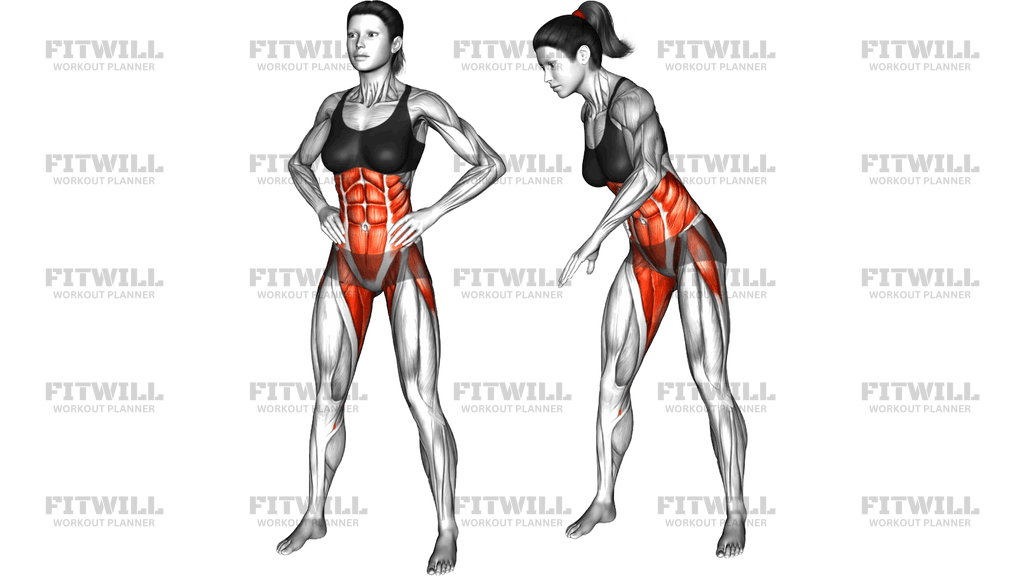
The Standing Hands Up Twist is a bodyweight rotational exercise performed from a simple standing stance with the arms raised and bent so the hands sit in front of the upper chest and the elbows flare out to the sides. From there, you sweep the entire upper body from one side to the other, letting the torso rotate around the spine while the legs and hips stay anchored. Because there is no equipment involved, you can do it anywhere — in a warm-up, between sets, or as part of a short core circuit at home.
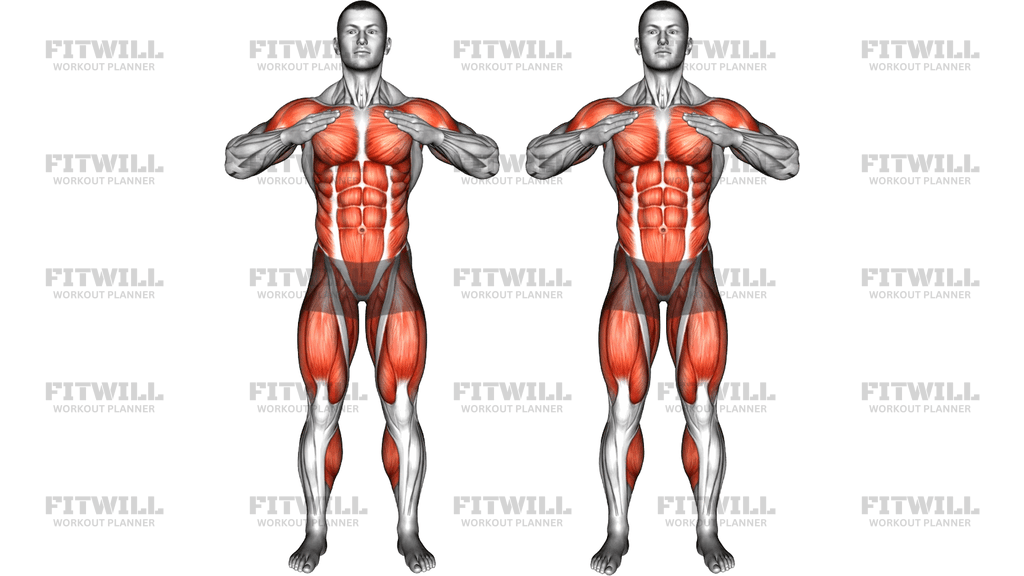
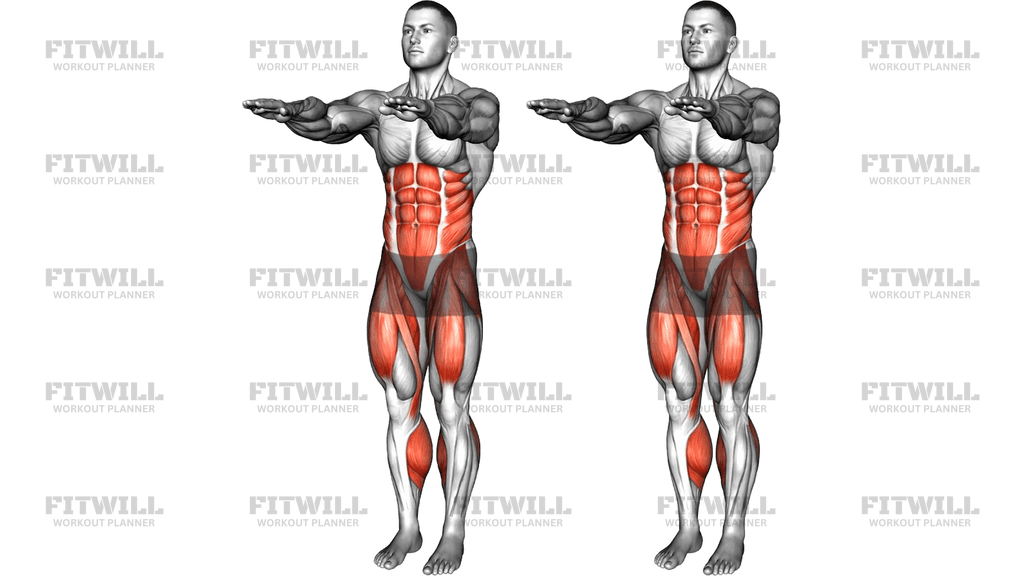
The main work falls on the obliques, the muscles running along the sides of your waist that handle rotation and anti-rotation. The rectus abdominis assists as the trunk turns, the shoulders and upper back hold the arms in the raised position the whole time, and the low back and hips stabilize so the twist comes from the waist rather than from swinging the pelvis. The highlighted areas in the muscle diagram — the side waist and the shoulder region — reflect exactly where you should feel this.
Setup matters more than it looks. With the hands lifted and elbows wide, your lever arm is long, so any momentum from the arms can fake the movement if you are not deliberate. Keep the feet roughly hip-width to shoulder-width apart, knees soft but not bending with each rep, and the hips squared forward. When the hips stay quiet and the rotation happens above the waistband, the obliques actually do the work instead of the lower back.
To execute it well, brace the core lightly, then rotate the ribcage and shoulders to one side as far as you can control, pause briefly, and sweep across to the opposite side. Think of turning from the midsection rather than whipping the hands — the arms travel because the torso turns, not the other way around. The tempo should be steady and smooth on both the way out and the way back, with breathing relaxed and continuous.
This movement fits well for beginners learning rotational control, for lifters warming up before heavier training, and for anyone wanting a low-impact way to wake up the waist after long sitting. It is also a reasonable low-back-friendly choice compared with loaded twists, since the resistance is only your own body. Stop short of any range that forces a twist through the low back, and keep the motion fluid rather than jerky to protect the spine.
Fitwill
Log Workouts, Track Progress & Build Strength.
Achieve more with Fitwill: explore over 9600 exercises with images and videos, access built-in and custom workouts, perfect for both gym and home sessions, and see real results.
Start your journey. Download today!




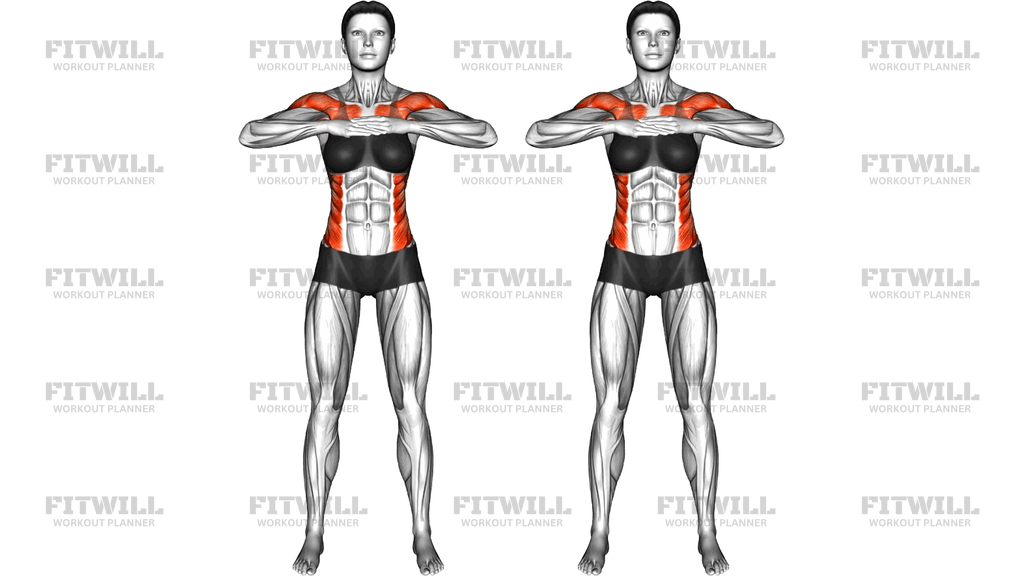
Instructions
- Stand tall with your feet about hip-width to shoulder-width apart, weight spread evenly across both feet, and knees soft.
- Raise both arms and bend the elbows so your hands come up in front of your upper chest, fingertips toward each other and elbows pointing out to the sides.
- Draw the shoulders down slightly, brace the abdominal wall, and square your hips forward — this is your starting position.
- Inhale, then exhale as you rotate your ribcage, shoulders, and arms together to the right, turning from the waist while the hips and legs stay facing forward.
- Rotate until you reach a comfortable end range where the side of your waist is working, and pause there for a beat.
- Sweep smoothly across the center and rotate to the left side, moving with the same controlled tempo — no bouncing at the turnaround.
- Keep breathing steadily throughout each sweep instead of holding your breath as you twist.
- Alternate sides for your target number of repetitions, counting one full left-and-right sweep as a single rep.
- When finished, lower the arms, take a breath, and shake out the shoulders and waist before the next set.
Tips & Tricks
- The most common mistake is letting the hips and knees swing with the arms. Press the feet into the floor and imagine your pelvis is set in wet cement — only the ribcage and shoulders should turn.
- If you feel the movement in your low back instead of your waist, reduce the range of the twist and tighten the brace before rotating; the end range should feel muscular, not spinal.
- Keep the elbows up and wide for the whole set. As fatigue sets in, the arms tend to drop toward the belly, which shortens the lever and steals work from the shoulders and core.
- Do not race the sweep. A two-second trip to each side with a short pause beats ten fast, sloppy swings for teaching the obliques to control rotation.
- If your shoulders tire before your waist, that is normal at first — lower the hands slightly toward mid-chest for a few sessions while the shoulder endurance catches up.
- Avoid locking the knees. Slightly bent knees absorb tension and keep the stance stable as the upper body turns.
- Keep your head traveling with the ribcage so the neck stays in line with the spine; leading with the eyes whipping around can strain the neck.
- On cold starts, do the first few reps at half range to warm the waist and shoulders before committing to the full twist.
Frequently Asked Questions
What muscles does the Standing Hands Up Twist work?
The obliques on the sides of your waist do the primary work of rotating the torso, with the rectus abdominis assisting. The shoulders and upper back hold the arms in the raised position, and the lower back and hips stabilize the stance.
Is the Standing Hands Up Twist good for beginners?
Yes. It requires no equipment, the resistance is just your own body, and the range can be scaled down easily. Beginners should start with a smaller twist and prioritize keeping the hips facing forward.
Why do my hands need to stay up by my chest during the twist?
Raising the hands and flaring the elbows lengthens the lever and keeps the arms from doing the driving, so the rotation has to come from the waist. If the arms drop, the shoulders stop working and the twist turns into an arm swing.
Should my hips move during the Standing Hands Up Twist?
No — the hips stay squared to the front while the ribcage and shoulders rotate above them. If the pelvis turns with each sweep, the obliques lose tension and the lower back takes on rotation it does not need.
How many reps of the Standing Hands Up Twist should I do?
For warm-ups, 10 to 15 slow alternating sweeps work well. For core conditioning, 2 to 3 sets of 15 to 20 controlled reps, pausing briefly at each side, is a solid range.
Can I use the Standing Hands Up Twist as a warm-up before lifting?
Absolutely. It raises the heart rate slightly, lubricates the thoracic spine, and primes the obliques for rotation, which makes it a good fit before squats, presses, or any rotational sport work.
What can I substitute if standing twists bother my lower back?
Try a Seated Torso Twist on a bench, a lying Knee Drop Twist on the floor, or a Pallof-style press with a band. All train rotation or anti-rotation with less spinal loading.
How do I know if I am rotating from the waist and not just swinging my arms?
Watch your elbows relative to your shoulders — they should travel together as one unit, and you should feel the side of your waist shorten on each side. If only the hands move while the chest stays forward, the arms are doing the work.
Is it safe to twist quickly through a full range?
Fast, end-range twisting under fatigue is where most people run into trouble. Keep the tempo smooth, stay slightly inside your maximum range, and save speed work for later once the controlled version feels automatic.