Kettlebell Sitting Calf Raise
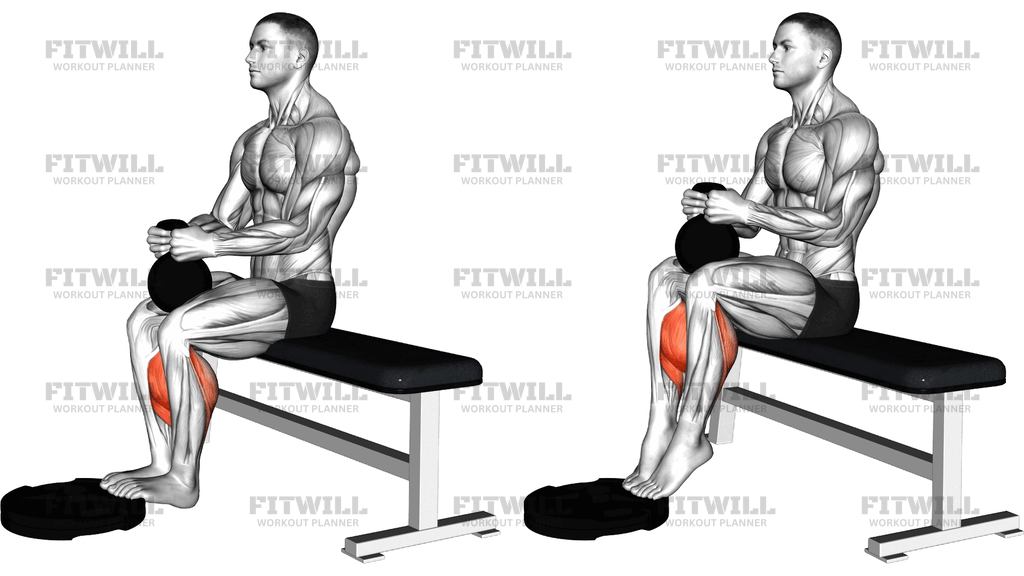
The Kettlebell Sitting Calf Raise is a seated calf exercise performed on a flat bench with a kettlebell resting on your thighs as resistance. Because you sit with your knees bent to roughly 90 degrees, the gastrocnemius—the two-headed calf muscle that crosses the knee—is placed at a mechanical disadvantage. That shifts most of the work to the soleus, the flat muscle underneath it that powers everyday standing, walking, and pushing off the ground.
This version is especially useful for people who find standing calf raises limited by balance, grip fatigue, or lower back strain. Sitting takes the rest of the body out of the equation, so the only joint moving is the ankle. That makes it a good fit for beginners learning what a proper calf contraction feels like, as well as for lifters who want higher-rep, focused soleus work without loading the spine.
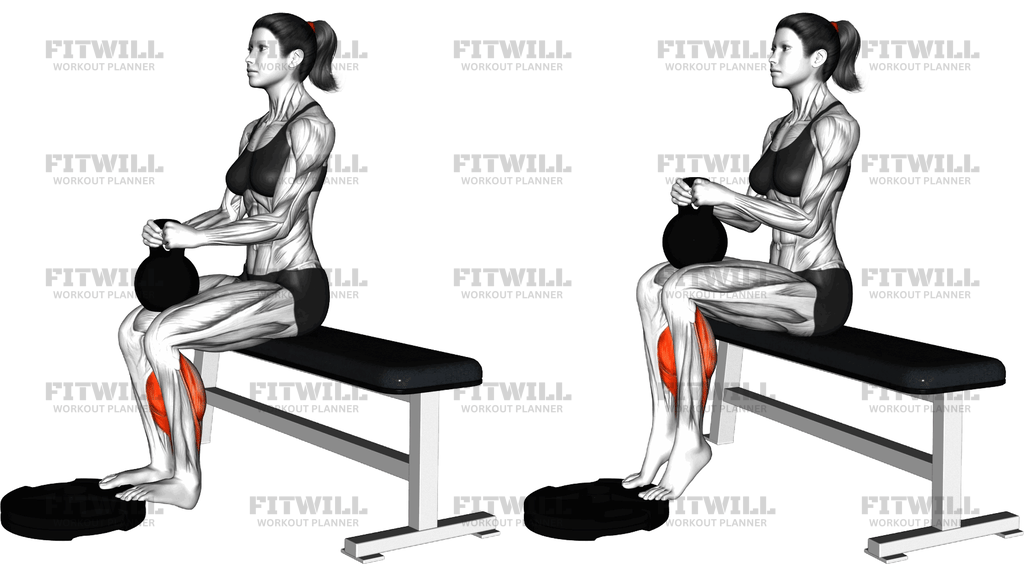
To set it up, sit on a bench with your feet flat on the floor about hip-width apart. Hold the kettlebell by the horns with both hands and place it on your thighs just above the knees, close to your hips so the load sits over the ankles rather than pulling you forward. From there, press through the balls of your feet to lift your heels as high as they will go, pause briefly at the top, then lower your heels toward the floor until you feel a mild stretch in the calves.
Because the range of motion at the ankle is short, control matters more than speed. Moving quickly turns the exercise into a bouncing drill where momentum, not muscle, does the lifting. Slow lowering, a clear pause at the top, and a full stretch at the bottom produce far better results than rushed reps, even with a lighter kettlebell.
Common mistakes include letting the kettlebell slide toward the knees, lifting the heels only partway, and cutting the stretch at the bottom short. Reps in the 12 to 20 range work well here, since the soleus is a fatigue-resistant muscle that responds to sustained tension. If your heels cannot reach a comfortable stretch from the floor, place the balls of your feet on a small plate or step platform to increase the range safely.
[ Workout Log & Planner ]
Put your next workout in Fitwill
Keep your plan and training log ready when you are.


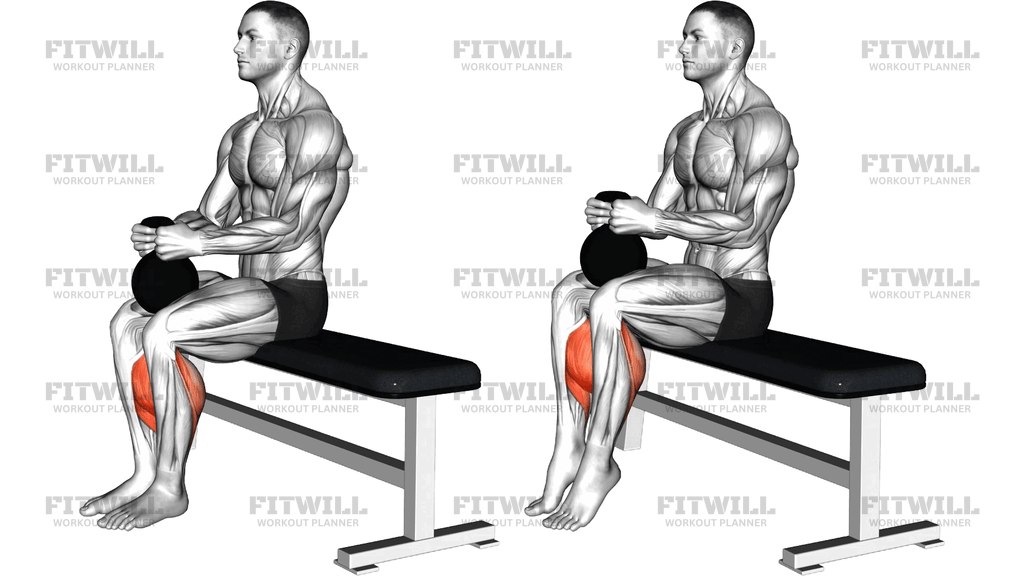
Instructions
- Sit on a flat bench with your feet flat on the floor, hip-width apart, and your knees bent at about 90 degrees.
- Hold a kettlebell by the horns with both hands and set it on your thighs just above the knees, close to your hips.
- Sit tall with your chest up and brace your core so the weight rests on your thighs instead of pulling your torso forward.
- Press the balls of your feet firmly into the floor and raise your heels as high as they will comfortably go.
- Squeeze your calves hard at the top and hold the contraction for one to two seconds.
- Lower your heels slowly toward the floor until you feel a mild stretch in your calves, without letting them slam down.
- Breathe out as you lift your heels and in as you lower them.
- Keep the kettlebell steady on your thighs by lightly gripping the handles and keeping your forearms relaxed on top of it.
- Complete your reps with even tempo, then stand up carefully and set the kettlebell down on the floor with a flat back.
Tips & Tricks
- If your heels hit the floor before you feel a stretch, put the balls of your feet on a weight plate or low step to add range at the bottom.
- A kettlebell that slides toward your knees changes the leverage and makes the movement easier—keep it close to your hip crease over the ankles.
- Pause at the top of every rep. The seated position lets you squeeze the calves deliberately, and skipping that pause is the most common way to make this exercise useless.
- If your thighs start burning before your calves, the kettlebell is tipping forward—re-grip the horns and pull it back toward your hips.
- Keep both heels lifting evenly; a stronger side will take over if you let one foot lag.
- Use a moderate weight and higher reps. The soleus is built for endurance, so eight grinding reps often deliver less than fifteen controlled ones.
- Do not let your torso round forward under the load. If you have to lean into the weight to move your heels, it is too heavy.
- The movement happens only at the ankle—if your hips or knees are bouncing, slow the tempo down.
Frequently Asked Questions
Which muscles does the Kettlebell Sitting Calf Raise work?
The soleus does most of the work because your knees are bent, which limits how much the gastrocnemius can contribute. The ankle stabilizers on the sides of the lower leg also assist with balance and control.
Why is the seated position better for the soleus than a standing calf raise?
The gastrocnemius crosses the knee joint, so bending your knees to 90 degrees slackens it and reduces its contribution. With the gastrocnemius partly out of the picture, the soleus has to handle the load.
Where exactly should the kettlebell sit on my legs?
Place it on your thighs just above the knees, as close to your hips as is comfortable. Weight positioned near the knees reduces the resistance, while weight closer to the hips sits directly over the ankles and loads the calves properly.
Is the Kettlebell Sitting Calf Raise good for beginners?
Yes. Sitting removes balance and coordination demands, so beginners can focus purely on moving the ankle through a full range. Start with a light kettlebell and master the pause at the top before adding weight.
How many reps should I do?
The soleus is fatigue-resistant, so most people get the best results in the 12 to 20 rep range with a controlled tempo. If you cannot reach 12 clean reps, the kettlebell is too heavy.
My heels will not go low enough to feel a stretch—what should I do?
Elevate the balls of your feet on a weight plate, step platform, or low block so your heels can drop below the level of your toes. This extends the range without forcing the ankle past a comfortable limit.
Can I do this exercise if I have knee discomfort?
The seated position puts very little demand on the knee, and many people find it easier than standing calf variations. Still, if discomfort appears during the movement, reduce the load and range, and check with a qualified professional before continuing.
What can I use instead of a kettlebell for seated calf raises?
A dumbbell held vertically on the thighs, a weight plate, or a barbell loaded across the knees all work. Any weight that rests over the thighs and can be controlled with your hands will do the job.
How do I know if I am bouncing instead of lifting?
If your heels never fully stop at the bottom and the reps have a rhythmic spring to them, momentum is doing the work. Add a one-second pause at the top and a deliberate one-second lower to reset the tempo.