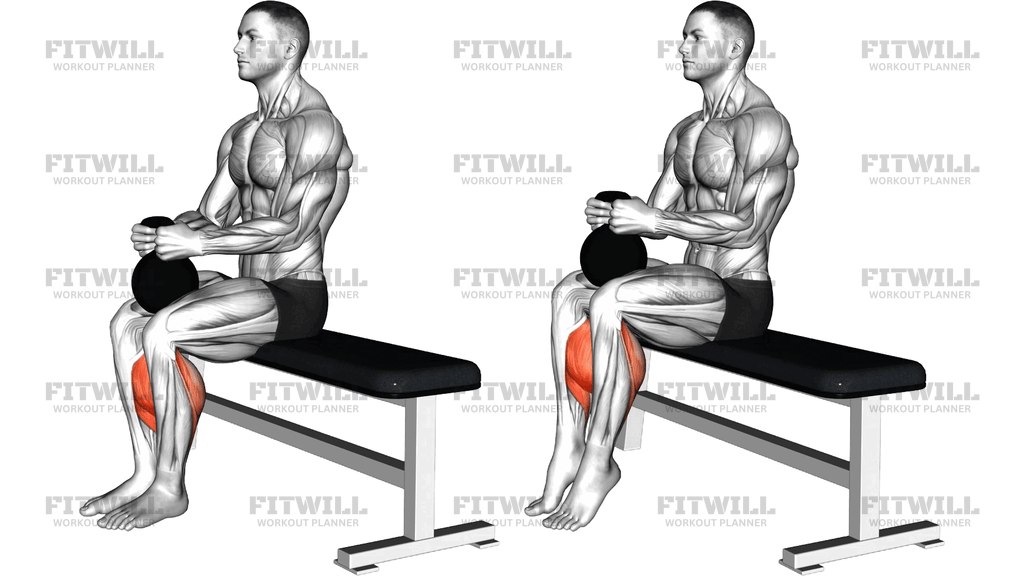
Kettlebell Standing Calf Raise
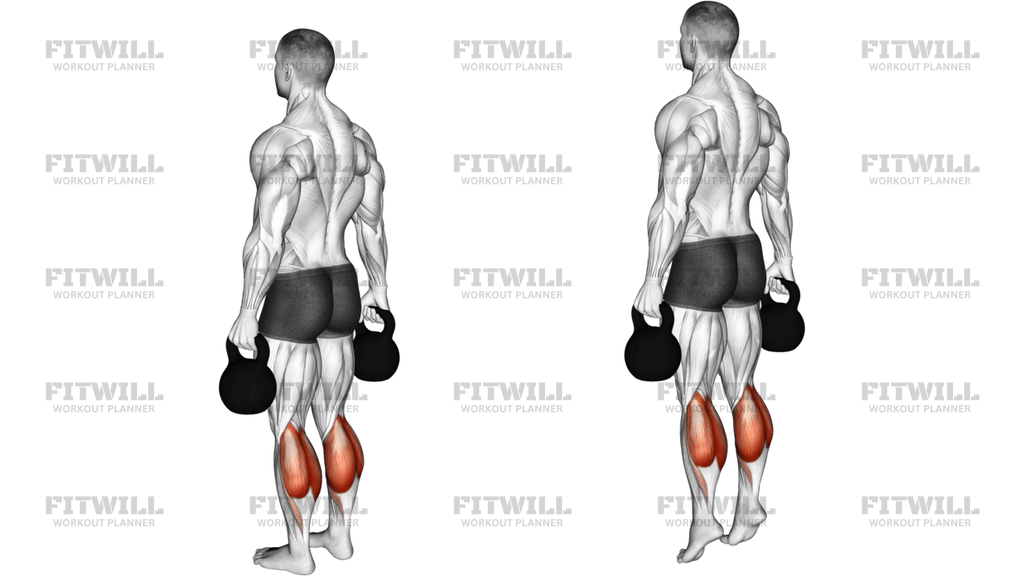
Kettlebell Standing Calf Raise is a simple lower-leg strength exercise that loads the calves while you stay upright and balanced. Holding a kettlebell in each hand adds resistance without changing the basic pattern: heels lower toward the floor, then the ankles drive you up onto the balls of the feet. It is a useful accessory movement for building stronger, more resilient calves and better ankle control.
The setup matters because the entire rep is decided by how well you can stay tall and steady before you begin. Stand with the kettlebells hanging at your sides, feet about hip-width apart, and pressure spread through the big toe, little toe, and heel. Keep the ribs stacked over the pelvis, soften the knees just enough to avoid locking them out, and let the shoulders stay quiet while the hands simply hold the weights.
Each repetition should start from a controlled stretch. Lower the heels slowly until you feel the calves lengthen, but do not let the arches collapse or the knees drift forward into a squat. From there, press through the forefoot and lift the heels as high as possible, finishing with the ankles fully extended and the calves visibly tightened at the top. A brief pause there makes the rep stricter and removes the temptation to bounce.
This exercise fits well as accessory work after squats, deadlifts, running, jumping, or lower-body machine work because it trains the lower leg in a straightforward standing position. It also works well when you want direct calf volume without complicated balance demands or a machine setup. If you need more range, a small step can increase the stretch, but only if you can keep the descent smooth and stable.
Clean execution matters more than load on this movement. Heavy kettlebells can make you lean, sway, or shorten the lowering phase, which shifts the work away from the calves. Keep the neck relaxed, the feet planted evenly, and the tempo consistent from rep to rep so the calves do the lifting instead of momentum, bouncing, or ankle collapse.
[ Workout Log & Planner ]
Put your next workout in Fitwill
Keep your plan and training log ready when you are.


Instructions
- Stand upright with a kettlebell in each hand, arms long at your sides, and your feet hip-width apart.
- Point your toes mostly forward and spread your weight across the big toe, little toe, and heel of each foot.
- Keep your chest tall, ribs stacked over your pelvis, and shoulders relaxed while the kettlebells hang still.
- Soften your knees slightly so your legs stay straight but not locked.
- Lower your heels toward the floor under control until you feel a clear stretch through the calves.
- Press through the balls of your feet and lift your heels as high as you can without leaning back.
- Squeeze the calves briefly at the top and keep the ankles from rolling outward or inward.
- Lower back down slowly to the starting position and reset your balance before the next repetition.
- After the final rep, place the kettlebells down carefully and return to a stable flat-footed stance.
Tips & Tricks
- Keep the kettlebells quiet; if they swing, the set is getting too fast.
- Use the full heel drop only if your arches stay lifted and your Achilles feels comfortable.
- Think about pushing through the big toe and second toe on the way up so the ankles do not drift outward.
- A one-count pause at the top makes the calf contraction much harder than bouncing through reps.
- Do not turn this into a mini-squat; the knees should stay almost straight from start to finish.
- If balance limits the set, lighten the kettlebells before you shorten the range of motion.
- Keep the torso stacked over the middle of the foot instead of leaning forward to cheat the lift.
- Use a slower lowering phase than the lifting phase to make the calves handle more of the work.
- Stop the set when the heels start wobbling side to side or the arches collapse inward.
Frequently Asked Questions
What does Kettlebell Standing Calf Raise train most?
It mainly targets the gastrocnemius, with the soleus and foot stabilizers helping keep the ankle controlled through the lift and lower.
Should Kettlebell Standing Calf Raise be done on the floor or a step?
The floor is the simplest option. A small step gives more stretch at the bottom, but only use it if you can lower under control without losing balance.
Do my knees need to stay straight during Kettlebell Standing Calf Raise?
Yes, keep them mostly straight with only a slight unlock. If you bend them too much, the movement shifts away from the standing calf-raise pattern.
How heavy should the kettlebells be?
Use enough load to challenge the calves, but not so much that your torso leans or the heels bounce. If your feet start wobbling, the weight is too high.
Can beginners do Kettlebell Standing Calf Raise?
Yes. Start light, use a flat floor, and focus on a smooth heel drop and a controlled rise before adding more load.
Why hold kettlebells at my sides instead of on my shoulders?
Side-loaded kettlebells keep the setup simple and let you focus on the ankle movement. They also train grip and standing stability without changing the calf-raise path.
What is the most common mistake in Kettlebell Standing Calf Raise?
Bouncing through short reps is the biggest issue. Lower the heels fully, pause briefly at the top, and avoid letting the weight do the work.
How can I make Kettlebell Standing Calf Raise harder without using huge weights?
Add a longer pause at the top, slow the lowering phase, or use one leg at a time after you master the two-leg version.