Kettlebell Seated Calf Raise
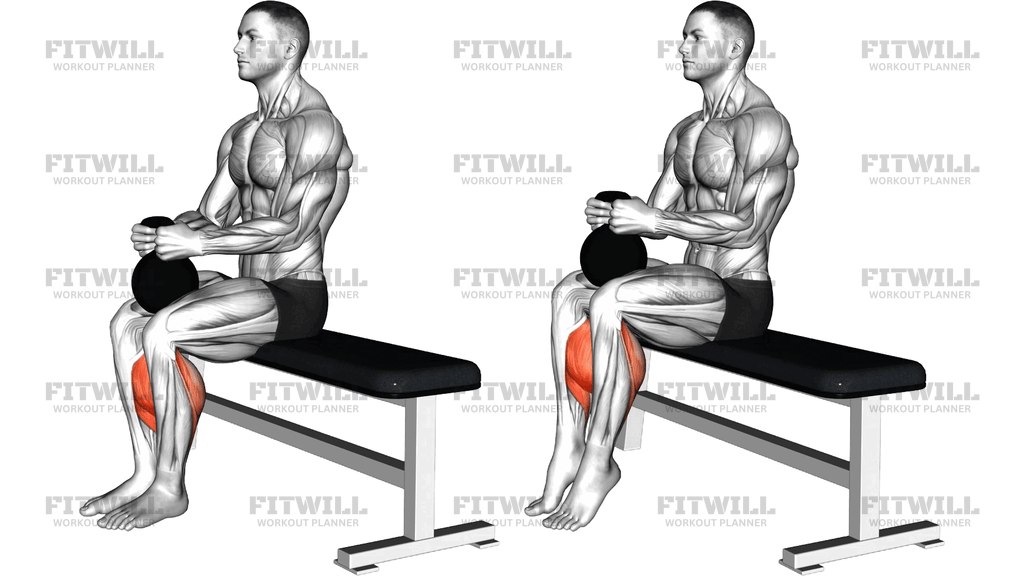
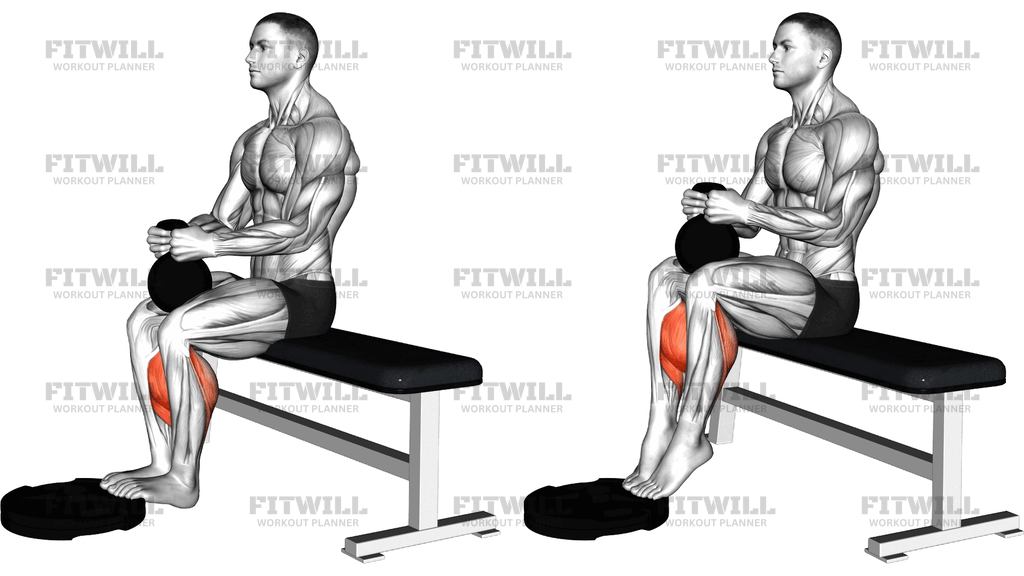
The Kettlebell Seated Calf Raise is a seated calf exercise performed on a flat bench with a kettlebell resting on your knees and the balls of your feet placed on a weight plate or other low, stable surface. Because your knees are bent at roughly ninety degrees, the gastrocnemius — the large two-headed calf muscle that crosses the knee joint — is placed in a shortened position, which shifts most of the work onto the soleus, the deeper calf muscle that sits beneath it and does not cross the knee.
This setup makes the movement a natural companion to standing calf raises rather than a replacement for them. If your goal is overall calf development, training the soleus directly matters: it makes up a large share of the calf's total muscle mass and is highly active in walking, running, cycling, and any sustained standing work. People who find standing raises limited by balance or by their gastrocnemius often get a better training stimulus from this seated version.
The equipment is deliberately simple. A flat bench supports your hips, a kettlebell loaded across the thighs supplies the resistance, and a plate under the forefoot lets your heels drop below toe level for a full stretch at the bottom and a complete plantar flexion at the top. Without that elevated surface your range of motion would be cut short, so it is worth taking a moment to set up properly.
Execution is straightforward but easy to rush. Sit tall on the bench with the kettlebell held steady on your knees, position the balls of both feet on the edge of the plate so the heels hang free, and drive up through the big toe side of the foot until you are as high on the toes as you can get. Pause briefly at the top, then lower the heels slowly toward the floor until you feel a distinct stretch in the calves before starting the next rep.
The most common faults are bouncing out of the bottom, letting the kettlebell slide off the thighs, and rolling the ankles outward to squeeze out extra height instead of pressing evenly through the forefoot. Keep the tempo controlled, use a weight you can hold steady for every rep, and stop the set when your form changes — the calves respond well to moderate loads performed through a full, honest range of motion.
[ Workout Log & Planner ]
Put your next workout in Fitwill
Keep your plan and training log ready when you are.


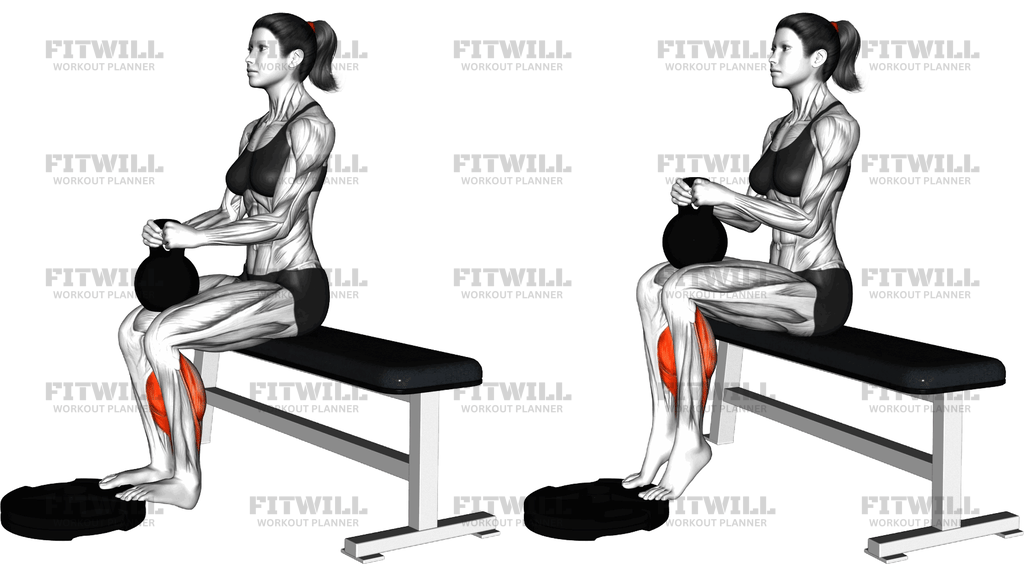
Instructions
- Sit on a flat bench with your feet flat on the floor and your knees bent at about ninety degrees.
- Place a weight plate or similar low, stable platform on the floor in front of you and set the balls of both feet on its edge so your heels hang off and can drop lower than your toes.
- Stand a kettlebell upright and rest it on your thighs just above the knees, holding the handle with both hands to keep it from sliding.
- Sit tall with your chest up and brace your trunk lightly so your torso does not round forward under the load.
- Press through the balls of your feet and drive your heels up as high as possible, keeping the pressure spread across the forefoot rather than rolling to the outside.
- Hold the top position for a moment with the calves fully contracted.
- Lower your heels in a slow, controlled motion until they drop just below the level of the plate and you feel a stretch through the calves.
- Breathe out as you press up and inhale as you lower the heels.
- Complete all reps with even pressure on both feet, then lift the kettlebell off your thighs and step your feet down off the plate to finish the set.
Tips & Tricks
- If the kettlebell digs into your thighs or slides around, place a folded towel or foam pad between the bell and your knees — discomfort there is the usual reason people cut sets short.
- Bouncing out of the stretched position is the most common fault in this exercise; the rebound takes work away from the soleus, so touch the heel down lightly and pause before the next rep.
- Check where the plate sits under your foot: too far under the arch shortens the range, too far onto the toes makes balance tricky. The edge of the plate should sit roughly under the ball of the foot.
- Do not let the heels drift to one side as you press up; crooked reps usually mean the load is too heavy or one calf is weaker than the other.
- Because the knees are bent, this movement targets the soleus more than the gastrocnemius — use moderate weight and higher reps rather than chasing maximal loads.
- Avoid shrugging or leaning back to help the weight up; your arms should only stabilize the kettlebell, and any trunk movement is a sign the set is done.
- A two-second pause at the top and a slow three-count lower make even a light kettlebell feel substantially harder.
- If a plate is not available, a low step or stacked mats can work, as long as the surface will not tip and your heels can drop freely below toe level.
Frequently Asked Questions
Which muscles does the Kettlebell Seated Calf Raise work?
The bent-knee position puts the emphasis on the soleus, the deep calf muscle, with the gastrocnemius assisting and the small stabilizers around the ankle working to keep the foot level.
Why do seated calf raises train a different part of the calf than standing raises?
The gastrocnemius crosses the knee, so bending the knee to about ninety degrees slackens it and reduces how much it can contribute. That is why the seated version leans heavily on the soleus.
Is the Kettlebell Seated Calf Raise suitable for beginners?
Yes. The bench provides stability, the range of motion is easy to see and feel, and you can start with a light kettlebell or even bodyweight only before adding load.
How heavy should the kettlebell be?
Choose a weight you can hold steady on your thighs for the entire set while still pausing at the top and lowering slowly. If the bell slides or your torso starts moving, it is too heavy.
What is the plate under the toes for?
It elevates the forefoot so the heels can drop below toe level, giving you a full stretch at the bottom and a longer range of motion than raising the heels from a flat floor.
What is the most common mistake in this exercise?
Bouncing through the bottom of the rep and rolling onto the outside of the feet to gain height. Both shorten the work the calves actually do — keep the tempo slow and the pressure even across the forefoot.
How many reps should I do?
Because the soleus is fatigue-resistant and responds well to volume, sets of roughly twelve to twenty controlled reps work well for most people.
Can I do the Kettlebell Seated Calf Raise one leg at a time?
Yes. Rest a single kettlebell or dumbbell on one thigh and work one calf at a time, which is useful for correcting a side-to-side strength difference.
Is it safe for my knees or ankles?
The knee stays fixed at ninety degrees and only the ankle moves, so the joint stress is low. If you have a recent ankle injury or feel sharp pain in the Achilles area at the bottom of the stretch, reduce the range or skip the exercise until it settles.