Resistance Band Seated Wide Row
The Resistance Band Seated Wide Row is a horizontal pulling exercise performed sitting on the floor with your legs extended and a resistance band looped around both feet. Unlike a close-grip row, the wide hand position spreads the band apart toward the ends, which shifts the emphasis toward the rhomboids, mid traps, and rear shoulders — the muscles responsible for pulling your shoulder blades together and keeping your posture upright.
This setup makes the movement a great choice for anyone who spends long hours sitting at a desk, since rounded shoulders and a slouched upper back usually trace back to weak scapular retractors. It also works well as a warm-up before heavier barbell or dumbbell rows, or as a standalone back exercise for home training where no cable machine or anchor point is available. Because your feet provide the anchor, the only equipment you need is a single band.
Sitting on the floor with your legs straight out in front gives you a stable base and lets you set the band tension simply by shortening your grip or moving your hands closer to your feet. The wide grip changes the elbow path: your arms travel out to the sides rather than hugging your ribs, which is what distinguishes this from a standard seated band row. That wider elbow flare drives more of the work into the upper back and rear shoulders and less into the lats.
Execution is straightforward but deserves attention to detail. Keep your torso tall and nearly upright, pull the band toward your lower chest with your elbows high and out, and finish by squeezing your shoulder blades together. The band should not be yanked with your arms alone — think of your hands as hooks and let your shoulder blades do the pulling. Return with control so the band's tension stays on your muscles rather than snapping your shoulders forward.
A few practical points will keep this exercise productive. Choose a band that lets you complete 10 to 15 clean reps without your torso rocking backward, and keep your knees soft rather than locked. If the band feels loose at the start, wrap it once around your hands or grip closer to your feet to remove the slack. Stop the set if you feel the pull shifting into your neck or lower back, since that usually means the tension is too heavy or your posture has drifted.
[ Workout Log & Planner ]
Put your next workout in Fitwill
Keep your plan and training log ready when you are.


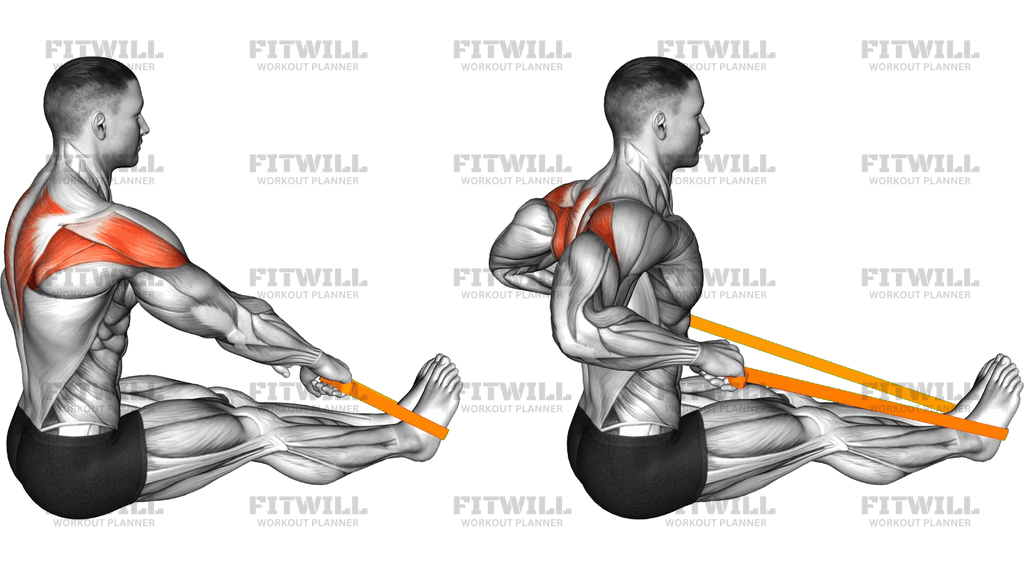
Instructions
- Sit on the floor with your legs extended straight in front of you and your feet flexed upward, about hip-width apart.
- Loop a resistance band around the soles of both feet and cross the ends in your hands so you hold the band wider than shoulder-width, one end in each hand.
- Sit tall with your chest up, shoulders back, and a slight natural arch in your lower back; let your knees stay soft instead of locking them.
- Brace your core lightly to keep your torso from leaning back as the tension increases.
- Start with your arms extended and mild tension on the band, hands held wide and in line with your feet.
- Pull the band toward your lower chest by driving your elbows out and back, keeping them above forearm height.
- At the end of the pull, squeeze your shoulder blades together and hold the contracted position for a brief pause.
- Slowly extend your arms forward to the starting position, resisting the band's pull rather than letting it snap you back.
- Exhale as you pull the band in and inhale as you return your arms forward.
- Complete your reps, then release the band from your feet carefully so it does not snap back toward your face.
Tips & Tricks
- If the band feels slack even with straight arms, wrap an extra loop around each hand or grip closer to your feet — a wide row only works when there is tension before you start pulling.
- Keep your elbows flared out wide; if they drop down toward your ribs, the exercise turns into a standard lat-focused row and you lose the rear-shoulder and upper-back emphasis.
- Avoid leaning your torso backward to help complete the pull. If your chest starts tipping away from your legs, the band is too heavy or you are rushing the reps.
- Do not shrug your shoulders up toward your ears as you pull — keep them pressed down so your mid traps and rhomboids do the work instead of your upper traps and neck.
- Picture pinching a pencil between your shoulder blades at the top of each rep rather than simply bending your elbows.
- Keep your wrists neutral and in line with your forearms; bent-back wrists are common when gripping the band too tightly.
- Move your hands slightly higher or lower along the band to fine-tune resistance without switching bands mid-set.
- Flex your feet firmly against the band so it cannot slip off your soles, especially near the stretched position where tension is highest.
- Slow the return portion down deliberately — the eccentric is where most of the upper-back muscle work happens in band rows.
Frequently Asked Questions
What muscles does the Resistance Band Seated Wide Row work?
It primarily targets the rhomboids and mid traps of the upper back, with strong involvement from the rear shoulders. The biceps and forearms assist as you grip and pull the band.
Why use a wide grip instead of a narrow grip on this seated row?
The wide grip makes your elbows flare outward, which shifts the pull away from the lats and toward the rhomboids, mid traps, and rear shoulders. A narrow grip with elbows tucked would emphasize the lats instead.
Is the Resistance Band Seated Wide Row good for beginners?
Yes, it is one of the safest ways to learn horizontal pulling because the resistance is smooth and self-limiting. Start with a light band and focus on squeezing your shoulder blades before adding tension.
How do I set up the band correctly for the Resistance Band Seated Wide Row?
Sit with your legs straight out, loop the band around the soles of both flexed feet, and hold the band wider than shoulder-width with one end in each hand. Flex your toes toward your shins so the band cannot slip off.
Why does my lower back feel the Resistance Band Seated Wide Row instead of my upper back?
That usually means your torso is rocking backward to generate momentum or your spine is rounding forward at the start. Sit tall with a braced core and reduce the band tension so your upper back, not your lower back, drives the movement.
What can I use instead of a Resistance Band Seated Wide Row if I have no band?
A cable machine with a wide-grip row handle or a seated cable row set wide gives a similar pull, and a bent-over dumbbell rear delt row is a close free-weight substitute. The band version is simply the most portable option.
How many reps and sets should I do of the Resistance Band Seated Wide Row?
Most people do well with 3 sets of 10 to 15 reps using a band that leaves the last two or three reps challenging. Because band tension drops off at the start of each rep, higher reps tend to feel more productive than very heavy, low-rep sets.
Should my legs stay straight during the Resistance Band Seated Wide Row?
Yes, keep your legs extended with a soft knee bend, as shown in the standard setup. The straight legs give the band a solid anchor and keep your torso upright, but do not lock your knees hard.
Is it safe to do the Resistance Band Seated Wide Row every day?
It is generally fine as a light daily posture exercise with an easy band, since the pulling muscles recover quickly from low-load work. If you are training it hard with heavy tension, treat it like any strength exercise and allow a day of recovery between sessions.
How do I make the Resistance Band Seated Wide Row harder without buying a heavier band?
Grip the band closer to your feet to remove slack, wrap it an extra loop around each hand, or pause for two seconds at the fully squeezed position. You can also slow the return portion to increase time under tension.