Cable Unilateral Step Up
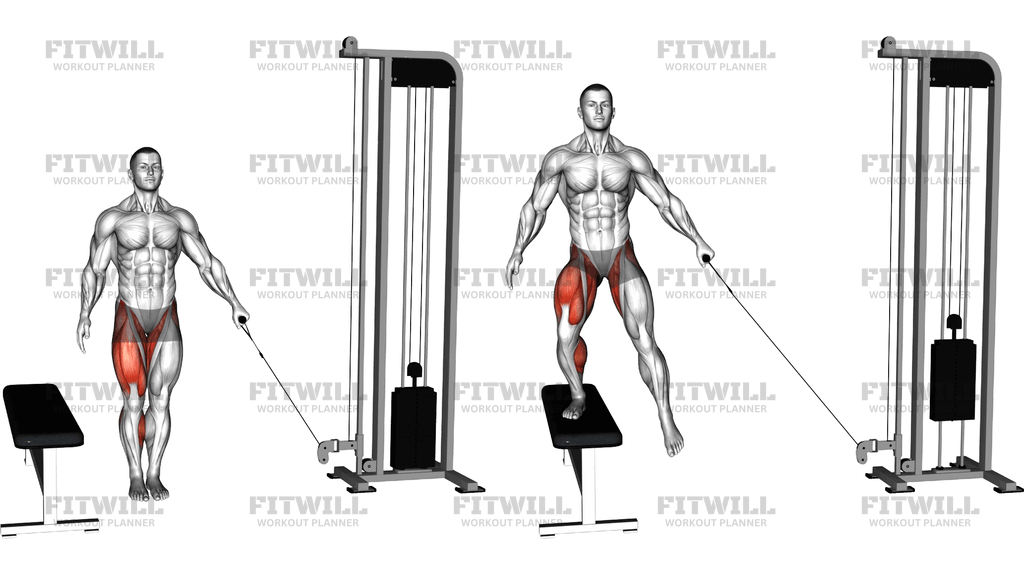
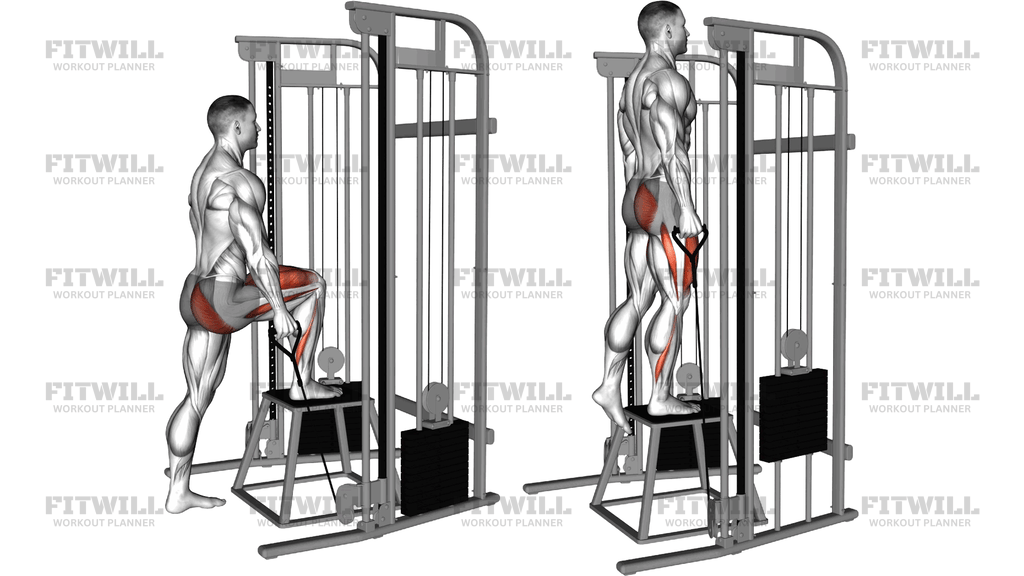
The Cable Unilateral Step Up is a single-leg strength exercise performed with a low pulley cable and a sturdy step platform. You stand facing away from the machine, hold the attached handle in one hand at your side, and drive one foot up onto the box until that leg is fully extended, then lower back down under the cable's constant tension. Because the resistance comes from a cable rather than a barbell or dumbbells, the pull stays smooth and vertical through the entire range, which makes it easier to keep your torso upright and your balance honest.
This movement trains the quads and glutes of the stepping leg as the primary drivers, with the calves assisting at the top of the step. The trailing leg and trunk work hard in a stabilizing role, and the single-sided loading challenges each hip to produce force without help from the other side. That makes it a practical tool for exposing and correcting side-to-side strength differences that bilateral lifts like squats can hide.
The setup matters more than most people expect. The cable should run from a low pulley down to a handle held at your side, not strapped to your body, so the added load pulls straight down and increases the demand on the stepping leg. Box height determines the emphasis: a lower box biases the quads, while a higher box that brings your thigh to at least parallel with the floor recruits more glute. Choose a height that lets you plant your whole foot flat and push through the middle of it.
Cable Unilateral Step Ups suit lifters who want leg work without heavy spinal loading, as well as runners, cyclists, and field sport athletes who need strong, independent legs. They also work well as an accessory after squats or deadlifts, or as a primary lower-body movement in a minimal-equipment session since a modest weight stack goes a long way on one leg.
Execute it by placing one foot fully on the platform, bracing your core, and driving that foot down to stand tall on the box without pushing off the trailing leg. Lower yourself slowly by bending at the hip and knee of the working leg until the trailing foot touches the floor. Keep the handle arm relaxed so it simply hangs and adds resistance rather than swinging. If you find yourself hopping, leaning hard toward the cable, or rocking sideways, the weight is too heavy or the box is too high.
[ Workout Log & Planner ]
Put your next workout in Fitwill
Keep your plan and training log ready when you are.


Instructions
- Set a sturdy step platform or box in front of a cable machine and attach a V-bar handle to the low pulley.
- Select a light weight to start, then stand facing away from the machine with the handle in one hand, letting your arm hang straight down at your side.
- Place one foot completely on top of the platform so your whole foot is flat, with the trailing foot on the floor slightly behind you.
- Brace your core and keep your chest tall, shoulders level, and gaze forward.
- Exhale and drive through the middle of the working foot to extend your hip and knee, standing fully upright on the box.
- At the top, squeeze the glute of the working leg and bring the trailing foot up beside it or hold it hovering, keeping your balance.
- Inhale and lower slowly by bending the working hip and knee until the trailing foot touches the floor, letting the cable's tension control the descent.
- Keep the handle arm relaxed and still throughout; it should hang at your side, not swing or pull.
- Complete all reps on one leg, then switch the handle to the other hand and repeat on the opposite leg.
Tips & Tricks
- Push through the whole foot, but focus on the heel and midfoot; driving off the toes turns the rep into a calf raise instead of a step up.
- Do not push off the trailing leg. Rest only the ball of that foot on the floor and keep the working leg doing the lifting.
- If your torso leans hard toward the cable or you twist at the hips, drop the weight. The cable should add vertical resistance, not pull you sideways.
- Tap the trailing foot down lightly between reps instead of loading it, or hover it just above the floor for a harder continuous set.
- Choose a box height where your thigh reaches parallel or slightly above without your heel lifting or your lower back rounding.
- Keep both hips square to the front. A common fault is letting the hip of the trailing side drop or rotate as you step up.
- Control the lowering phase for two to three seconds. The eccentric part is where most of the strength benefit lives, and rushing it usually causes the knee to cave inward.
- Grip the handle loosely. Squeezing it hard tends to tense the shoulder and pull you off balance.
- Do the weaker leg first and match the reps with your stronger leg so the imbalance does not grow.
Frequently Asked Questions
What muscles does the Cable Unilateral Step Up work?
The glutes and quads of the stepping leg do most of the work, with the calves assisting as you extend at the top. The hamstrings, hip stabilizers, and core also contribute to balance and control.
Is the Cable Unilateral Step Up good for beginners?
Yes, provided the box is low and the weight is light. Beginners often benefit from starting with bodyweight step ups to learn the pattern, then adding the cable once they can step up without pushing off the trailing foot.
Should I hold the cable handle in the same hand as the working leg or the opposite hand?
Either works, and holding it in one hand is part of the unilateral challenge. If balance is difficult, holding the handle on the working-leg side tends to feel more stable for most lifters.
Why use a cable instead of dumbbells for step ups?
A low pulley provides smooth, constant tension and lets the load hang at your side without gripping heavy dumbbells, which is easier on the grip and upper back. It also keeps resistance vertical even as you lean slightly during the step.
How high should the step platform be for the Cable Unilateral Step Up?
A height that puts your thigh at or just above parallel when your foot is flat on the box is a good default. If your heel lifts or you have to rock to get up, the box is too high.
My knee caves inward when I step up. How do I fix it?
Lighten the load and consciously drive your knee in line with your toes as you press up. Strengthening the glutes through this exact pattern usually resolves it over time.
How many reps and sets should I do?
Two to four sets of 6 to 12 reps per leg works well for strength and muscle. Higher reps with lighter weight are useful for muscular endurance and balance practice.
Can I substitute the Cable Unilateral Step Up if I have no cable machine?
Dumbbell or kettlebell step ups are the closest substitute. Holding one weight in a single hand preserves the asymmetric loading that makes this version valuable.
Is it safe for my knees?
When performed with a controlled tempo, a moderate box height, and a knee that tracks over the foot, it is a knee-friendly strength exercise. Stop and reassess your setup if you feel pinching or sharp discomfort.