Kettlebell Side Swing
The Kettlebell Side Swing is a hinged, one-arm swing variation in which the kettlebell travels in an arc to the side of the body instead of straight back between the legs. You set up in a hip hinge with a wide stance, hold the bell in one hand, and let the free arm reach out to the opposite side for counterbalance. As the bell swings out wide and across the midline, your hips, glutes, and hamstrings power the movement while the obliques and lats work hard to control the off-center load.
Because the bell never hangs directly under your shoulder, the pull on your torso is asymmetrical in every phase. That makes this version noticeably more demanding for the waist and mid-back than a standard two-arm or single-arm swing, even at lighter weights. The working shoulder also has to stay packed and stable as the arc changes direction, which builds useful strength around the shoulder blade.
Setup matters a lot here. A deep enough hinge, a braced trunk, and a stance wide enough to let the bell clear your knee are what separate a smooth side swing from a sloppy lower-back pull. The free arm reaching out is not just decoration; it shifts your center of mass so you can keep the spine neutral while the weight moves off to one side.
This movement suits lifters who already own a basic swing and want to challenge rotation control, and it fits well into conditioning circuits, sport preparation for throwing or striking athletes, and unilateral posterior chain work. Beginners can benefit too, but only after they have learned a clean hip hinge and a conventional swing first.
Execute it by hiking the bell back, letting it arc out wide to the side of the working leg, and snapping the hips forward so the bell floats up in front of you at roughly chest height. The return is just as important: track the bell back along the same arc, re-hinge, and keep the wrist neutral through the change of direction.
Practically, keep the weight modest when you first learn this. The sideways trajectory invites the bell to drift too far out or yank the shoulder forward, so err on the side of control and only progress the load once the arc feels repeatable on both sides.
[ Workout Log & Planner ]
Put your next workout in Fitwill
Keep your plan and training log ready when you are.


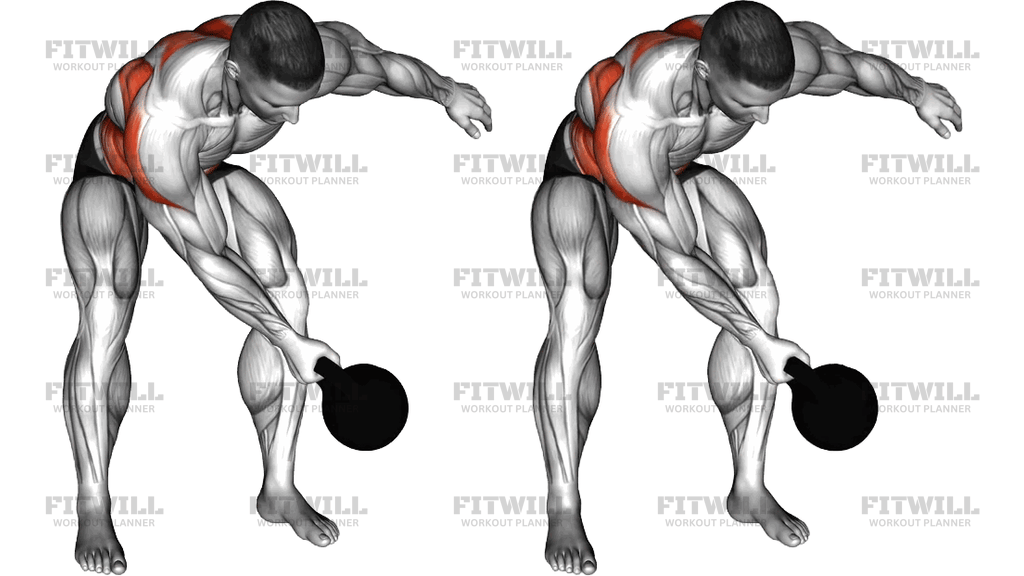
Instructions
- Stand with your feet noticeably wider than shoulder width, toes turned slightly out, so the kettlebell has room to travel outside the working leg.
- Hinge forward at the hips with a flat back and soft knees until your torso is angled down toward the floor, then grip the kettlebell handle in one hand with your arm hanging straight down.
- Extend your free arm straight out to the opposite side at about shoulder height to counterbalance the off-center load.
- Brace your trunk as if bracing for a light punch, and pull your shoulder blade down so the working arm stays connected to your torso.
- Hike the kettlebell back like a football snap, letting it swing in an arc out to the side of your body rather than straight between your legs.
- Snap your hips forward and squeeze your glutes so the bell swings up in front of you to roughly chest height, arm extended but not locked.
- Track the bell back down along the same wide arc, re-hinging at the hips and letting it pass outside the working leg.
- Exhale sharply as the hips snap forward, and inhale through the nose during the backswing.
- Complete all repetitions on one side, set the bell down between your feet, then switch hands and repeat on the other side.
Tips & Tricks
- If the bell smacks into the inside of your knee, your stance is too narrow or your hinge is too shallow; widen your feet and push your hips back further.
- A common fault is rotating the whole spine toward the bell on the backswing. Keep your chest facing the floor and let the rotation happen at the hips, not the lower back.
- Dropping the free arm mid-set changes your balance immediately. Hold it out at shoulder height for every rep so your torso stays square.
- If your working shoulder gets yanked forward at the top, you are muscling the bell with your arm. Drive harder through the hips and let the arm stay relaxed.
- Keep the wrist neutral instead of letting the hand flex back. A bent wrist under the sideways arc is a fast route to forearm fatigue and a sloppy release.
- Start with a lighter bell than your normal swing weight. The lateral arc changes the timing and the load on your waist more than most people expect.
- Do not let the bell drift into a straight front-to-back path halfway through the set. That means fatigue is setting in and your arc is collapsing.
- Film yourself from the side occasionally. It is easy to feel like you are hinged when your torso has quietly crept upright and the lift has become a squat.
- Chalk or a dry towel helps more here than on a standard swing, since the handle tends to rotate slightly in the hand as the bell moves across the body.
Frequently Asked Questions
Which muscles does the Kettlebell Side Swing work most?
The glutes and hamstrings drive the hip snap, while the obliques and lower back stabilize the torso against the sideways pull of the bell. The lats, grip, and front of the working shoulder also work to control the arc.
Is the Kettlebell Side Swing suitable for beginners?
Not as a first kettlebell exercise. Learn a solid hip hinge and a conventional swing first, then introduce the side swing with a light bell once your hinge is automatic.
Why does the free arm reach out to the side during the Kettlebell Side Swing?
The extended arm counterbalances the off-center kettlebell so your spine can stay neutral while the weight travels outside your midline. Pulling the free arm in usually causes the torso to twist or lean.
How is the Kettlebell Side Swing different from a regular swing?
The bell travels in a lateral arc around the side of the body instead of straight back between the legs, which places a rotating demand on the waist and makes the movement one arm at a time.
How heavy should the kettlebell be for the Kettlebell Side Swing?
Start roughly one or two sizes lighter than your regular swing bell. The sideways trajectory and single-arm hold make the same weight feel much less stable.
Should my knees bend much during the Kettlebell Side Swing?
Only slightly. This is a hip hinge, not a squat, so most of the movement comes from pushing the hips back while the knees stay softly bent.
Can I use the Kettlebell Side Swing for conditioning?
Yes, timed sets or intervals work well once your technique is consistent. Alternating sides each round also balances out the workload between left and right.
What should I do if my lower back feels strained during the Kettlebell Side Swing?
Stop and check two things: whether you are truly hinging at the hips instead of rounding, and whether the bell is yanking you into rotation on the backswing. Reduce the weight and slow the tempo before continuing.
What can I substitute if I do not have a kettlebell for the Kettlebell Side Swing?
A single dumbbell held by one end can mimic the arc reasonably well. A cable or band set low at your side can also train the same hip-drive and anti-rotation pattern.