Superman Pulse
Superman Pulse is a bodyweight posterior chain exercise performed lying face down on a mat with your arms stretched straight overhead and legs extended behind you. Instead of holding a static superman position, you lift your chest, arms, and thighs off the floor and then make small, rhythmic pulses at the top of the lift. Those quick, controlled pulses keep constant tension on the muscles along your spine, your glutes, and the backs of your thighs, which is what separates this variation from the standard hold.
This movement is a solid choice for anyone building foundational lower back strength, whether you sit for long hours, are returning to training after a layoff, or want accessory work to support deadlifts, squats, and hip hinges. Because it requires no equipment beyond a mat and loads the spine only through your own bodyweight, it is accessible to beginners while still challenging enough for experienced lifters who need higher-repetition posterior chain work.
The primary muscles working are the erector spinae, which run up both sides of your spine and extend your torso. Your glutes and hamstrings drive the leg lift, while your upper back, rear shoulders, and even your deep core contribute to stabilizing the whole extended position. The pulsing action keeps these muscles under continuous tension rather than letting them relax between repetitions, so the demand is more about endurance and control than raw strength.
Setup matters more than most people expect. Lying with arms and legs fully lengthened creates a long lever on both ends of your body, which means any arching through the lower back or craning of the neck gets amplified. Keep your spine in one long line, reach actively through your fingertips and heels rather than just lifting, and let the lift come from your mid back and hips instead of forcing your head up.
To execute the pulse well, raise into the superman position, pause briefly at the top, and then pulse upward a few inches in a steady rhythm, breathing continuously rather than holding your breath. Keep the pulses small; height is not the goal, tension is. Lower fully between sets rather than dropping out of the position abruptly.
If you feel the work shifting into your neck or lower back joints rather than the muscles alongside your spine, reduce the range or pulse only the upper body or only the legs first. Superman Pulse pairs well with planks and bird dogs as a balanced core and back routine, and it works nicely as a finisher on lower body or back training days.
[ Workout Log & Planner ]
Put your next workout in Fitwill
Keep your plan and training log ready when you are.


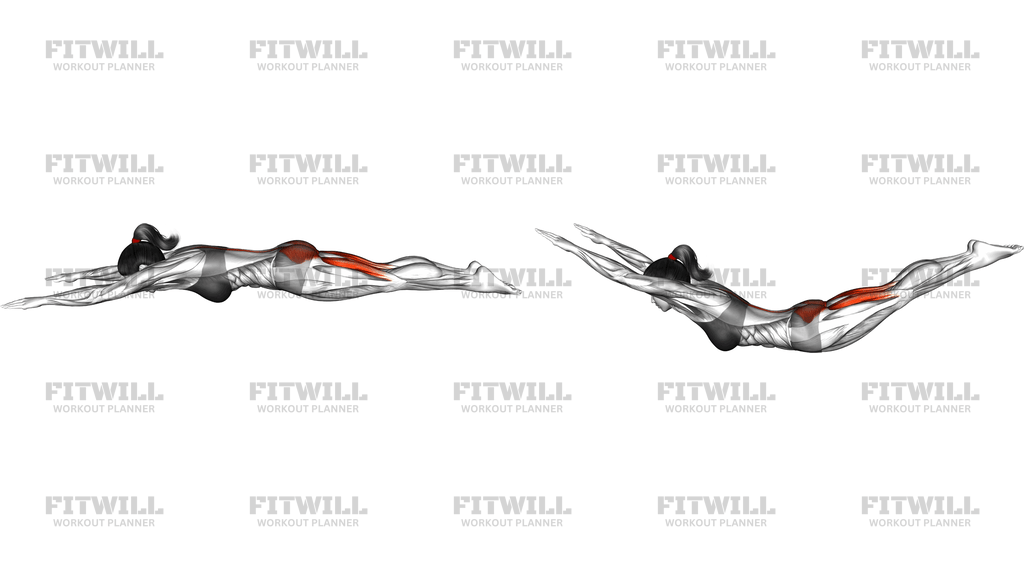
Instructions
- Lay an exercise mat on the floor and lie face down with your legs straight behind you and your arms extended straight overhead, palms facing each other.
- Point your toes away and reach your fingertips forward so your body forms one long line from hands to heels.
- Gently draw your shoulder blades down and back, rest your forehead lightly toward the mat, and brace your stomach slightly before moving.
- Exhale and lift your chest, arms, and thighs off the mat at the same time until you feel the muscles along your spine and in your glutes working.
- From that lifted position, perform small, quick pulses upward with your arms and legs together, moving only a few inches with each pulse.
- Keep your neck in line with your spine throughout; do not tilt your head back to gain height.
- Breathe steadily during the pulses, avoiding holding your breath as tension builds.
- Complete your target number of pulses, then lower your chest, arms, and legs back to the mat with control and rest briefly before the next set.
Tips & Tricks
- If your lower back feels pinched rather than worked, lift less aggressively into the initial position and make the pulses even smaller; the muscles alongside your spine should feel the effort, not the joints.
- Squeeze your glutes deliberately to drive the leg lift. When the glutes stay inactive, the hamstrings and lower back compensate and fatigue sets in unevenly.
- Avoid pushing off the floor with your hands between pulses. Once your chest and arms are lifted, your hands should hover and travel with your shoulders, not press down for help.
- Keep your reach long rather than chasing height. Active reaching through the fingertips and heels engages the upper back and glutes far better than lifting as high as possible.
- Watch for a fast, jerky pulse rhythm. If you cannot stay smooth, pause at the top and restart at a slower tempo instead of letting momentum take over.
- If holding the full position is too demanding, pulse only your upper body with legs down, or only your legs with hands under your forehead, and build up to the full version.
- Place a thin folded towel under your hip bones if lying flat on a hard floor is uncomfortable; discomfort at the pelvis usually causes people to tilt and arch unintentionally.
- Stop the set when your pulses start drifting sideways or your arms drop noticeably. Fatigue in this position usually shows up as lost alignment before it shows up as lost height.
Frequently Asked Questions
What muscles does the Superman Pulse work?
The erector spinae along your lower back do most of the work lifting your chest and arms, while your glutes and hamstrings lift and pulse the legs. Your upper back and rear shoulders help hold the arms overhead in the extended position.
How is the Superman Pulse different from a regular Superman hold?
A regular Superman is a static hold or a full lift-and-lower repetition, while the Superman Pulse uses small, rhythmic up-and-down movements at the top of the lift. This keeps the muscles under continuous tension and emphasizes endurance over single-effort strength.
Is the Superman Pulse safe for beginners with no lower back training history?
Yes, it is one of the most beginner-friendly lower back exercises because your bodyweight is the only load. Start with shorter sets and smaller pulses, and stop if you feel sharp or pinching sensations rather than muscle fatigue.
Why should my arms stay overhead during the pulses instead of at my sides?
Reaching overhead lengthens the lever your upper body has to lift, which increases the demand on the erector spinae and upper back. It also matches the long-line body position shown in the exercise, from fingertips to pointed toes.
How high should I lift my chest and legs in the Superman Pulse?
Only as high as you can lift while keeping your spine long and your neck neutral. A few inches of clearance with active reaching is enough; forcing extra height usually comes from arching the lower back or craning the head.
What should I do if my neck gets tired before my back does?
Keep your forehead angled slightly down and your gaze on the mat so your neck stays aligned with your spine. If fatigue continues, rest your forehead lightly against the mat between pulses or place a small folded towel under it.
Can I substitute the Superman Pulse if lying on my stomach is uncomfortable?
You can use a reverse hyperextension over a bench, a bird dog on hands and knees, or glute bridges to train a similar pattern. These put less direct pressure on the front of your body while still working the glutes and spinal support muscles.
How many pulses should I do per set?
Because this is an endurance-focused movement, sets of 20 to 40 small pulses or 20 to 30 seconds of continuous pulsing work well. End the set when your rhythm or alignment breaks down, not when height drops slightly.
Should I feel soreness in my lower back the next day?
Mild muscle soreness along both sides of your spine is normal when you are new to the movement. Sharp, one-sided, or joint-like discomfort is a signal to reduce your range, slow the tempo, and check that your glutes are doing their share of the lifting.