Standing Forward Bent Alternating Twist
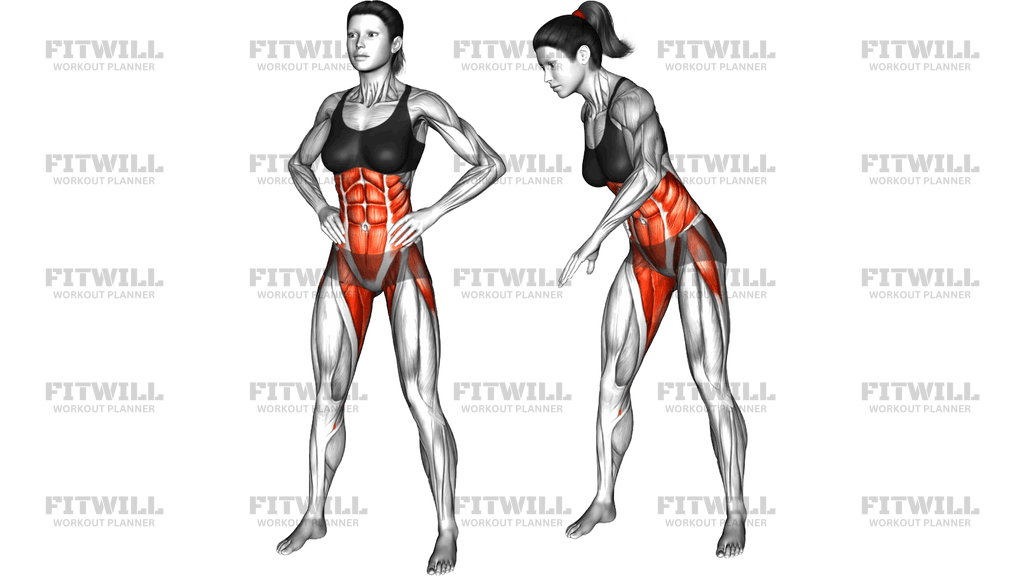
The Standing Forward Bent Alternating Twist is a body weight mobility drill that combines a wide-legged forward fold with a rotational reach of one arm toward the ceiling. You set up in a broad stance, hinge forward from the hips, plant one hand on the floor between or slightly ahead of your feet, and then rotate through the trunk to open the opposite arm and shoulder upward. After completing the reps on one side, you switch the planted hand and twist to the other direction, which is what makes it an alternating movement.
This drill earns its place in warm-ups and cooldowns because it hits several areas at once. The wide-leg hinge lengthens the hamstrings, inner thighs, and lower back, while the rotating reach mobilizes the thoracic spine and challenges the obliques to control and produce the turn. The shoulder of the reaching arm also works through a large range, which helps loosen the front of the shoulder and chest after sitting or pressing work.
Setup matters more than most people expect. A stance wider than shoulder width gives your hips room to fold without rounding the spine excessively, and soft knees protect the hamstrings if you are tight. Placing the supporting hand firmly on the floor with fingers spread gives you a stable base to rotate around; without that anchor, the twist tends to collapse into the lower back instead of coming from the mid-back and hips.
To execute it well, think of the rotation as a coil and unwind. As you reach one arm up, your eyes follow the hand, the supporting shoulder stacks roughly over the planted arm, and the twist comes from turning the ribcage, not just swinging the arm. Move at a pace you can breathe through, pausing briefly at the top of each reach, then lower the arm and re-square the torso before repeating or switching sides.
You will see this movement used in general warm-ups, martial arts and golf-style rotational prep, and post-workout mobility routines for the posterior chain. It needs no equipment and very little space, which makes it easy to slot into a home routine or a gym floor warm-up.
A few practical points keep it safe. If your hands cannot comfortably reach the floor, place them on a yoga block, a low step, or your shin rather than forcing the fold. Keep the rotation within a range where you can keep breathing normally, and avoid jerking the arm to force extra range. People with lower back sensitivity should favor smaller rotations with a stronger knee bend and a longer supporting arm reach instead of a deep fold.
Fitwill
Log Workouts, Track Progress & Build Strength.
Achieve more with Fitwill: explore over 9600 exercises with images and videos, access built-in and custom workouts, perfect for both gym and home sessions, and see real results.
Start your journey. Download today!




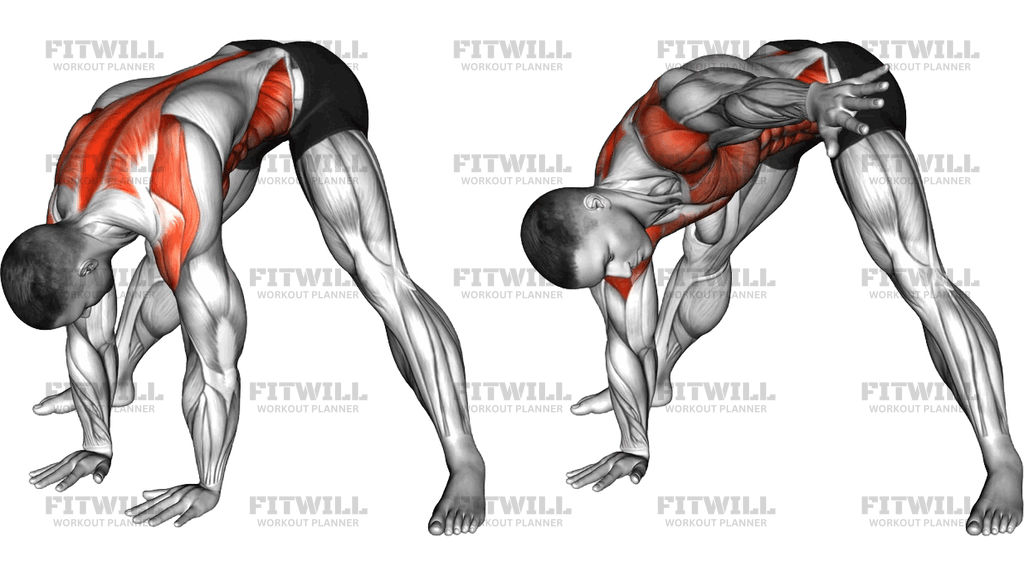
Instructions
- Stand with your feet roughly one and a half shoulder widths apart, toes turned slightly out, and weight spread across the whole foot.
- Hinge forward from the hips with a soft bend in both knees, letting your torso lower until you can place your right hand flat on the floor between or slightly in front of your feet, fingers spread.
- Let your head relax down between your arms so the neck stays long rather than craning upward.
- Brace the trunk lightly, then rotate your ribcage to the right as you sweep your left arm up and open toward the ceiling, eyes following the moving hand.
- Hold the twisted position for a beat at your end range, keeping the supporting arm straight and the hips level rather than letting one hip drop.
- Lower the left arm with control and re-square your chest toward the floor, completing the set number of twists on this side.
- Switch the planted hand to the left and repeat the same rotating reach with the right arm to work the opposite direction.
- Exhale as you rotate up and inhale as you return to the folded position, keeping the breath steady throughout.
- To finish, walk the hands slightly forward, bend both knees more deeply, and roll the torso up one vertebra at a time to stand back tall.
Tips & Tricks
- If the floor feels too far away, the fold is usually rounding the lower back instead of hinging at the hips. Bend the knees more or place the supporting hand on a block so the spine can stay long.
- A common mistake is twisting only at the arm. The reach should come from turning the ribcage, so imagine your chest rotating toward the ceiling before the hand starts to lift.
- Do not let the supporting shoulder sag toward the floor. Keep that arm straight and active, pressing the floor away, or the rotation loses its stable base.
- If the top arm swings back forcefully, you are using momentum. Slow the tempo and pause one to two seconds at the top of each twist to earn the range.
- Tight inner thighs often pull the knees inward during the fold. Actively press the knees slightly out over the toes to keep the hips open.
- Keep the hips fairly square to the floor. If one hip lifts and rotates with the arm, the twist is coming from the pelvis instead of the trunk.
- If your neck feels strained from looking up at the hand, follow the movement with your eyes only as far as is comfortable and let the rotation, not the head, lead the range.
- Breathe out fully at the top of each reach. Many people hold their breath in the twist, which makes the ribcage stiff and limits the turn.
Frequently Asked Questions
Which muscles does the Standing Forward Bent Alternating Twist work?
It primarily trains the obliques and the rotational mobility of the mid-back, with the supporting shoulder, traps, and lower back working to stabilize. The wide-leg fold also lengthens the hamstrings, inner thighs, and glutes.
Is the Standing Forward Bent Alternating Twist suitable for beginners?
Yes, as long as the range is scaled. Beginners can bend the knees generously and rest the supporting hand on a block or the shin until the floor is reachable without straining.
Why does one hand stay on the floor during the Standing Forward Bent Alternating Twist?
The planted hand is the anchor the whole rotation pivots around. Without that fixed point, the twist loses stability and tends to be produced by swinging the arm or collapsing the lower back.
Should my knees be straight or bent in the Standing Forward Bent Alternating Twist?
A soft knee bend is the better default. Straight legs increase the hamstring stretch, but bent knees let you hinge deeper from the hips and rotate with a longer, safer spine position.
What is the most common mistake in the Standing Forward Bent Alternating Twist?
Swinging the top arm for momentum instead of rotating the ribcage. This turns a controlled mobility drill into an uncontrolled fling and usually shows up as the hips twisting along with the arm.
Can I substitute the Standing Forward Bent Alternating Twist if I cannot reach the floor?
Yes. Place the supporting hand on a yoga block, a low step, or your shin, or perform the twist from a seated position with one hand planted beside your hip until hip and hamstring flexibility improves.
How many repetitions of the Standing Forward Bent Alternating Twist should I do?
Five to eight slow twists per side works well as a warm-up, or two to three holds of fifteen to twenty seconds per side if you are using it as a cooldown stretch. Keep the pace slow enough to breathe through each rep.
Is the Standing Forward Bent Alternating Twist safe for a sensitive lower back?
It can be, with modifications. Use a bigger knee bend, rest the hand on an elevated surface to reduce the fold, and keep the rotation within a range where the movement feels controlled and pain-free rather than forcing end-range turns.
When is the best time to use the Standing Forward Bent Alternating Twist in a workout?
It fits well as an early warm-up drill before rotational sports or lifting, and equally well as a cooldown to lengthen the posterior chain after leg day. Either way, keep the movements slow rather than ballistic.