Dumbbell Opposite Reverse Lunge From Deficit
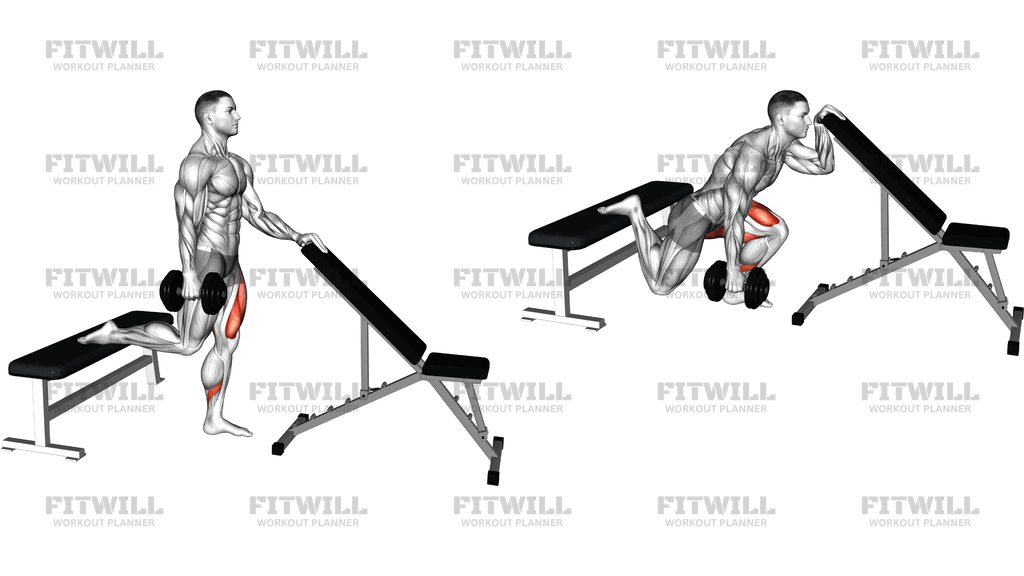
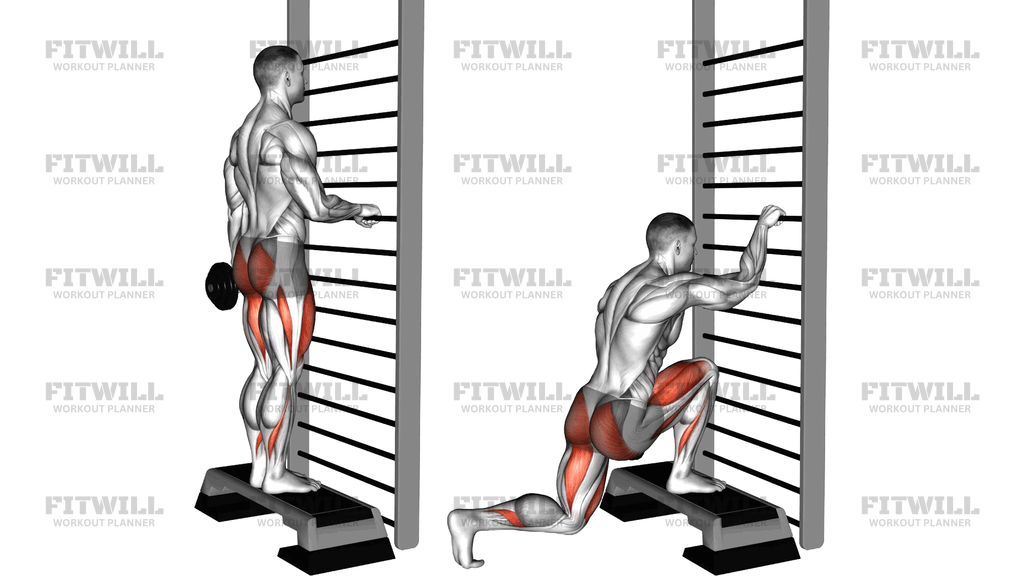
The Dumbbell Opposite Reverse Lunge From Deficit is a single-leg strength exercise performed with your front foot elevated on a step platform or low box while you step your other leg back off the edge and lower into a reverse lunge. You hold one dumbbell in the hand opposite your working leg and use your free hand to lightly grip a rack upright, wall bar, or other fixed support for balance. The deficit increases the depth of the lunge, which means the front knee travels through a longer range and the glutes and hamstrings of the front leg work harder at the bottom.
What makes this variation different from a standard reverse lunge is the combination of three challenges at once: the elevated front foot, the offset load in one hand, and the opposite-side hand support. Because the dumbbell sits on the side opposite the working leg, your hips and trunk have to resist side-to-side tilt throughout the rep. The light hand contact on the rack is there to keep you honest, not to carry your weight, so most of the work still lands on the front leg.
This movement is a good fit for intermediate lifters who want to load one leg at a time without the balance demands of a completely unsupported lunge. It is commonly used to bring up a weaker or less coordinated side, to add quad and glute volume without heavy spinal loading, and to build the deep knee and hip control that transfers to squats, split squats, and running and jumping activities.
Setup matters more here than in a floor-level lunge. Choose a step height of roughly 10 to 20 centimeters to start; the higher the platform, the more hip flexor and hamstring flexibility you need to reach the floor without rounding your lower back. Stand tall on the platform with your feet together, dumbbell hanging at your side in the opposite hand, and your other hand resting on the rack at about shoulder height. Your stance width and foot position on the platform should stay identical from rep to rep so the load distribution is consistent.
To execute the rep, shift your weight fully onto the front leg, step the free leg straight back off the edge, and lower until the rear knee touches or nearly touches the floor and the front thigh is roughly parallel to the platform. Keep your torso leaning slightly forward toward the support without collapsing through the midsection. Drive through the whole front foot, push the platform away, and return both feet to the top of the step before switching sides or repeating.
A few practical points will keep this exercise productive. Control the lowering phase for two to three seconds rather than dropping into the bottom, keep the front knee tracking over the toes without caving inward, and stop at a depth where your back stays neutral. If you find yourself pulling heavily on the rack or losing your balance at the bottom, reduce the weight or lower the step height before adding load.
[ Workout Log & Planner ]
Put your next workout in Fitwill
Keep your plan and training log ready when you are.


Instructions
- Place a step platform or low box next to a rack upright or wall bar, high enough that your hand can rest on it at about shoulder height while you stand on top.
- Hold one dumbbell in your left hand at your side and stand on the platform with both feet, then step your right foot forward to your working stance position and grip the rack with your right hand.
- Set your feet hip-width apart on the platform with your weight spread across the whole front foot and your toes gripping the edge lightly.
- Brace your core, lift your chest, and stand tall with your shoulders level before starting the rep.
- Shift all your weight onto the front leg and step your free leg straight back off the edge of the platform, reaching the ball of that foot toward the floor.
- Lower with control until your rear knee touches or nearly touches the floor and your front thigh is about parallel to the top of the platform, keeping your front knee lined up over your toes.
- Pause briefly at the bottom, keeping slight tension in the front leg rather than resting your weight on the rear knee.
- Drive through the entire front foot to push back up, bringing the rear leg back onto the platform until you are standing tall again.
- Exhale as you push up and inhale as you lower into the lunge, keeping your breathing steady throughout the set.
- Complete all reps on one side, then switch the dumbbell to the other hand, change your grip on the rack, and repeat on the opposite leg.
Tips & Tricks
- Do not let the hand on the rack do the lifting. Use it for balance only; if you are pulling yourself up, the dumbbell is too heavy or the step is too high.
- The most common mistake is letting the front heel lift off the platform as you descend. Keep weight across the whole foot so the knee stays stable at the bottom.
- Watch for the front knee caving inward as you lower, especially with the offset dumbbell pulling you to one side. Think about spreading the floor with your front foot.
- Reach the rear leg back rather than straight down. Stepping too close to the platform edge crowds the knee and turns the movement into a short, choppy lunge.
- If your lower back rounds when you reach full depth, the deficit is too aggressive for your current hip and hamstring mobility. Drop to a lower step before forcing depth.
- Keep the dumbbell arm long and quiet. Swinging or drifting the weight away from your body exaggerates the side-to-side tilt and steals stability from the working leg.
- Control a two to three second descent. The deep stretch position at the bottom is where much of the glute and hamstring work happens, and rushing past it wastes the deficit.
- Mark your front foot position with your eyes or keep it in the same spot every rep. Small changes in stance width change how the load is shared between quads and glutes.
- Start with a light dumbbell or body weight for your first session. The deficit plus offset load is harder than it looks, and depth control should come before load.
Frequently Asked Questions
What muscles does the Dumbbell Opposite Reverse Lunge From Deficit work?
The quadriceps and glutes of the front leg do most of the work, with the hamstrings contributing at the bottom of the deep range. The adductors, calves, and trunk stabilizers assist with balance and control, especially because the dumbbell is held on the opposite side of the body.
Why is the dumbbell held in the hand opposite the working leg?
The offset load forces your hips and core to resist sideways tilting, which increases the balance and stability demand. It also lets you use light hand support on the rack with the free side without interfering with the working leg.
How high should the step platform be for this exercise?
Start with 10 to 20 centimeters. A lower step lets you own the movement pattern and depth first; only raise the height when you can lower smoothly to the floor without your lower back rounding or your front heel lifting.
Can beginners do the Dumbbell Opposite Reverse Lunge From Deficit?
Beginners can, but it is better to start with a regular reverse lunge on the floor or a split squat first. Once you can control a full-depth lunge with good knee tracking, add the deficit and light hand support with little or no weight.
Is it okay to pull on the rack during the exercise?
Light fingertip contact for balance is fine, but if you are pulling yourself out of the bottom, you are offloading the front leg. Reduce the dumbbell weight or lower the step height until you can rise under your own leg strength.
Should the rear knee touch the floor?
Touching or hovering just above the floor marks full depth and works well if you control it. Do not slam the knee down or rest your weight on it at the bottom; keep tension in the front leg throughout the rep.
What is the most common mistake with this movement?
Stepping the rear foot too close to the platform, which turns the lunge short and shifts stress into the front knee. Reach the rear leg well back and drop the knee toward the floor so the front thigh reaches parallel.
What can I use if I do not have a step platform?
Any stable, low surface around 10 to 20 centimeters high works, such as a sturdy low box or stacked weight plates, as long as it cannot slide. You can also do the same offset reverse lunge from the floor to scale it down.
How do I stay safe doing the Dumbbell Opposite Reverse Lunge From Deficit?
Keep the depth within a range where your torso stays upright and your front knee tracks over your toes, use a non-slip platform, and stop the set when your balance starts to break down. Fatigue-related wobble is the usual point where form and knee position degrade.
How many reps and sets should I use?
Two to four sets of 6 to 10 reps per leg works well for strength, or 10 to 15 per leg with a lighter dumbbell for muscular endurance. Because balance is a limiter early on, leave a rep or two in reserve rather than training to failure.