Dumbbell Bulgarian Split Squat With Support
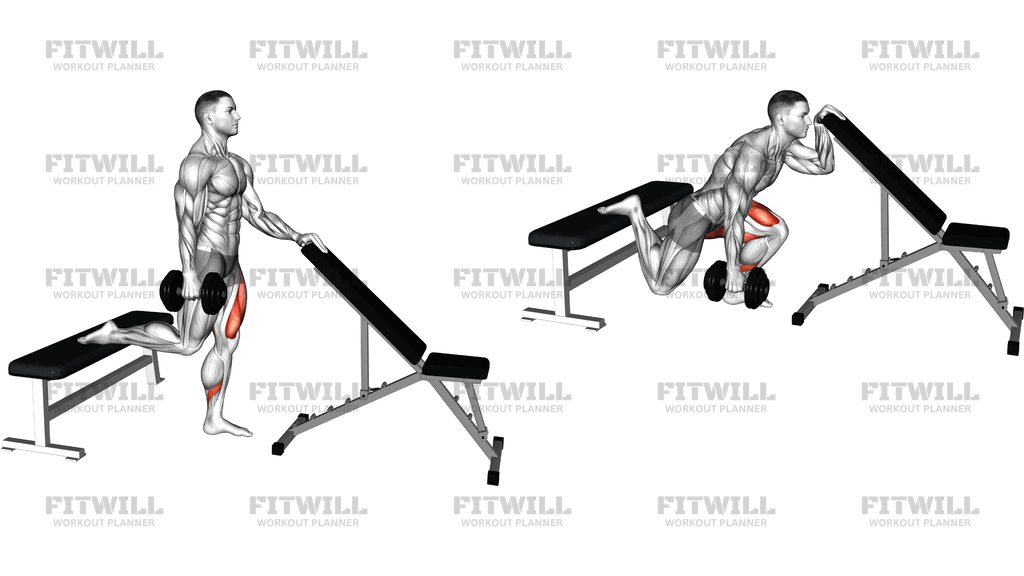
The Dumbbell Bulgarian Split Squat With Support is a rear-foot-elevated split squat performed with one dumbbell in the working hand and your free hand braced on an incline bench for balance. The back foot rests on a flat bench behind you, which shifts nearly all of the load onto the front leg. The added hand support makes this version noticeably more stable than the unsupported split squat, so you can focus on depth, knee tracking, and loading rather than fighting to stay balanced.
This exercise is one of the best single-leg strength builders available with minimal equipment. It targets the quadriceps of the front leg as the primary mover, with the glutes and hamstrings contributing as you descend and drive back up. Because the rear leg is elevated and largely unloaded, it works as a stabilizer only, which means you can train each leg hard without the weaker side hiding behind the stronger one. The gluteus medius on the standing leg also works hard to keep your hips level throughout the rep.
The hand support changes the character of the movement in a useful way. Bracing one hand on the bench lets you lean slightly forward and shift more load into the front leg's quads and hips, and it allows heavier dumbbells than you could handle trying to balance with two weights at your sides. It is especially valuable for lifters who find the traditional Bulgarian split squat wobbly, for anyone rehabilitating balance after an injury layoff, or for lifters who want to push a leg close to failure without balance being the limiting factor.
Setup matters more here than in most leg exercises. The distance between your front foot and the bench determines whether the movement leans quad-dominant (front foot closer, more knee travel) or glute and hamstring dominant (front foot farther out, more hip hinge). Your rear foot should sit laces-down on the bench at roughly shin height. Pick up the dumbbell with the hand on the same side as your working leg or the opposite hand, whichever feels steadier, and place your free hand on the incline bench at about chest height.
To execute it well, drop straight down rather than drifting forward, letting the front knee travel over or slightly past the toes while the torso leans a touch toward the supporting hand. Lower until your rear knee is close to the floor or your front thigh reaches at least parallel, then push through the whole front foot to stand back up. Keep the movement vertical and controlled, and keep your weight on the front leg for the entire set before switching sides.
As for safety, the elevated rear foot restricts ankle and hip mobility demands on the back leg, but the front knee still takes real load. Warm up with bodyweight reps first, keep the descent slow, and stop short of any pinching or twisting sensation at the front of the knee. Because you are holding a dumbbell on one side only, expect some anti-rotation work through your core, which is a bonus but also a reason to keep the torso square rather than letting it rotate toward the weight.
[ Workout Log & Planner ]
Put your next workout in Fitwill
Keep your plan and training log ready when you are.


Instructions
- Place a flat bench behind you and set the top of your rear foot on it laces-down, at about shin height.
- Step your front foot forward until you can lower into a split squat without the front heel lifting; a distance of roughly two to three feet from the bench works for most people.
- Hold a dumbbell in one hand at your side with a neutral grip, and place your free hand on the top of an incline bench in front of you at about chest height for support.
- Stand tall, brace your core, and square your hips so they point forward, then shift your weight fully onto the front leg.
- Inhale, then lower your hips straight down by bending the front knee, letting the torso lean slightly toward the supporting hand while the rear knee descends toward the floor.
- Continue down until your front thigh is at least parallel to the floor or your rear knee nearly touches the ground, keeping the front heel flat.
- Exhale and drive through the entire front foot to extend the knee and hip, returning to the top without locking the front knee hard.
- Complete all reps on one leg, keeping the rear foot on the bench and the hand on the support for the whole set.
- Switch the dumbbell to the other hand, place the opposite hand on the bench, and work the other leg.
- Step the rear foot off the bench carefully and reset your stance between sets.
- Rest the dumbbell on the floor between legs and re-grip before starting the next set.
Tips & Tricks
- If your front knee caves inward as you descend, think about spreading the floor with your front foot and tracking the knee over your second toe.
- A set with the front foot too close to the bench will feel like it crunches the knee; move the front foot a few inches farther out until the bottom position feels smooth.
- Do not let the supporting hand push you up out of the bottom. It is there for balance, so keep it light and let the front leg do the work.
- Keep your hips square to the front. A common mistake is letting the hips rotate open toward the bench behind you, which shortens the range on the working glute.
- If you feel the rear knee jamming at the bottom, place a folded mat under it or reduce your depth slightly rather than bouncing off the floor.
- Start with a lighter dumbbell than your split squat one-rep logic suggests, since the single-sided load and the lean toward the support hand both add difficulty.
- Keep the rear foot relaxed on the bench. Actively driving off the back foot steals work from the front leg and turns the rep into a lunge.
- Pause for one to two seconds in the bottom position on your lighter sets to reinforce control before adding load.
- If the top of the rear foot hurts on the bench pad, slide it back so the toes hang off the edge and only the shin rests on the pad.
Frequently Asked Questions
Which muscles does the Dumbbell Bulgarian Split Squat With Support work?
The quadriceps of the front leg do most of the work, with strong contributions from the glutes and hamstrings, especially at deeper depths. The adductors and calves of the front leg assist, and the core works to resist the rotation caused by holding the dumbbell on one side.
Is the hand support on the bench cheating?
No, it is a deliberate setup choice. The support removes balance as the limiting factor so you can load the front leg harder and with better depth, but keep the hand contact light so the working leg still does the lifting.
Should I hold the dumbbell in the hand on the same side as my working leg or the opposite side?
Holding it in the opposite hand is slightly more natural for most people and balances the lean toward the supporting hand. Same-side loading shifts a bit more stress into the working glute. Try both and use whichever lets you keep your torso square and your heel down.
How far should my front foot be from the bench?
A good starting point is about two to three feet, roughly one shin length plus a foot. Closer emphasizes the quads with more knee travel, farther emphasizes the glutes and hamstrings. Adjust until your front heel stays flat and the knee tracks smoothly.
My rear knee hurts when it gets close to the floor. What should I change?
Put a folded mat under the knee or stop the descent just above the floor. Also check that your rear foot is not sliding on the bench, which changes the knee angle at the bottom.
Can beginners do the Dumbbell Bulgarian Split Squat With Support?
Yes, and the supported setup makes it one of the more beginner-friendly ways to learn single-leg squatting. Start with bodyweight or a very light dumbbell, use a slightly shallower depth, and add load once your balance and knee tracking are consistent.
How is this different from a regular Bulgarian split squat with two dumbbells?
With one dumbbell and a hand on a bench, you trade some demand on balance for the ability to use heavier load and a more deliberate forward lean. The unsupported two-dumbbell version trains stability harder, while the supported version is better for pure leg strength and volume.
What can I use if I only have one bench?
Set the rear foot on the bench and brace your free hand on a sturdy rack upright, railing, or the same bench if its height and position allow. Any stable surface around chest height works as the support.
How deep should I go on each rep?
Aim for your front thigh reaching parallel to the floor or your rear knee coming within a few inches of the ground. Go deeper only if you can keep the front heel down and the knee tracking in line without discomfort.
Is it safe for the front knee?
When loaded progressively and performed with the heel down and the knee tracking over the toes, it is a well-tolerated exercise for most healthy lifters. Warm up with bodyweight reps, control the descent, and avoid pushing through sharp pinching or twisting sensations.