Weighted Flutter Kicks
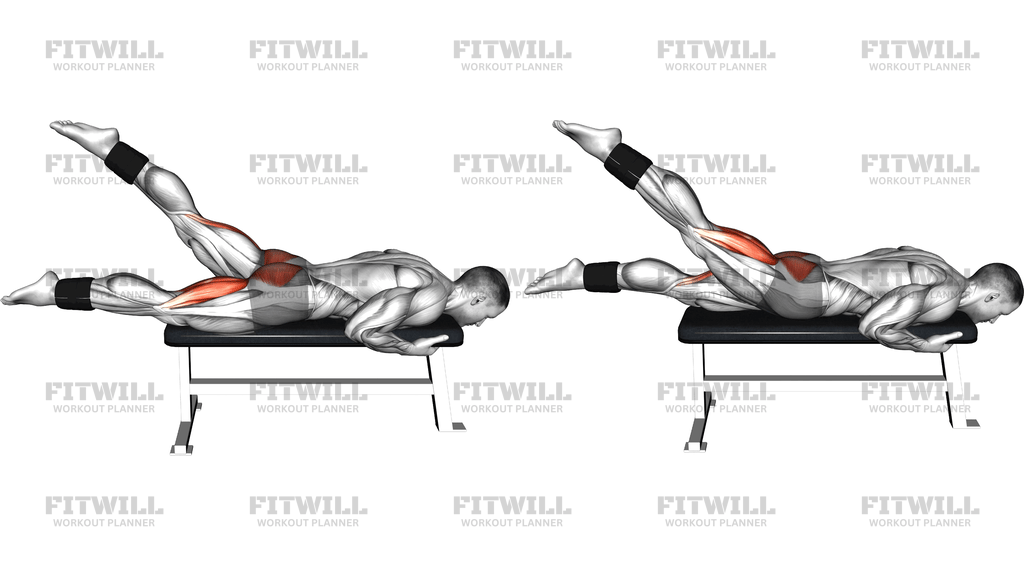
Weighted Flutter Kicks are a prone hip extension exercise performed face down on a flat bench with ankle weights strapped on. Instead of the familiar supine version that targets the abs, this variation has you lying on your stomach with your hips at the edge of the bench and your legs free to move behind you. From there you alternate raising one leg and then the other in a steady fluttering rhythm, driving each lift with the glutes and hamstrings rather than swinging from the lower back.
The added ankle weight is what separates this from the bodyweight version. Because the load sits at the end of a long lever, even a modest cuff dramatically increases the demand on the gluteus maximus and hamstrings through hip extension. The erector spinae and deep trunk muscles also work isometrically the entire time to keep your torso anchored to the bench and stop your chest or pelvis from rocking with each kick.
This movement is especially useful for anyone whose glutes struggle to fire during bigger lifts. Squat and deadlift warm-ups, posterior chain accessory work, and rehabilitation-style glute activation all benefit from it. It is also a smart choice for people who find standing hip extension or bridge variations uncomfortable, since the bench supports the torso and removes balance from the equation. Because each leg works independently, it will quickly expose a stronger side and help you iron out left-right differences.
Setup matters more than it looks. Your hip bones need to sit right at the edge of the bench with the legs hanging free, and your grip on the bench should be firm enough to keep your torso still. If your hips slide back onto the padding, your range of motion gets cut off; if you drift too far forward, your lower back takes over the movement. A pad under the hip crease can make longer sets more comfortable.
Execution should look like a controlled kick, not a race. Lift one leg by squeezing the glute on that side until the thigh is clearly extended behind you, lower it with control, and let the other leg take its turn. Keep the knee mostly straight but not locked, point the working effort into the hip rather than the foot, and keep both ankles weighted evenly. Breathing stays rhythmic throughout, and the set ends when your form starts to break, not when your legs stop moving.
Keep the weight conservative at first. The flutter pattern is fast enough that momentum can quietly replace muscular work, and too much ankle load turns the exercise into a lower back swing. Start light, own the tempo, and only add load when every rep looks identical to the first.
[ Workout Log & Planner ]
Put your next workout in Fitwill
Keep your plan and training log ready when you are.


Instructions
- Secure an ankle weight or weight-loaded ankle strap around each ankle so both cuffs sit snugly above the ankle bone and cannot slide during the set.
- Lie face down along a flat bench with the pads supporting you from your chest to your hip crease, so both legs hang completely free from the hip down.
- Grip the sides or legs of the bench firmly with both hands and rest your face comfortably toward the padding, keeping your neck in line with your spine.
- Brace your trunk lightly and tuck your pelvis so your lower back is long rather than arched before your legs start moving.
- Begin with both legs hanging at or just below bench height as your starting position.
- Squeeze the glute of one leg and raise it behind you until the thigh is clearly extended above your torso line, keeping the knee straight but soft.
- Lower that leg under control while the opposite leg begins its lift, creating a continuous alternating flutter with one leg always on the way up.
- Exhale on each upward kick and inhale as the leg lowers, keeping the breathing steady rather than holding your breath.
- Continue alternating for your target number of reps or time, then stop, sit up slowly, and remove the ankle weights while seated.
Tips & Tricks
- The most common fault is arching the lower back to gain leg height. If your chest lifts off the bench as your leg rises, the weight is too heavy or you are chasing range at the expense of your spine.
- Aim the effort into your hip, not your foot. Kicking forcefully from the ankle turns the set into a knee and calf flick instead of a glute-driven hip extension.
- Keep your hip bones anchored at the very edge of the bench. If your hips creep back onto the padding mid-set, your working range shortens and the glute stops driving the lift.
- Match the tempo on both legs. A fast leg paired with a slow one usually means one side is compensating for the other, so count your reps per leg or work by time instead.
- Do not lock the working knee hard at the top. A rigid knee shifts tension away from the hip and can strain the back of the knee under the cuff's load.
- Let the descending leg control its way down rather than dropping. The lowering half is where the hamstrings contribute most, so dumping it wastes half the exercise.
- If the bench edge digs into your hip crease, fold a small towel or pad under the front of your hips rather than shifting position to escape the pressure.
- Start with 1-2 kg per ankle. Because the weight sits at the end of a long leg lever, a light cuff already feels heavy by the end of a thirty-second set.
- Squeeze the working glute deliberately at the top of each kick for a beat if your legs are moving but you feel nothing in your hips.
Frequently Asked Questions
Which muscles do Weighted Flutter Kicks work?
The gluteus maximus and hamstrings drive each leg lift, making the glutes the primary mover. Your lower back and deep core muscles work isometrically to hold your torso steady on the bench throughout the set.
Why perform Weighted Flutter Kicks face down on a bench instead of lying on your back?
The prone position turns the flutter pattern into a hip extension exercise, so it targets the glutes and hamstrings rather than the abs. The bench also supports your torso, which removes balance demands and lets you focus purely on driving the legs.
Can beginners do Weighted Flutter Kicks?
Yes, but start without ankle weights or with very light cuffs until the alternating rhythm feels smooth. The hip position on the bench is identical either way, so learning the pattern unloaded first is the safest route.
How much ankle weight should I use for Weighted Flutter Kicks?
Most people do well starting with 1-2 kg per ankle. Because the load sits at the end of a long lever, small increases feel significant, and too much weight usually causes lower back arching rather than better glute work.
Where exactly should my hips be on the bench?
Your hip bones should rest right at the edge of the bench so both legs hang completely free from the hip crease down. If your hips are fully on the padding, your legs cannot extend behind you properly; if you slide too far forward, your lower back starts compensating.
My lower back aches after Weighted Flutter Kicks. What am I doing wrong?
You are most likely arching to gain leg height or letting your pelvis tilt with each kick. Reduce the weight, shorten the range on each kick, and consciously brace your trunk so the movement comes from the hip joint only.
How fast should the flutter be?
Aim for a controlled, even rhythm where each leg lifts and lowers on purpose, roughly one kick per second or slightly slower. Speed that outruns your control means momentum is doing the work your glutes should be doing.
What can I use instead of an ankle strap for Weighted Flutter Kicks?
A cuff-style ankle weight works exactly the same way, and if neither is available you can do the movement unweighted or hold a light dumbbell between your feet. The bench and body position stay the same in every version.
Should my knees stay straight during Weighted Flutter Kicks?
Keep them essentially straight with only a slight soft bend, never locked. Bending the knees deeply shifts the work toward the hamstrings' knee function and shortens the lever your glutes are moving.
How do Weighted Flutter Kicks fit into a workout?
They work well as a glute activation drill before squats or deadlifts, or as a finishing move after your main posterior chain work. Two to three sets of 20-40 seconds per set is a practical starting dose.