Weighted Lying Leg Raise Flat Bench
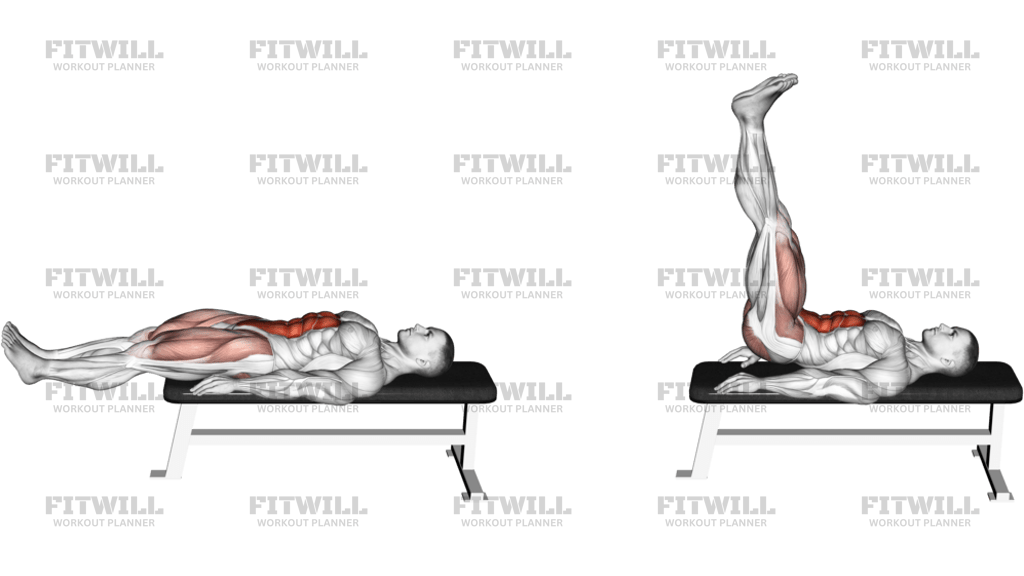
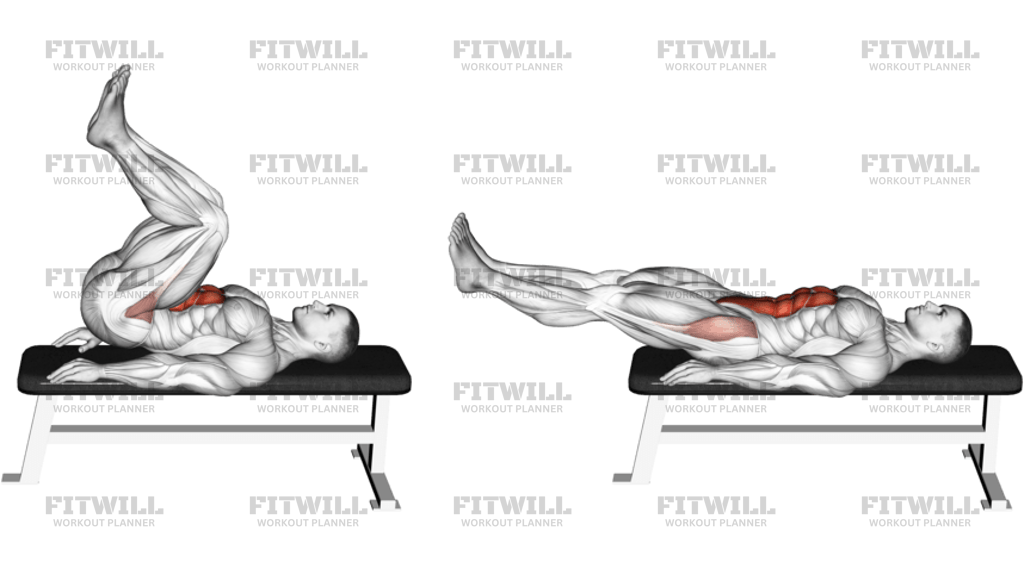
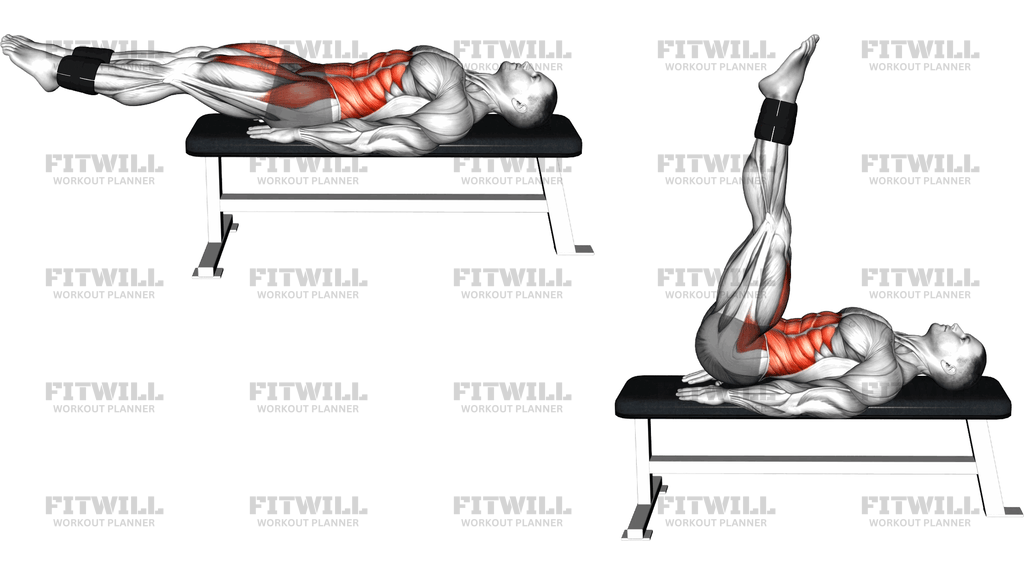
The Weighted Lying Leg Raise Flat Bench is a core exercise performed while lying flat on your back on a standard exercise bench, with a weighted ankle strap secured around both ankles. From there, you raise your straight legs up until they point toward the ceiling, then lower them back down under control. The added load at the ankles makes the movement noticeably harder than the bodyweight version and lets you progress it like any other strength exercise.
This movement targets the lower portion of the rectus abdominis, with strong assistance from the hip flexors, which lift the legs. Because your torso is fixed on the bench and your arms brace you against the sides, the work stays concentrated in the trunk and hips rather than spreading out through the whole body. The deep core also works continuously to keep your lower back from arching off the bench as the legs move.
The setup matters more here than in most ab exercises. Lying on a bench lets your legs hang past the end at the start, which increases the range of motion and means the hips must control the weight through a longer arc. Gripping the bench behind or beside your head anchors your upper body so that when the legs rise, the pelvis can curl slightly upward instead of the whole body shifting.
To perform it well, press your head, shoulders, and hips firmly into the bench, brace your abdominal wall before the first rep, and think of lifting the legs by pulling the hips into flexion rather than just swinging the feet upward. At the top, the legs should be roughly vertical with the glutes slightly off the bench if you are curling the pelvis. On the way down, fight the descent so the legs lower slowly rather than dropping, stopping just before the lower back feels like it is being pulled into an arch.
This exercise suits lifters who have outgrown bodyweight leg raises and want a measurable way to add load, as well as anyone training the midsection with low reps for strength rather than high reps for endurance. It appears in core blocks for strength sports, in general ab training two to three times per week, and as a progression before attempting hanging weighted leg raises.
Because the weight sits at the ankles and the lower back is loaded through a long lever, start light and treat technique as the priority. If your back arches or your hips rock, reduce the load before anything else. Done with control, this is one of the most demanding and productive weighted abdominal movements available with minimal equipment.
[ Workout Log & Planner ]
Put your next workout in Fitwill
Keep your plan and training log ready when you are.


Instructions
- Lie flat on your back on a flat bench with your head, shoulders, and hips in full contact with the pad and your legs extended straight past the end of the bench.
- Secure a weighted ankle strap around both ankles, snug enough that it will not slide during the set, and let your legs hang straight so the weight rests below the level of the bench.
- Reach your arms alongside your torso and grip the edges of the bench behind or beside your hips to lock your upper body in place.
- Brace your abdominal wall and press your lower back down toward the bench before starting the first rep.
- Exhale as you raise your straight legs up in a smooth arc until they are roughly vertical over your hips, letting your pelvis curl a few degrees off the bench at the very top.
- Pause briefly at the top with the legs stacked over the hips and the abs squeezed.
- Inhale as you lower the legs back down in a slow, controlled arc, resisting the weight the entire way and stopping before your lower back arches off the bench.
- Without resting the legs or bouncing, begin the next rep from that controlled hang position.
- When the set is finished, use your hands to help guide the legs down safely, then unclip the ankle strap before stepping off the bench.
Tips & Tricks
- If your hips rock or your heels drop toward the floor mid-set, the ankle weight is too heavy; the most common failure point in this exercise is load, not effort.
- Keep a slight, natural bend in the knees if your hamstrings feel tight and pull your legs off the ideal arc—forcing perfectly straight legs often shortens the range instead of improving it.
- Think about pulling your hips upward at the top rather than just pointing your feet at the ceiling; the pelvic curl is what separates an abdominal leg raise from a hip flexor lift.
- Do not let the legs fall through the bottom half of the range—the eccentric portion is where the lower abs work hardest, so a two- to three-second descent is worth the discipline.
- Grip the bench firmly on every rep; if your hands slip, your torso will slide toward the end of the bench and change your leverage as the set goes on.
- Start with the lightest ankle weight available, or even a single small plate in a strap, and only add load when you can complete all reps with zero lower back arching.
- Stop each descent at the point where your pelvis would tip forward—letting the legs drop far past the bench edge turns the exercise into a stress on the lumbar spine rather than the abs.
- Keep your head and shoulders down; lifting the head toward the knees mid-rep usually means the abs have stopped doing the work and the neck is compensating.
Frequently Asked Questions
Which muscles does the Weighted Lying Leg Raise Flat Bench work?
The lower portion of the abs, specifically the rectus abdominis, is the primary mover, while the hip flexors raise the legs. The deep core also works throughout to stabilize the pelvis and keep the lower back against the bench.
Why use a flat bench instead of doing leg raises on the floor?
The bench lets your legs start below hip level, which lengthens the range of motion and increases the demand on the abs and hip flexors. It also gives you a firm edge to grip, anchoring your upper body as the legs rise.
How heavy should the ankle weight be for the Weighted Lying Leg Raise Flat Bench?
Start with a very light weight, often just one or two pounds per ankle, and prioritize a slow descent with no lower back arching. Add load only when you can complete every rep with the same range and control.
Is it safe for my lower back?
It is generally well tolerated when you keep your lower back pressed toward the bench and stop the descent before the pelvis tips forward. If you feel strain in your lower back rather than your abs, reduce the weight and shorten the range at the bottom.
Should my hips come off the bench at the top of the Weighted Lying Leg Raise Flat Bench?
A slight pelvic lift of a few degrees at the very top is normal and adds lower ab involvement. Your hips should not lift so far that your lower back peels off the bench or your body slides down the pad.
What is the most common mistake in this exercise?
Dropping the legs quickly through the bottom half of the range, which shifts the load from the abs to the lower back. Fix it by lowering for two to three seconds and stopping before your back arches.
What can I use if I do not have an ankle strap?
You can clamp a small dumbbell between your feet, hold a light medicine ball between the ankles, or perform the movement bodyweight until a strap is available. The bench and technique stay exactly the same.
Can beginners do the Weighted Lying Leg Raise Flat Bench?
Beginners are better served by the unweighted version or by bending the knees to shorten the lever first. Once you can control full-range leg raises with no arching, adding a light ankle weight is a sensible progression.
How does this compare to hanging leg raises?
Both train the same primary muscles, but the bench supports your torso and removes the grip and shoulder stability demands of hanging. That makes the flat bench version easier to load precisely and a good stepping stone toward hanging variations.