Seated Double Jab On Chair
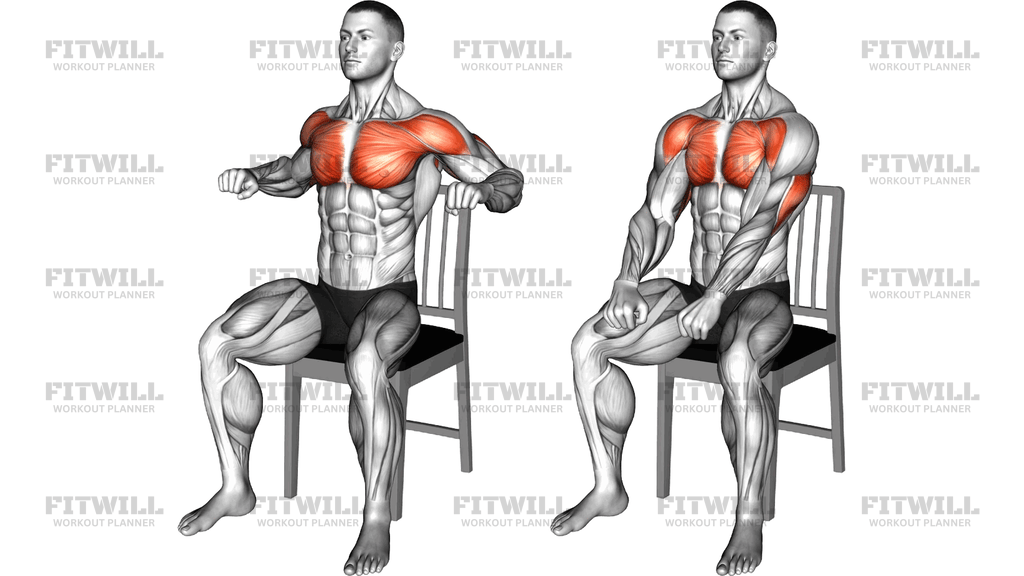
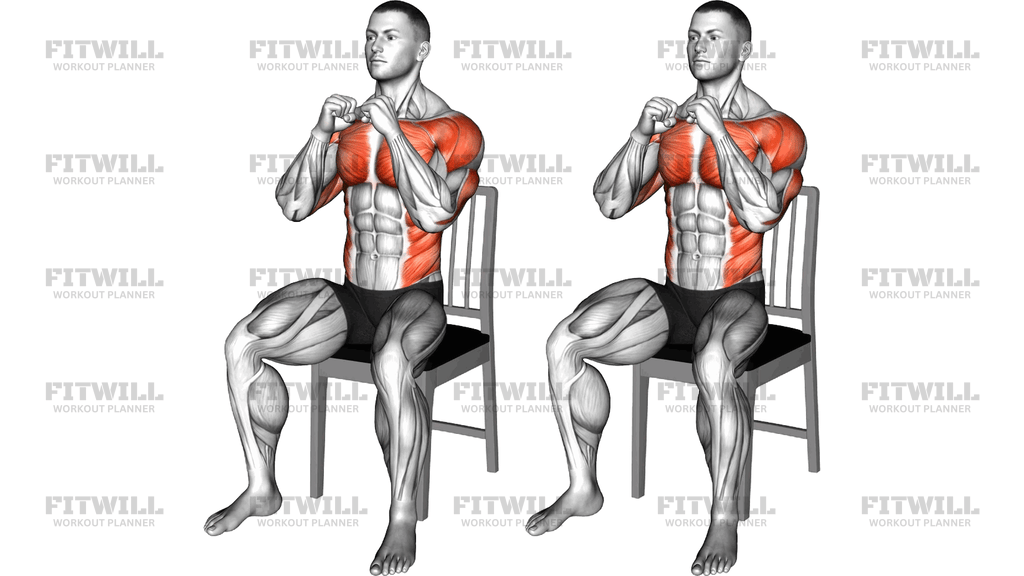
Seated Double Jab On Chair is a boxing-style striking drill performed from a stable seated position. You sit upright on a firm chair with feet planted, hands raised in a guard position at chin level, and throw two quick jabs in succession — one with each hand — straight out in front of you at roughly chest or chin height. Because the chair removes your legs from the equation, all the work concentrates in the shoulders, chest, triceps, and the trunk muscles that keep your torso tall and controlled through every punch.
The highlight of this movement is the front of the shoulders, which drives each jab forward, supported by the chest and triceps as the arm extends. Your core — especially the obliques — works isometrically and with small rotational control to stop your torso from twisting or leaning with each punch. The forearms and grip stay active holding the fists closed in guard throughout the set.
The seated setup is what makes this drill valuable. Standing jab work lets you cheat by pushing off the floor, rocking your hips, or stepping into the punch. Sitting on a chair takes that away, so any power you generate has to come from clean shoulder and arm mechanics rather than body momentum. That makes it an excellent tool for learning what proper jab extension actually feels like, and it's why the drill suits beginners learning punch mechanics, office workers looking for a discreet upper-body energizer, and anyone with limited mobility who trains from a chair.
To execute it well, sit tall toward the front edge of the chair with your feet flat on the floor about hip-width apart. Keep your ribs stacked over your pelvis and brace your core lightly. From the guard position, snap the lead hand straight out, turning the fist so the palm faces down at full extension, then immediately retract it back to your chin as the second hand fires. The two jabs should flow as one smooth one-two rhythm, not two separate deliberate pushes.
Common use cases include warm-ups before upper-body training, conditioning rounds where you throw continuous double jabs for time, and technique work where you want to isolate the upper body without footwork. Because it requires no equipment beyond a sturdy chair, it travels well — hotel rooms, home workouts, and desk breaks are all fair game.
A few safety points matter here. Use a chair without wheels and stable enough that it won't tip when you move. Never lock the elbow hard at full extension — punch to about ninety-five percent and let the arm decelerate under control. And resist the urge to hunch forward or shrug your shoulders toward your ears; if your shoulders start creeping up, that's a sign to slow the tempo down.
[ Workout Log & Planner ]
Put your next workout in Fitwill
Keep your plan and training log ready when you are.


Instructions
- Place a stable, armless chair on a non-slip surface and sit toward the front edge with your feet flat on the floor, hip-width apart, knees bent roughly ninety degrees.
- Sit tall with your ribs over your hips, then raise both fists to chin height with elbows tucked close to your ribs in a guard position, palms facing in.
- Brace your core lightly and pull your shoulders down away from your ears before you throw the first punch.
- Exhale sharply and snap your lead hand straight forward at chin height, rotating the fist so the palm faces down at full extension.
- As the first hand retracts along the same straight line back to your chin, fire the second hand forward in the same path — the two punches should chain together as a quick one-two.
- Stop each punch just short of full elbow lock so the joint stays protected and the arm snaps back faster.
- Keep your torso facing forward and upright; let the small rotation come from the shoulder, not from leaning or twisting your spine.
- Breathe out on each jab and inhale during the brief reset between double jab reps.
- Complete your reps, then lower both hands to your thighs and roll your shoulders to reset before the next set.
Tips & Tricks
- A common mistake is punching with a straight, rigid wrist — keep the fist closed firmly and the wrist in line with the forearm so impact force (real or imagined) travels through the knuckles, not the joint.
- If you feel the chair shift or rock, you're driving your hips into the punches; grip the chair edge lightly with nothing or plant your feet harder and dial the power down until only the arms move.
- Watch for elbows flaring out to the sides as you fatigue — jabs travel in a straight line, so picture your fist sliding along a rail aimed at a point in front of your chin.
- Don't shrug your shoulders as the arm extends; the front of the shoulder should do the lifting, and the space between your ear and shoulder should stay the same throughout.
- Speed comes from the snap back to guard, not just the punch out — retract the hand as fast as you extend it to get the boxing rhythm and more work from the rear delts and upper back.
- If your lower back starts to arch, tighten the brace or sit an inch further back on the chair; the seated position only teaches good mechanics if your spine stays neutral.
- Start with slower, deliberate double jabs to groove the path, then add speed once both hands return to the exact same guard spot every time.
- For a conditioning round, throw continuous double jabs for 20-30 seconds and focus on consistent height — punches that drift lower as you tire are a cue to end the set.
Frequently Asked Questions
What muscles does the Seated Double Jab On Chair work?
The front of the shoulders drives each jab, with the chest and triceps assisting on extension. Your obliques and deep core work continuously to keep the torso upright and prevent unwanted twisting.
Why perform jabs seated on a chair instead of standing?
Sitting removes leg drive and hip movement, so you can't borrow power from the ground or body momentum. This forces clean shoulder and arm mechanics and makes faulty form much easier to notice.
Is the Seated Double Jab On Chair suitable for beginners?
Yes, it's one of the simplest ways to learn jab mechanics because there's no footwork to coordinate. Start with slow, controlled double jabs and only build speed once the straight path feels automatic.
What kind of chair should I use for this exercise?
Use a stable, armless chair without wheels, sitting toward the front edge so your back doesn't lean on the rest. The chair only supports your seat, so it must not slide or tip as your arms move.
How high should each jab extend in the Seated Double Jab On Chair?
Aim for roughly chin height, which matches the guard position you start from. Extending much higher tends to make the shoulder shrug and pulls your posture out of alignment.
Should my elbows be fully straight at the end of each jab?
No — stop just short of full lockout so the elbow isn't jammed at full extension. This protects the joint and lets the arm snap back to guard faster.
What's the most common mistake in this drill?
Leaning the torso forward or twisting to add reach, which turns a shoulder-driven punch into a body-driven one. Keep your ribs stacked over your hips and accept the shorter range the seated position gives you.
How can I make the Seated Double Jab On Chair more challenging?
Add time-based rounds, such as continuous double jabs for 30 seconds with short rests, or hold very light weights in each hand. Keep the speed honest — if the punch path gets sloppy, drop the intensity.
Can I substitute this exercise if I don't have a suitable chair?
Any firm, stable seat such as a bench or sturdy box works the same way. If you have no seat at all, a standing jab with your feet planted hip-width apart is the closest alternative, though it's easier to cheat with body sway.
Is it safe for someone with shoulder issues to do this movement?
The light, controlled range is generally gentle on the shoulders, but keep the punches slow and stay well short of any painful arc. If you have a current or recent shoulder injury, get clearance from a qualified professional before adding striking drills.