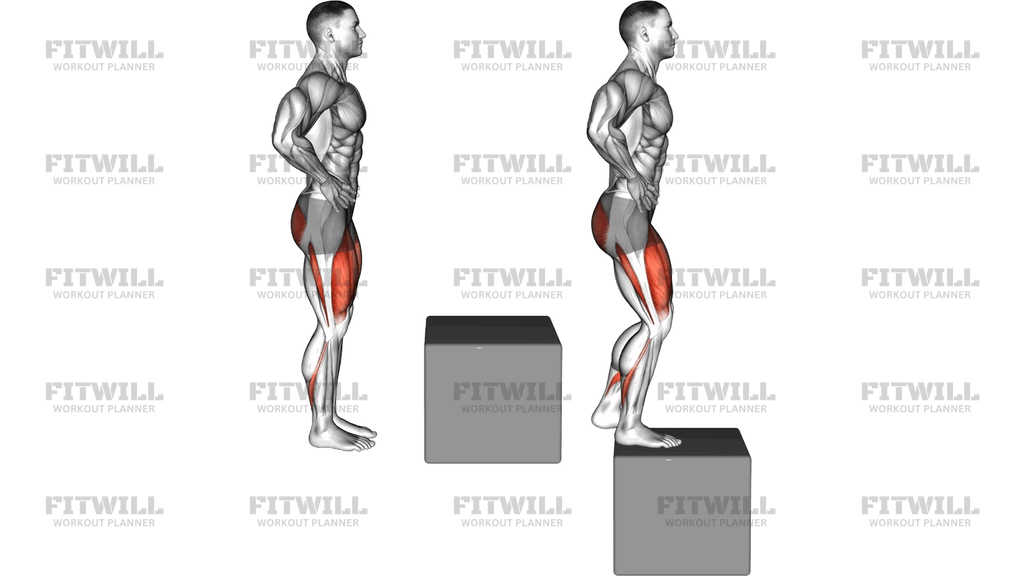
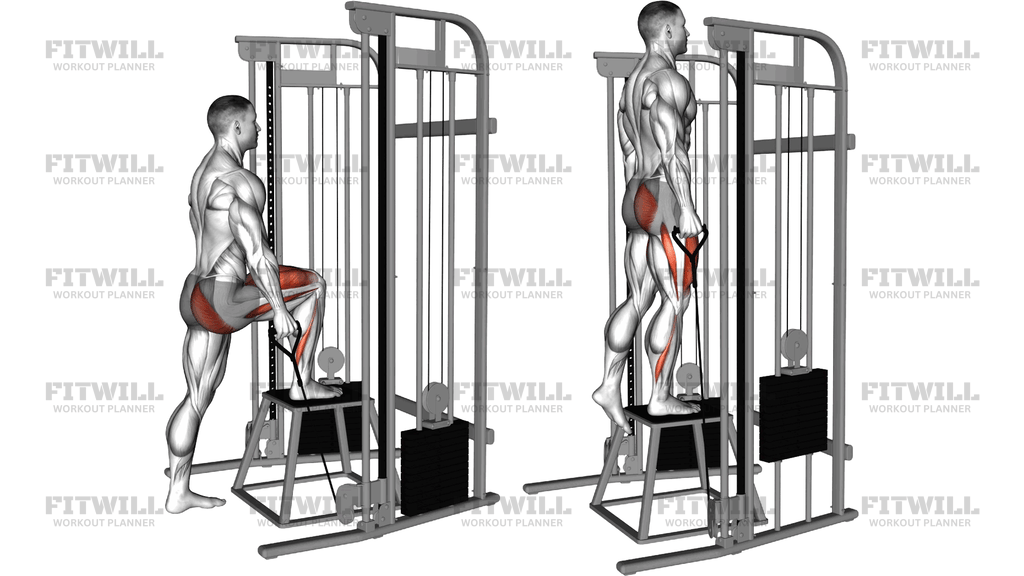
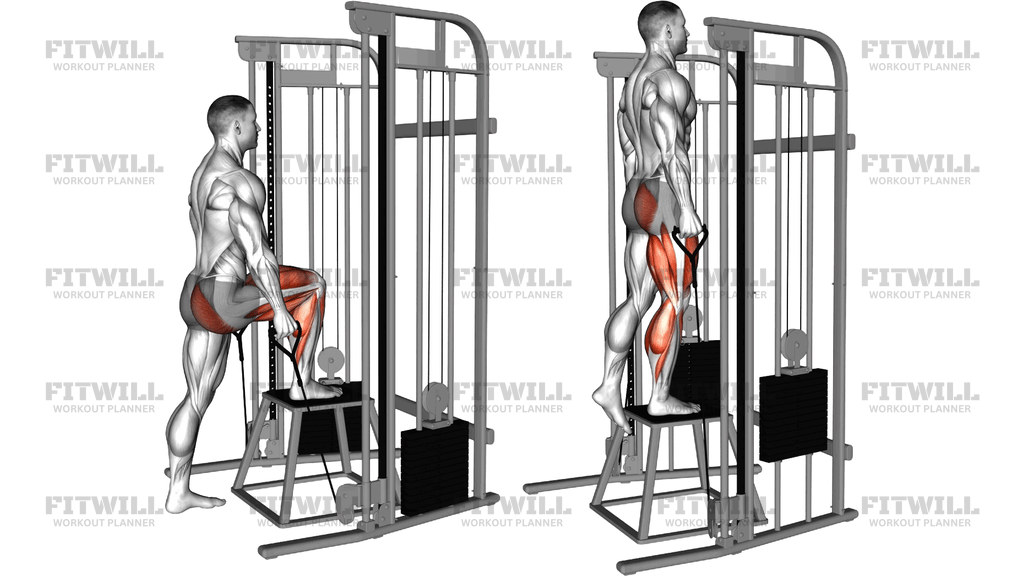
Standing Single Leg Concentration Calf Raise
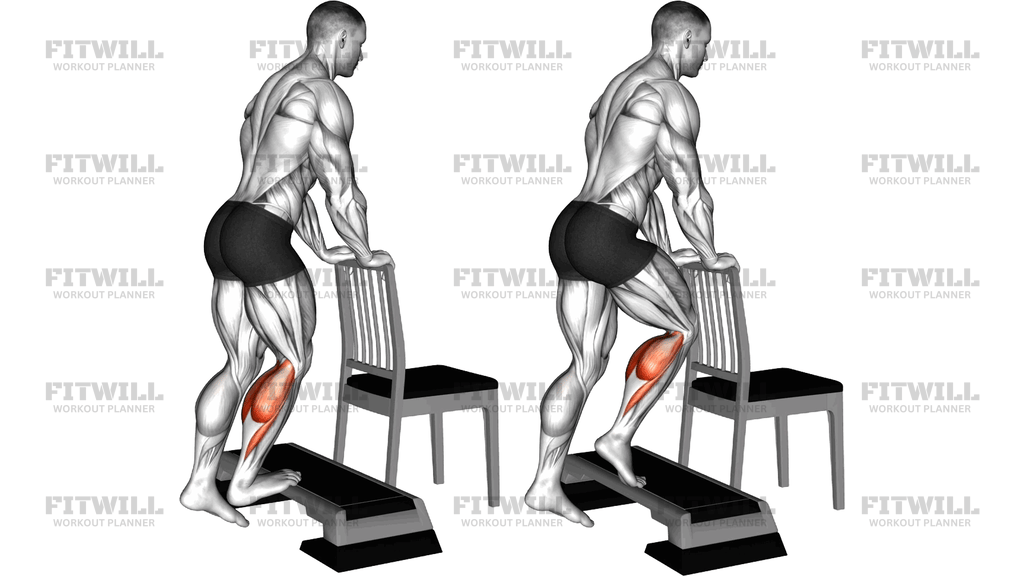
The Standing Single Leg Concentration Calf Raise is a one-legged calf exercise performed with the torso hinged forward and one hand braced on the back of a sturdy chair or bench for balance. The working foot sits on a step platform so the heel can drop well below the toes at the bottom, and the free leg is lifted off the floor with the knee bent. The forward-lean position is what separates this from a standard standing calf raise: bending at the hips while reaching for support puts the calf under a slightly different line of pull and gives you a strong, stable anchor so all your focus stays on one calf at a time.
This exercise is useful for anyone dealing with a size or strength difference between their left and right calves, since training one leg at a time prevents the stronger side from taking over. It also suits lifters who find two-legged raises too easy and want to load each calf more heavily without adding external weight. Because you are holding a chair for balance rather than balancing freely, you can push close to failure on the working calf without your stability limiting the set.
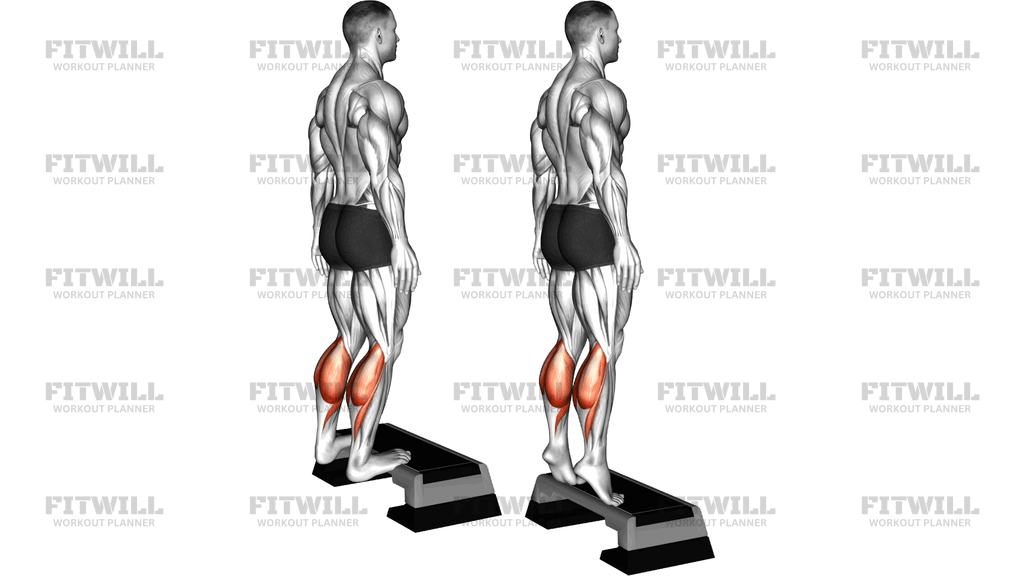
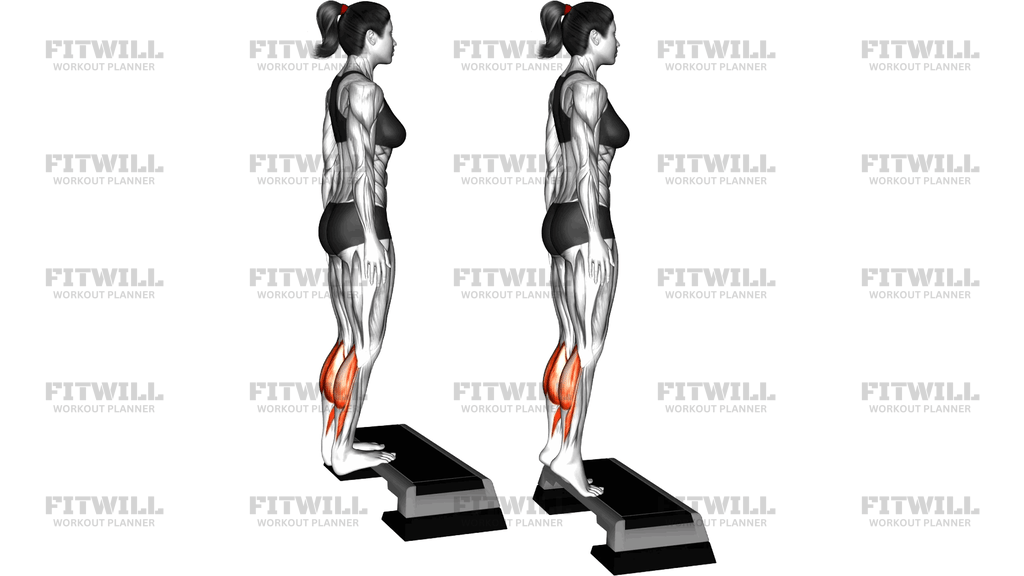
The main muscles worked are the calves, with the gastrocnemius doing most of the visible work during a straight-knee raise and the soleus assisting underneath. The smaller muscles around the ankle joint also work to keep the foot aligned over the toes as you rise and lower, which makes this a good exercise for ankle control as well as calf size.
Setup matters here because the step height and your hand position determine both your range of motion and your safety. The ball of the working foot needs to be fully on the step with enough of the heel hanging off to drop below the level of the platform. The chair or bench should be solid and positioned so your arm can stay extended without rounding your back. Keep the knee of the working leg straight but not locked, and let the free leg hang relaxed behind you.
To perform it well, drive up through the big toe and ball of the foot until the calf is fully shortened at the top, pause briefly, then lower under control until you feel a complete stretch in the calf before starting the next rep. Moving slowly, especially on the way down, is what makes this exercise effective; bouncing out of the stretch reduces the work the calf actually does.
Common use cases include finishing a leg day, rehabilitating a weaker or previously injured side with careful control, and adding focused calf volume without needing weights or machines. Move only within a pain-free range, keep your hand support close enough that a loss of balance is never a real risk, and stop the set if your ankle starts to roll or the arch of your foot cramps repeatedly.
[ Workout Log & Planner ]
Put your next workout in Fitwill
Keep your plan and training log ready when you are.


Instructions
- Place a step platform or low stable step on the floor and stand facing the back of a sturdy chair or bench positioned just in front of it.
- Set the ball of your right foot firmly on the edge of the step with your heel hanging off, and place your left hand on the chair back for support.
- Hinge forward from the hips until your torso is angled toward the chair and your supporting arm is nearly straight, then lift your left foot off the floor and bend that knee slightly behind you.
- Lower your right heel slowly toward the floor until you feel a full stretch along the calf, keeping the knee straight but not locked.
- Brace your core and keep your weight balanced over the ball of the foot before starting the rep.
- Press up through the ball of the foot and big toe, rising as high onto the toes as you can until the calf is fully contracted.
- Hold the top position for a moment and squeeze the calf before beginning the descent.
- Lower the heel under control over two to three seconds until it passes below the level of the step, then start the next repetition.
- Breathe out as you rise onto the toes and breathe in as you lower the heel.
- Complete all repetitions on the right leg, then switch sides, placing the left foot on the step and bracing with your right hand.
Tips & Tricks
- Do not let the supporting hand take over the movement; it should only steady you, so keep your weight loaded through the working foot.
- If your heel will not reach below the step level without pain, your step is too high or your calf is tight — use a lower platform and build range gradually.
- Avoid rolling the ankle outward at the top of the rep; if the foot tips to the outside, cut the range slightly and focus on pressing through the big toe.
- A common mistake is bouncing the heel off the floor at the bottom; pause for a beat in the stretched position instead to keep tension on the calf.
- Keep the working knee straight throughout — bending it shifts emphasis toward the soleus and changes this from a standing raise to a different exercise.
- If your foot arches or cramps mid-set, shorten the range, slow the tempo, and make sure the ball of the foot is centered on the step rather than angled.
- Stand close enough to the chair that your support arm stays nearly vertical; reaching too far forward rounds the back and pulls weight off the working leg.
- Point the toes of the free leg down slightly and keep it behind you so it cannot silently tap the floor and steal load from the working calf.
- Since one calf usually lags behind the other, start sets with your weaker leg and match the repetitions on the stronger side rather than working to failure on both.
Frequently Asked Questions
Which muscles does the Standing Single Leg Concentration Calf Raise target?
It primarily targets the gastrocnemius, the large visible calf muscle, with the soleus assisting underneath. The smaller ankle stabilizers also work to keep the foot aligned as you rise and lower on one leg.
Why is the torso bent forward in this exercise instead of standing upright?
The forward lean with a hand braced on a chair shifts your center of gravity over the working foot and gives you firm support. This lets you focus entirely on one calf and use a full range of motion without balance limiting the set.
Do I need a step platform, or can I do this exercise on the floor?
A step platform is strongly preferred because it lets the heel drop below the level of the toes, giving the calf a full stretch. On a flat floor the range of motion is shorter and the exercise becomes noticeably easier.
Is the Standing Single Leg Concentration Calf Raise suitable for beginners?
Yes, as long as you start with a low step and use the chair for genuine support. Beginners often have limited ankle range of motion, so a shallower heel drop and shorter sets are the right starting point.
How is this different from a regular two-legged standing calf raise?
Working one leg at a time doubles the load on each calf without extra weight and exposes side-to-side differences. The concentration setup also removes balance as a limiting factor, so the calf, not your stability, ends the set.
Should my working knee be straight or bent?
Keep it straight but not locked. A straight knee emphasizes the gastrocnemius; if you bend the knee you shift the work toward the soleus and turn this into a different variation.
What is the most common mistake in this movement?
Bouncing the heel at the bottom of each rep and relying on the stretch reflex instead of muscle control. Pause briefly in the stretched position and lower over two to three seconds to keep the calf doing the work.
How many repetitions should I do per leg?
Most people do well with 10 to 20 controlled reps per side for two to four sets. Since the calf handles body weight all day, higher rep ranges with a slow tempo tend to work better than very low reps.
Can I substitute this exercise if I do not have a chair or step?
You can hold a wall or rack instead of a chair and perform single-leg raises on a flat surface, though the range will be shorter. A stair edge with a handrail is a practical substitute for the step platform.
Is it safe to do this exercise if my ankle feels unstable?
If your ankle rolls, wobbles, or produces pain during the set, stop and reduce the range or step height first. Because you are on one foot, start conservatively and keep the chair within easy reach at all times.