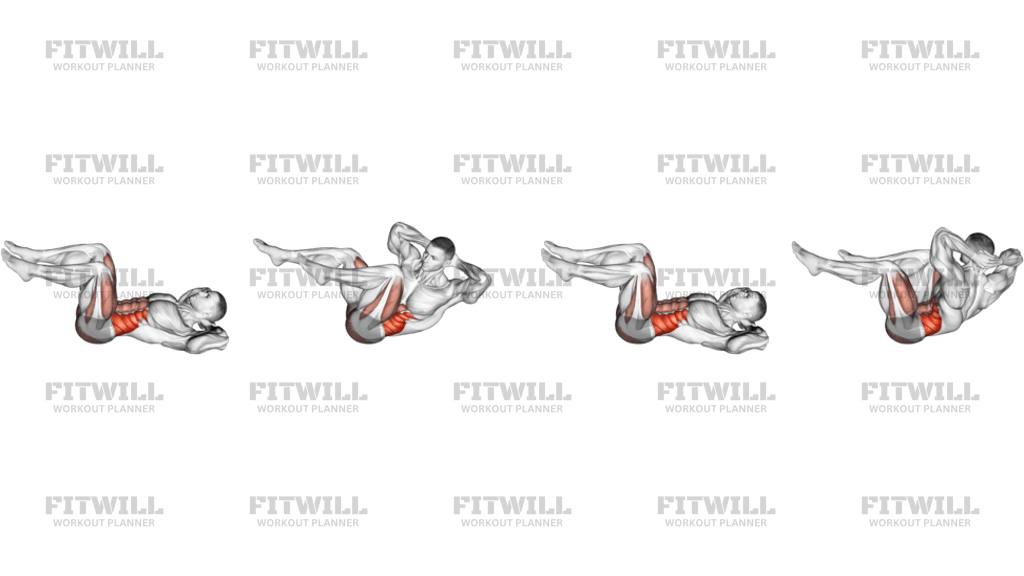
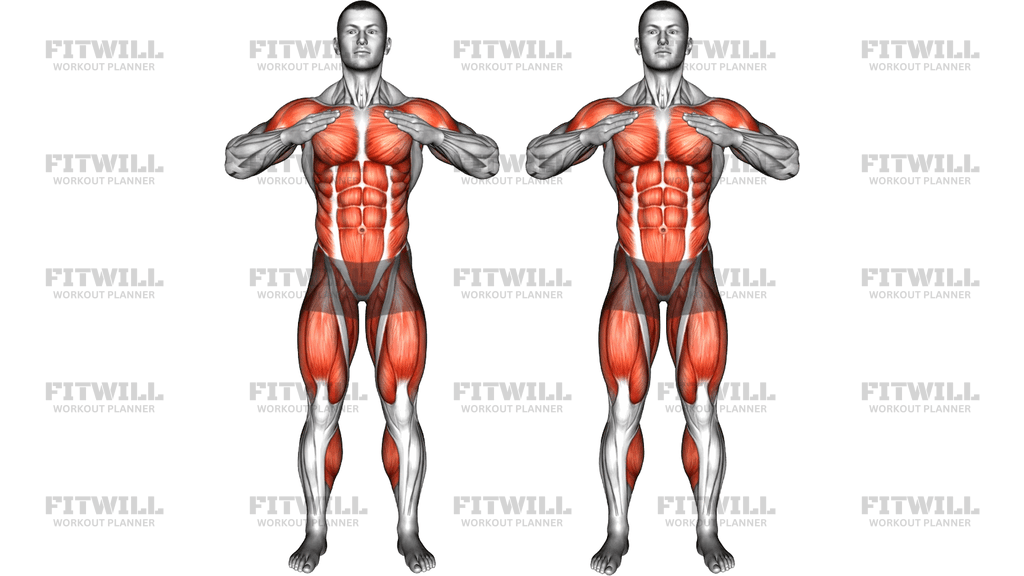
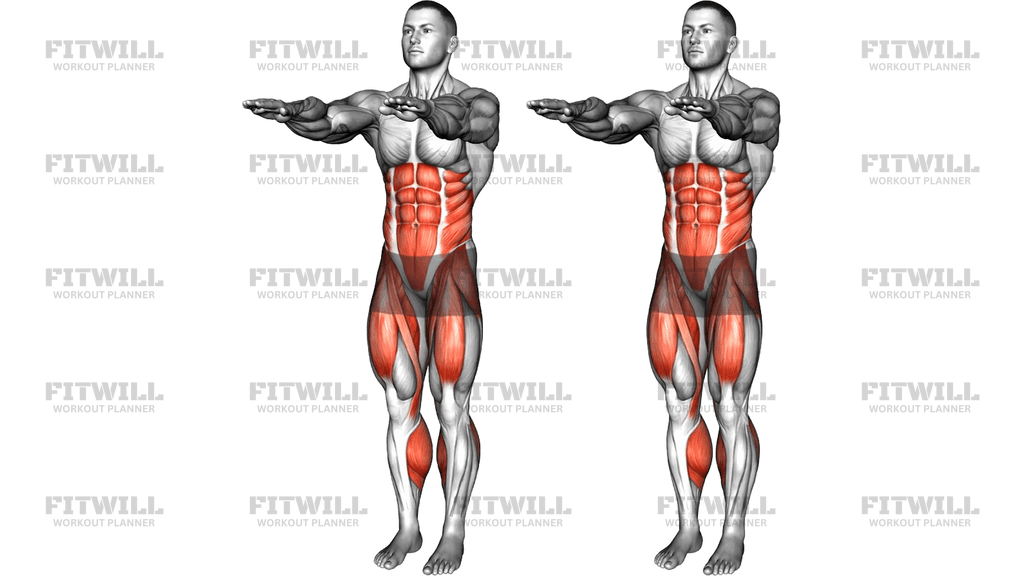
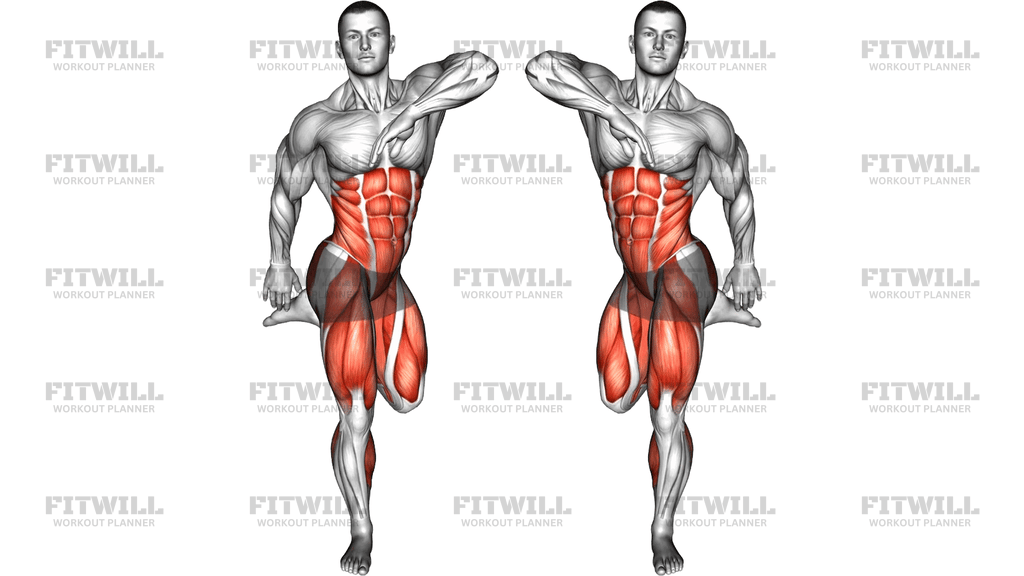
Half Kneeling Torso Twist
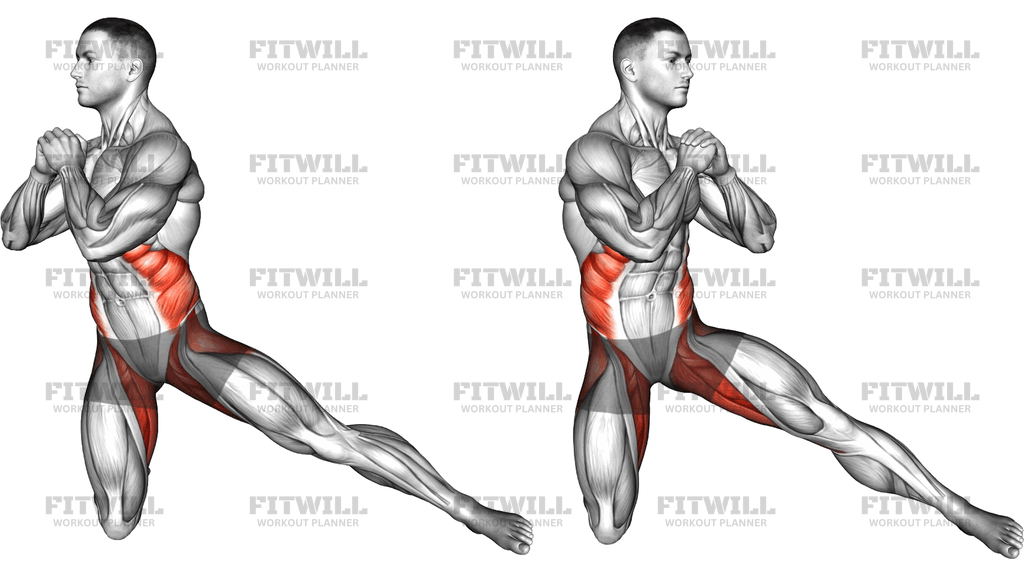
The Half Kneeling Torso Twist is a body weight rotational exercise performed from a half-kneeling base, with one knee on the floor and the other leg extended out to the side. Your hands stay clasped together at chest height while you rotate the upper body from one side to the other. Because the lower body is locked in place, every degree of rotation has to come from the trunk itself, which makes the obliques do the real work instead of letting the hips swing and fake the movement.
The half-kneeling stance is what separates this from a standing twist. With one knee down and the opposite leg stretched wide, the base is stable enough that you cannot cheat by shifting your weight or spinning your feet. That fixed lower body also puts a gentle stretch on the inner thigh and hip of the extended leg while challenging the glutes and hip stabilizers of the kneeling side to keep you square. It is a two-for-one: rotational core strength and hip mobility in the same drill.
This exercise suits a wide range of people. Golfers, tennis players, baseball players, and anyone in a throwing or swinging sport benefit from controlled trunk rotation, and desk workers often find it helps restore rotational mobility that stiff sitting takes away. Because it requires no equipment and loads the spine only with your own body weight, it works well as a warm-up activation drill, a core finisher, or a low-impact option for anyone easing back into rotational training.
To execute it well, think of your hips as a statue and your ribcage as the only thing that moves. Keep the pelvis facing forward the entire time, squeeze the glute of the kneeling leg to lock the hips, and rotate from the waist as if you were trying to point your chest at the wall behind you on each side. The hands stay glued to the sternum so the arms do not lead and the twist does not become a shoulder swing.
The most common faults are letting the front knee or extended leg rotate with the torso, arching the lower back to buy extra range, and rushing the turn so momentum does the work. Slow the tempo down, pause briefly at each end of the rotation, and only turn as far as you can while keeping the hips square. Controlled range beats max range every time in this movement.
[ Workout Log & Planner ]
Put your next workout in Fitwill
Keep your plan and training log ready when you are.


Instructions
- Kneel on your right knee with the left leg extended straight out to your left side, foot flat on the floor and toes pointing forward or slightly outward.
- Keep the torso tall and square your hips so both pelvis bones point straight ahead, then clasp your hands together in front of your chest with elbows bent and tucked.
- Brace your abdominal wall as if preparing for a light push, and squeeze the glute of the kneeling leg to lock the pelvis in place.
- Exhale as you rotate your ribcage and shoulders to the left, keeping your hands anchored at the sternum and your hips completely still.
- Pause for one to two seconds at the end of the rotation, feeling the work in the side of your waist rather than in your shoulders.
- Inhale as you rotate with control all the way to the right side, passing back through center without letting the hips twist along.
- Pause again at the right end range, then continue alternating side to side for the desired number of repetitions.
- Keep your gaze following your hands so the neck rotates with the upper back instead of craning on its own.
- When finished, bring the extended leg back in, stand up carefully, and switch sides so the opposite knee is down and the twist repeats on the other base.
Tips & Tricks
- If you feel the twist in your shoulders instead of your waist, press your clasped hands closer to your sternum — the farther the hands drift, the more the arms steal the rotation.
- A rolling hip on the kneeling side is the most common fault; fix it by actively driving the kneeling hip forward and keeping both kneecaps of the pelvis aimed at the wall in front of you.
- Shorten the range before you lengthen it: a half turn with square hips builds more oblique strength than a big turn where the pelvis follows the shoulders.
- If the extended leg's inner thigh feels too tight to sit tall, bend that knee slightly or bring the foot closer to reduce the stretch until mobility improves.
- Place a pad or folded mat under the kneeling knee — hard floors make you subtly shift weight off the kneeling leg, which breaks the stable base the rotation depends on.
- Do not hold your breath; exhaling into each rotation naturally engages the deep core and helps the ribcage turn a little farther.
- Keep the chest lifted and the lower back neutral — if you notice yourself leaning back to reach the end range, stop at the point where your posture is still clean.
- Move deliberately: a two-second turn with a one-second hold per side makes this a real strength drill, while fast whipping turns turn it into a momentum exercise.
- If you cannot keep the extended foot flat, point the toes up and press the heel down — this also adds a mild stretch to the hamstrings of that leg.
Frequently Asked Questions
Which muscles does the Half Kneeling Torso Twist work?
The primary movers are the obliques on the sides of your waist, with support from the deep core muscles that stabilize the trunk. The kneeling leg's glutes and the extended leg's inner thigh and hip muscles also work to hold the base steady.
Is the Half Kneeling Torso Twist good for beginners?
Yes. The body weight load and stable half-kneeling base make it easy to learn, and beginners can reduce the range of rotation until they can keep the hips square. It is one of the safest ways to introduce controlled rotation.
Why is one leg extended out to the side in the Half Kneeling Torso Twist?
The wide, braced base locks the pelvis in place so the rotation must come from the torso rather than the hips. It also adds a stretch to the inner thigh and hip of the extended leg while the kneeling side trains hip stability.
Should my hips move during the twist?
No — the pelvis should stay square and facing forward for the entire set. If your hips rotate with your shoulders, the obliques stop doing the work, so reduce the range of motion until you can keep the pelvis still.
Can I do the Half Kneeling Torso Twist every day?
Since it uses only body weight and controlled range, most people can perform it several times per week as part of a warm-up or mobility routine. If your waist muscles feel sore the next day, give them a rest before training rotation again.
What can I use instead of the Half Kneeling Torso Twist if kneeling hurts my knee?
Try a seated torso twist on a bench or the floor with legs crossed, keeping the same hands-at-chest rotation and square hips. You lose some of the hip stretch, but the obliques still do the rotational work.
Should I hold a weight while doing this exercise?
Not at first. Master the square-hip rotation with clasped hands only; if you later want more challenge, a light medicine ball held at the chest can add resistance, but only once your pelvis stays completely still.
How many repetitions of the Half Kneeling Torso Twist should I do?
Eight to twelve controlled rotations per side is a solid working set, or five per side as a warm-up activation. Prioritize slow, square-hip reps over total volume.
Is it safe for my lower back?
When performed with a braced core, upright posture, and a range you can control with square hips, the movement is generally well tolerated. If twisting produces discomfort in your back, shorten the range and check that your lower back is not arching to compensate.