Weighted Squat Side Leg Kick
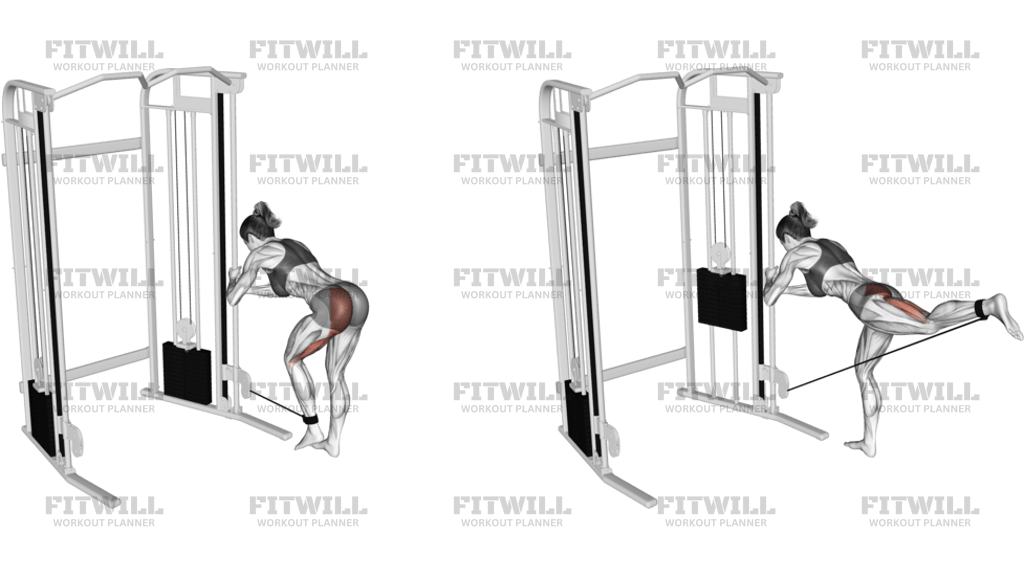
The Weighted Squat Side Leg Kick combines two jobs that are usually done separately: holding a squat position on one leg while the other leg kicks out to the side against cable resistance. You wear an ankle strap connected to the low pulley of a cable machine, stand side-on to the stack, and brace one hand on the machine frame for balance. From a shallow single-leg squat, you sweep the strapped leg out and away from your body, then control it back in.
What makes this movement valuable is the double demand it places on your lower body. The support leg has to hold a bent-knee position the entire time, which loads the quadriceps and glutes isometrically, while the kicking leg drives outward through hip abduction. That abduction is where the gluteus medius and the muscles along the outer hip do their work. Because the cable pulls the leg back toward the machine, your outer hip muscles never get a break, even at the top of the kick.
This is a useful exercise for anyone whose side-glute training has stalled with bodyweight leg lifts. The weight stack gives you a measurable, progressive load, which is hard to achieve with floor work alone. It also doubles as balance and stability work: every rep forces the standing leg's hip and inner thigh to keep your pelvis level while the other leg swings away from your center of mass. People rehabbing hip stability, runners looking for single-leg control, and lifters who want more lateral glute development all get something out of it.
Setup matters more here than in most leg exercises because the cable angle determines the resistance path. Stand close enough to the machine that the cable runs nearly vertical when your strapped leg hangs at your side, and make sure the strap sits snugly around the ankle, not the shin or the top of the foot. If you stand too far away, the cable drags the leg backward or forward and turns the kick into something sloppier and less targeted.
Execution comes down to three things: a stable squat, a clean lateral arc, and a controlled return. Keep the torso tall and the standing knee tracking over the toes rather than caving inward. The kick itself should feel like the leg is being pushed along a rail at hip height or slightly below, not flung upward with momentum. Height is not the goal; tension is. A kick that stops at forty-five degrees with constant cable tension beats a high, swinging kick that briefly unloads the muscle.
Because the loaded leg is swinging while the other leg works statically, start light and treat the first few sessions as practice. Expect your balance, not your strength, to be the limiting factor early on. Once you can complete all reps on both sides without wobbling or leaning hard into the machine, add weight in small increments.
[ Workout Log & Planner ]
Put your next workout in Fitwill
Keep your plan and training log ready when you are.


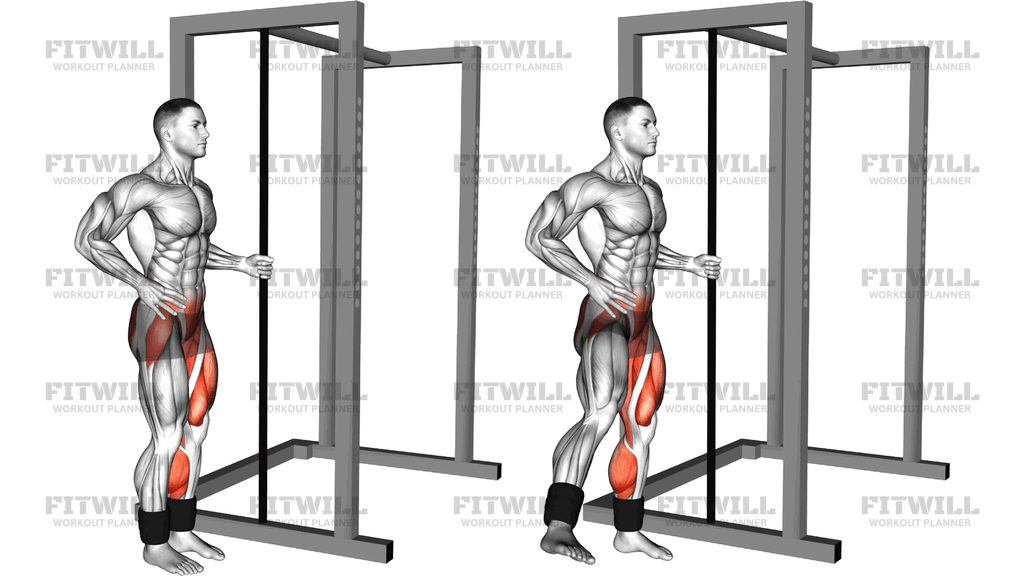
Instructions
- Attach an ankle strap to the low pulley of a cable machine and secure it snugly around one ankle, with the buckle fastened so it cannot loosen mid-set.
- Stand side-on to the machine with the strapped leg closest to the pulley, feet about hip-width apart, and grip the machine frame with the hand on that same side for balance.
- Place your free hand on your hip, set your feet so the cable hangs straight down beside the strapped leg, and find a stance width that feels stable.
- Brace your core, pull your shoulders back, and shift your weight onto the unstrapped leg.
- Lower both hips into a shallow squat on the standing leg, keeping that knee lined up over your toes and your torso upright.
- From the squat, kick the strapped leg out to the side in a smooth arc, away from the machine, keeping the leg nearly straight and the toes pointing forward.
- Stop the kick when you feel steady tension across the outer hip, typically around hip height or slightly below, without leaning your torso away from the machine.
- Exhale as you kick out, then inhale as you slowly lower the leg back down against the cable's pull, resisting the weight rather than letting it snap your leg back.
- Return the leg to the starting position beside the standing foot, rise out of the squat, and complete all reps on one side before switching the strap to the other ankle.
Tips & Tricks
- If the cable drags your leg forward or backward during the kick, you are standing too far from the machine; step in until the cable runs almost straight down beside your strapped ankle.
- A common mistake is leaning the torso away from the machine to fake a higher kick. This robs the outer hip of work, so keep your body upright and let the leg do the traveling.
- Watch the standing knee during the squat. If it drifts inward, deliberately push it outward over your little toe; the inner thigh of the support leg should feel active, not passive.
- Keep the strap on the ankle, not higher on the calf. A strap worn above the ankle joint shortens the lever and makes the kick feel easier but far less precise.
- Do not lock the kicking leg completely straight. A soft knee protects the joint and keeps tension on the hip instead of stressing the knee at the top of the arc.
- If you swing the leg up with momentum, the weight stack will visibly drop and slam. If you see the stack bouncing, slow down and cut the weight by a plate or two.
- Grip the machine frame lightly. Leaning your full weight into the hand turns the exercise into a standing rest, so hold on only as much as your balance actually requires.
- Warm up the hips with a few bodyweight side leg raises before loading this movement, since the gluteus medius tends to cramp when worked cold at the top of a kick.
- Do your weaker side first and match the reps with your stronger side rather than the other way around, so neither hip drifts ahead of the other.
Frequently Asked Questions
Which muscles does the Weighted Squat Side Leg Kick target most?
The main work comes from the gluteus medius and the other muscles along the outer hip that lift the leg sideways. The standing leg's glutes, quads, and inner thigh muscles work isometrically to hold the shallow squat and keep the pelvis level.
Why does the Weighted Squat Side Leg Kick use an ankle strap instead of a handle?
A strap fixed at the ankle makes the whole leg the lever, so the resistance acts directly on the hip joint through a long lever arm. A handle held at the foot or a strap placed higher on the leg shortens that lever and changes the feel of the kick.
How deep should the squat be before kicking the leg out?
A shallow squat is enough, roughly a quarter of the way down, as long as the standing knee stays stable and tracks over the toes. Going deeper mainly adds fatigue to the support leg and makes balance harder without improving the hip abduction work.
Is the Weighted Squat Side Leg Kick suitable for beginners?
Yes, but start with a very light weight and hold the machine frame for support. Most beginners are limited by balance on the standing leg rather than hip strength, so expect the first few sessions to feel more like stability practice than a hard glute workout.
How high should I kick my leg during the Weighted Squat Side Leg Kick?
Kick only as high as you can while keeping your torso upright and constant tension in the cable, which for most people is around hip height or a bit below. Chasing extra height usually causes leaning and momentum, both of which unload the outer hip muscles.
What is the most common mistake in this exercise?
Leaning the torso away from the machine and swinging the leg up with momentum. Both errors let the weight stack drop and slam, which is a clear sign the muscles are not controlling the load.
Can I do the Weighted Squat Side Leg Kick without a cable machine?
You can perform the squat and side kick pattern with bodyweight only or with a resistance band looped around the ankles. The band version still loads the outer hips, though the resistance peaks at a different point in the arc than the cable provides.
How many reps and sets should I use for the Weighted Squat Side Leg Kick?
Moderate rep ranges work well, around 10 to 15 controlled kicks per side for 2 to 4 sets. Since the standing leg fatigues isometrically, rest briefly between sides and stop the set once your balance or knee position starts to break down.
Is it safe for the knees to hold a squat while kicking with the other leg?
For healthy knees, the shallow hold is generally well tolerated because the standing leg stays in a small range under your own body weight. If you feel knee discomfort, reduce the squat depth or straighten the standing leg and perform the kick from a standing position instead.
Should I do both sides back to back or rest between sides of the Weighted Squat Side Leg Kick?
Rest briefly between sides, since the support leg takes on considerable static work and your balance degrades as it tires. Switching the strap takes only a few seconds, and a short reset keeps your form consistent from side to side.