Barbell Lying Front Raise
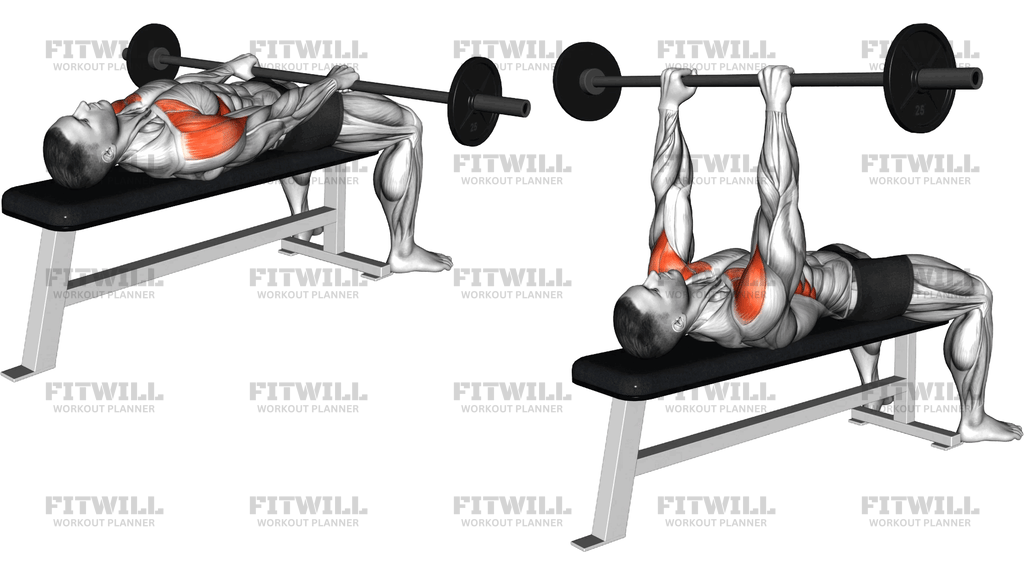
The Barbell Lying Front Raise is a shoulder flexion exercise performed on a flat bench. You lie on your back with a barbell held at arm's length over your upper thighs, then sweep your straight arms up in an arc until the bar sits above your chest or face before lowering it back down under control. Because your torso is supported and your elbows stay locked, the work is funneled almost entirely through the shoulder flexors, with the front delts and the upper portion of the chest doing the bulk of the lifting.
Lying down changes the exercise compared to a standing front raise in two important ways. First, the bench removes any temptation to swing your torso or use your lower back to heave the weight up, so every rep has to come from the shoulders. Second, gravity pulls the bar straight down toward the floor, which means the hardest part of the rep shifts depending on where the bar is in the arc. The movement is most demanding near the start when the bar is at hip level, and relatively easier once the bar is overhead, which is the opposite of many seated raise variations.
This lift is a solid pick for lifters who want to emphasize the front of the shoulders with strict form, or who feel standing raises in their lower back. It also fits well into chest-focused sessions, since the long lever position at the bottom of the arc places meaningful tension on the upper chest fibers as they assist in shoulder flexion. Bodybuilders often use it as a finishing movement after pressing work, when the delts are already fatigued and lighter loads still produce a strong stimulus.
Setup matters more than it might appear. Choose a bench that fully supports your head, shoulders, and hips, and plant your feet flat on the floor so your body stays stable under the bar. Use a shoulder-width overhand grip, and start with a lighter load than you would press, because a straight-arm lever makes even a modest barbell feel heavy near the bottom of the rep. A standard barbell with collared plates is ideal; a fixed straight bar from a rack works just as well for lighter sets.
Execution is simple but unforgiving of sloppiness. Keep your elbows nearly locked, lift in a smooth arc rather than a straight vertical pull, and stop when the bar is stacked over your shoulders. Breathe in as the bar travels toward your thighs and exhale as you raise it. If you cannot keep the bar path smooth or your arms start to bend, the weight is too heavy, and dropping to a lighter plate is the fastest fix.
The main safety point is respect for the barbell itself. Because the bar travels over your face and chest with open plates on either side, never fight a failing rep. If the bar drifts toward your head, lower it toward the floor in a controlled manner or let a plate touch down rather than twisting to catch it. Train this movement within a range you can confidently control, and it will reward you with a deep, isolated burn through the front delts that pressing alone rarely provides.
[ Workout Log & Planner ]
Put your next workout in Fitwill
Keep your plan and training log ready when you are.


Instructions
- Place a flat bench on open floor space and set a lightly loaded barbell on the floor or a rack beside it so you can pick it up while lying down.
- Lie back so your head, shoulder blades, and hips are all supported on the bench, with your feet flat on the floor and knees bent.
- Grip the bar with an overhand, shoulder-width grip and press it to arm's length straight above your upper chest.
- Keeping your elbows nearly locked, slowly lower the bar in a smooth arc toward your hips until it rests just above or lightly touches your upper thighs.
- Brace your core and press your lower back gently into the bench so your torso does not arch as you lift.
- Raise the bar along the same wide arc with straight arms until it is stacked directly over your shoulders and upper chest.
- Pause for a beat at the top with the bar over your chest, feeling the contraction in your front delts.
- Lower the bar back to your thighs slowly, resisting the weight the whole way down instead of letting gravity drop it.
- Exhale as you raise the bar and inhale as you lower it, keeping each breath steady throughout the set.
- At the end of the set, guide the bar back to the floor or rack with both hands before you sit up.
Tips & Tricks
- The bottom of the rep, where the bar sits near your thighs, is where the lever is longest and the load feels heaviest. Start lighter than your standing front raise and add weight slowly.
- If you feel the bar drifting toward your face at the top, it usually means you are pulling in a vertical line instead of arcing over your shoulders. Think about sweeping the bar in a half circle rather than lifting it straight up.
- Bent elbows turn the movement into a partial press and take tension off the front delts. Check your arm angle in a mirror or film a set to confirm your elbows stay extended.
- An arched lower back is a common cheat on this bench setup. Wedge your shoulder blades down into the bench and keep your ribs stacked over your pelvis for the entire set.
- Your grip can loosen as the front delts fatigue, especially near the bottom. Chalk or a firm thumbless-to-thumbs-wrapped grip check before each set prevents a slipping bar over your face.
- Use a controlled two-to-three second lowering phase. Because the hardest position is at the start, dropping the bar quickly from the chest makes the bottom portion jerky and hard to restart cleanly.
- Stop the lowering phase once the bar reaches your thighs or just above them. Letting it sink past hip level stretches the shoulder capsule under load for little extra benefit.
- If your wrists ache, narrow or widen your grip slightly by half a hand width. A grip too narrow forces the wrists to bend backward to hold the bar level.
- Pair this with a pressing exercise rather than another raise. It isolates shoulder flexion, so it works best as a finisher after your main compound lift.
Frequently Asked Questions
Which muscles does the Barbell Lying Front Raise work?
The front delts are the primary movers, since they perform the shoulder flexion that lifts the bar. The upper chest assists significantly through the lower half of the arc, and the side delts and traps help stabilize the arm overhead.
How is the Barbell Lying Front Raise different from a standing front raise?
The bench supports your torso, which eliminates body English and lower back involvement, so the shoulders have to do all the work. Gravity also acts differently, making the rep hardest when the bar is near your thighs instead of at shoulder height.
Is the Barbell Lying Front Raise safe for beginners?
Yes, as long as you start with a very light bar and master the arc before adding plates. Because the bar passes over your face and chest, beginners should practice the path with an empty bar for a few sessions first.
Why does the Barbell Lying Front Raise feel so much heavier than my standing front raise weight?
With straight arms and the bar starting near hip level, the barbell acts as a long lever far from the shoulder joint. The bottom of the rep is the mechanical weak point, so loads must stay modest compared to pressing or standing raise variations.
Should my elbows be fully locked during the Barbell Lying Front Raise?
Keep them nearly straight with only a tiny soft bend to protect the joint. A significant bend turns the exercise into a partial press and shifts work away from the front delts.
How far down should I lower the bar?
Lower it in an arc until the bar reaches just above or lightly touches your upper thighs. Going past hip level puts the shoulder in a deep extended position under load with little additional training benefit.
Can I do the Barbell Lying Front Raise if I do not have a barbell?
A single dumbbell held in both hands, a weight plate, or a light EZ bar all work with the same lying technique. The key is keeping the straight-arm arc identical, not the specific implement.
How many sets and reps should I use for the Barbell Lying Front Raise?
Two to four sets of 10 to 15 reps suits most lifters, since the straight-arm position limits how much load you can handle. Keep rest periods around 60 to 90 seconds and prioritize smooth reps over heavy weight.
What should I do if the bar starts to slip or drift during a set?
Guide it back toward your thighs and set it down on the floor rather than trying to rescue the rep overhead. Reset your grip and back position before starting the next rep, and consider reducing the weight if slippage repeats.
Can the Barbell Lying Front Raise replace chest presses in my routine?
No, it should not. Pressing movements load the chest and triceps far more heavily, while this exercise is an isolation movement for shoulder flexion. Treat it as an accessory that complements presses, not a substitute for them.