Walkout Lat Stretch
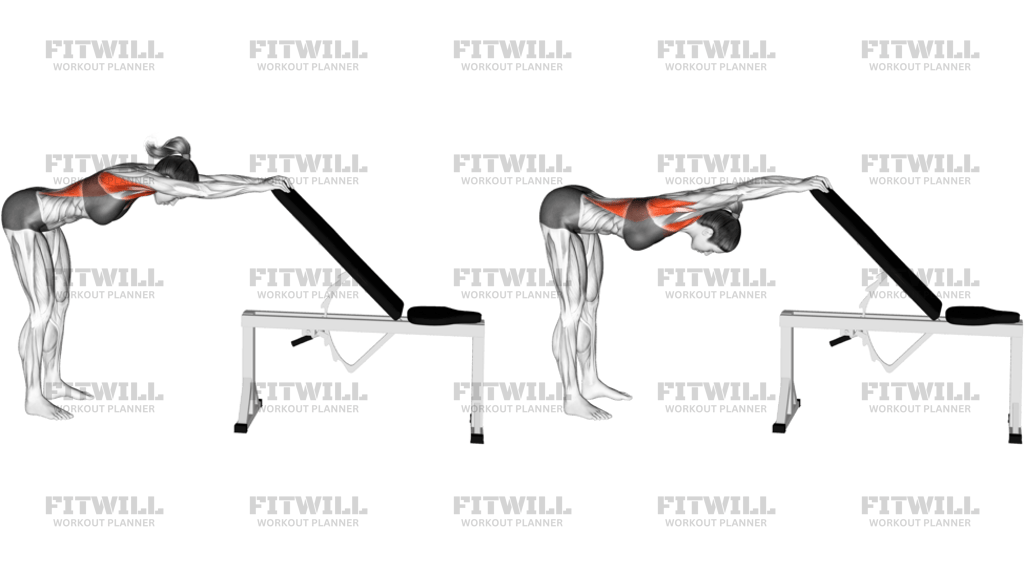
The Walkout Lat Stretch is a body-weight mobility drill that targets the latissimus dorsi, the broad muscles running from your armpits down your back to your pelvis. You set your hands on a bench or sturdy box, then walk your feet backward so your torso tilts down and your arms extend long overhead. As your hips shift back and your chest drops toward the floor, the lats are pulled into a deep, controllable stretch that is hard to reach with many other movements.
Tight lats are extremely common, especially in people who lift regularly, do pull-ups, swim, throw, or spend long hours at a desk with rounded shoulders. When the lats lose length, overhead pressing and pulling feel restricted, and the lower back often compensates during exercises like squats and deadlifts. This stretch is useful for lifters warming up before upper-body training, athletes cooling down after pulling work, or anyone whose shoulders stop short overhead.
The setup matters because the bench gives your hands a fixed anchor point while your body provides the adjustable tension. Standing tall with hands on the bench barely stretches anything; it is the backward walk and the deliberate drop of the chest between the shoulder blades that puts the lats under length. Because your feet control how far you walk out, you decide exactly how intense the stretch becomes, which makes the movement easy to scale for stiff or beginners.
To execute it well, keep your arms straight, press your chest down toward the floor rather than just pushing your hips back, and think about lengthening the sides of your torso. Let your head drop between your arms and breathe slowly into the ribcage so each exhale lets you sink slightly deeper. Hold the stretched position for 20 to 40 seconds, then walk your feet back in to release.
Because no weight is involved and the position is self-limiting, the Walkout Lat Stretch is very safe when done with control. The main cautions are to avoid shrugging your shoulders up toward your ears, to keep the spine long instead of letting the lower back sag, and to ease out of the stretch gradually rather than bouncing. Two to three rounds before or after training is usually enough to feel the sides of the back open up.
[ Workout Log & Planner ]
Put your next workout in Fitwill
Keep your plan and training log ready when you are.


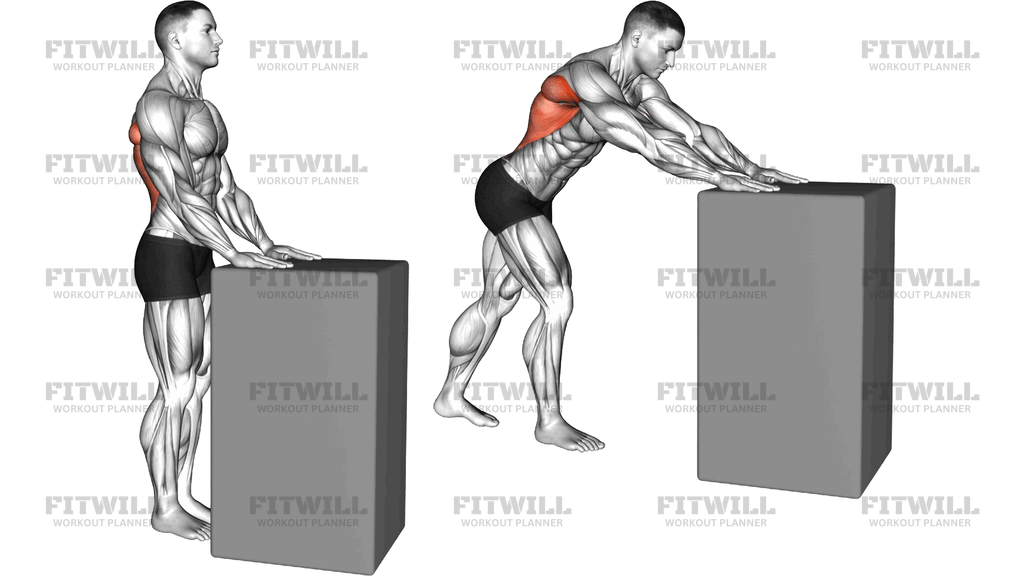
Instructions
- Stand facing a flat bench or sturdy box that sits roughly hip to waist height, and place both palms flat on top of it with your fingers spread comfortably and arms fully straight.
- Step your feet backward one at a time until your body forms an angled line, with your arms extended long in front of you and your weight supported through your hands.
- Set your feet about hip-width apart with a soft bend in the knees, and brace your trunk lightly so your lower back does not sag.
- Press your palms down firmly into the bench and push your chest toward the floor, letting your head drop between your arms.
- If you want more intensity, walk your feet a little further back; if the stretch is too strong, walk them slightly closer in.
- Hold the stretched position for 20 to 40 seconds, breathing slowly and letting each exhale settle you a little deeper into the sides of your back.
- Keep your shoulders pulled away from your ears throughout the hold so the tension stays in the lats and upper back rather than the neck.
- To release, walk your feet back toward the bench and stand up slowly instead of popping out of the position.
- Reset your hand position and repeat for 2 to 3 rounds, adjusting the walkout distance as your shoulders loosen.
Tips & Tricks
- The most common mistake is pushing only the hips back, which turns this into a hamstring stretch; actively press the chest down toward the floor to keep the tension on the lats.
- If your shoulders shrug up during the walkout, your arms are probably not fully straight or the angle is too steep; shorten the distance and re-press the palms down before sinking again.
- Rotate your fingers slightly outward or turn the palms to face each other on the bench edge if your wrists complain in the straight-arm position.
- Try alternating a gentle side-to-side hip shift at the bottom of the hold to bias one lat at a time, since the walkout position often stretches both sides equally.
- Do not lock the knees hard; a soft knee bend lets the pelvis tilt and gives the lats a longer path to stretch across.
- Breathe into your lower ribs rather than shrugging your chest up; chest breathing lifts the shoulders and shortens the lats you are trying to lengthen.
- If the bench is too low and your hands slip, choose a taller box so you can keep your arms in line with your torso instead of loading the shoulders at an extreme angle.
- Ease out of the stretch gradually by walking the feet in; standing up suddenly from a deep hold can make the shoulders and lower back feel jolted.
- Use this before pull-ups, pulldowns, or overhead pressing to check your overhead range, and again after training when the lats are warm and responsive.
Frequently Asked Questions
What muscles does the Walkout Lat Stretch target?
The primary target is the latissimus dorsi, the large muscle on the outer side of the back. The teres major, lower traps, and shoulder stabilizers also get lengthened, and the trunk works lightly to hold the angled position.
How high should the bench or box be for the Walkout Lat Stretch?
A surface roughly hip to waist height works well, such as a flat bench or plyo box. If your shoulders feel pinched at the bottom, use a slightly taller surface so your arms stay closer to torso height.
Is the Walkout Lat Stretch good for beginners?
Yes, because you control the intensity simply by how far you walk your feet back. Beginners should start with a short walkout and a shallow angle, then gradually increase the distance as their shoulders loosen.
How long should I hold the Walkout Lat Stretch?
Hold for 20 to 40 seconds per round and repeat 2 to 3 times. Before a workout, shorter holds of around 20 seconds are enough; longer holds work well during cooldowns.
Why do I feel the Walkout Lat Stretch in my hamstrings instead of my lats?
That usually means you are hinging at the hips and pushing your hips back without dropping your chest. Focus on pressing the palms down and sinking the chest toward the floor to shift the stretch up into the sides of the back.
Can I do the Walkout Lat Stretch every day?
Yes, gentle daily lat stretching is generally fine, especially if you train pulling movements or sit at a desk often. Keep the intensity moderate and avoid forcing a deeper range when the muscles feel sore.
What can I use instead of a bench for the Walkout Lat Stretch?
Any stable surface around hip to waist height works, such as a plyo box, sturdy table, or railing. You can also perform a similar lat stretch on the floor from a kneeling child's-pose position with the arms reached forward.
Should my knees be bent or straight during the Walkout Lat Stretch?
Keep a soft bend in the knees. Locking them straight tends to pull the stretch into the hamstrings and can flatten the lower back, which reduces the lat length you are trying to create.
When is the best time to use the Walkout Lat Stretch in a workout?
It works both as a warm-up before pull-ups, pulldowns, rows, or overhead pressing, and as a cooldown afterward. Keep pre-training holds shorter and more active, and use longer relaxed holds after training.
Is it safe if I have shoulder problems?
If you have a current or recent shoulder injury, keep the walkout very shallow and stay well below any pinching point, or check with a qualified professional first. The stretch should feel like lengthening, never sharp pain in the joint.