Standing Shoulders Roll
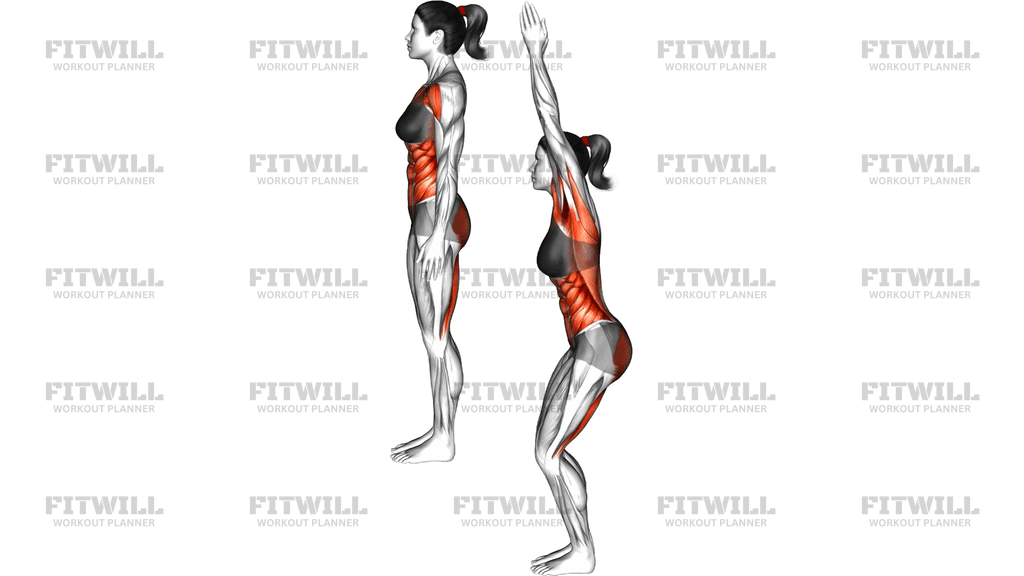
Standing Shoulders Roll is a simple bodyweight mobility drill where you stand tall with your arms relaxed at your sides and roll your shoulders in smooth, continuous circles. It is one of the most common warm-up movements in existence, and for good reason: it takes about thirty seconds, requires no equipment or space, and immediately loosens the upper back, shoulders, and neck before pressing, pulling, or overhead work.
The movement primarily mobilizes the shoulder girdle. As your shoulders travel up, back, and down, the upper trapezius, levator scapulae, and rhomboid area move through a full cycle of elevation, retraction, and depression, while the deltoids and rotator cuff are taken through their resting range. Because the arms stay completely relaxed, the motion comes from the shoulder blades rather than the shoulder joints themselves, which is exactly what makes it useful for people with stiff or elevated shoulders.
Setup matters more than most people expect. Stand with your feet about hip-width apart, knees soft rather than locked, and your spine tall but not rigid. Let your arms hang naturally at your sides with no tension in the hands. If you stand slouched or hold your arms stiffly, the rolls become small and jerky and you lose most of the benefit around the upper back.
To perform the roll, lift both shoulders straight up toward your ears, then draw them back and squeeze your shoulder blades together briefly, then press them down and let them drift slightly forward to complete the circle. Keep the circle large, slow, and even. After your intended reps backward, reverse the direction so the shoulders travel up, forward, and around. Breathing stays relaxed and continuous throughout.
Standing Shoulders Roll is most often used as the first movement in a warm-up before bench presses, overhead presses, pull-ups, rows, or any desk-bound day that has left the upper back feeling locked. Office workers with forward-head posture and lifters who feel tight before pressing both benefit from a couple of controlled sets. It is also a reasonable recovery drill between heavy pressing sets to keep the shoulder girdle from creeping upward under fatigue.
The main coaching point is control. Fast, violent rolling with a craned neck does nothing useful and can aggravate the very area you are trying to loosen. Keep the head stacked over the ribcage, let the arms stay passive, and make the circles big enough that you feel the shoulder blades clearly gliding. If one side feels tighter than the other, slow down and spend a few extra reps on that side rather than speeding up.
Fitwill
Log Workouts, Track Progress & Build Strength.
Achieve more with Fitwill: explore over 9600 exercises with images and videos, access built-in and custom workouts, perfect for both gym and home sessions, and see real results.
Start your journey. Download today!




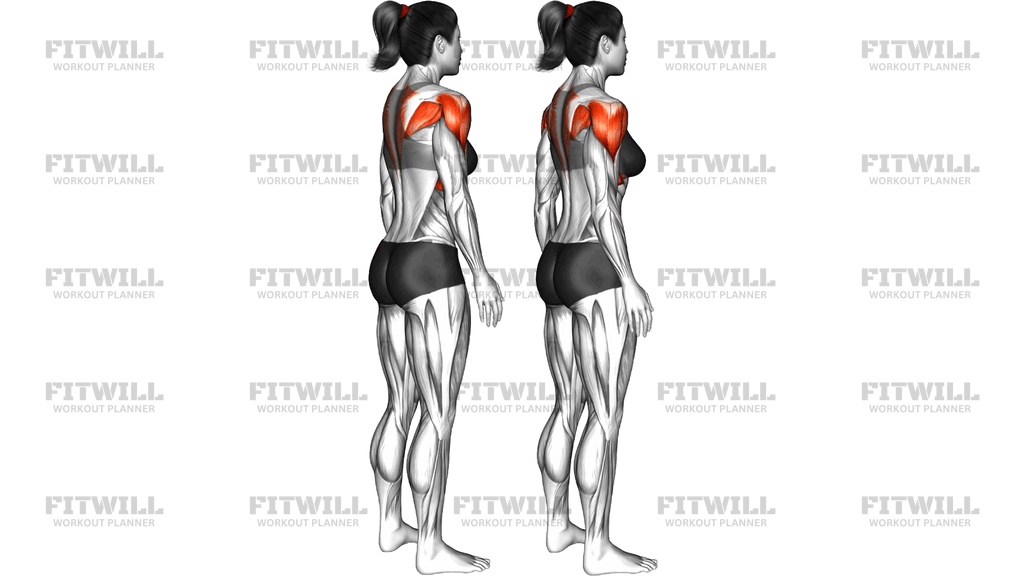
Instructions
- Stand with your feet hip-width apart, weight spread evenly across both feet, and your knees slightly soft rather than locked.
- Let your arms hang fully relaxed at your sides with your hands loose and no tension in the wrists or fingers.
- Tighten your midsection lightly and stack your ribs over your hips so your torso stays upright and still.
- Keep your head level with your gaze forward and your neck long, avoiding any forward poke of the chin.
- Lift both shoulders straight up toward your ears to start the circle.
- Roll your shoulders backward, squeezing your shoulder blades together as they travel behind you, then press them down and let them glide slightly forward to complete the circle.
- Continue the backward circles at a slow, even tempo for your desired number of reps, keeping the arms completely passive.
- Reverse the direction and roll forward for the same number of reps, lifting up, drifting forward, and pressing down and back.
- Breathe steadily throughout, inhaling on the lift and exhaling as the shoulders drop.
- Finish by standing tall, letting the shoulders settle into a relaxed, down-and-back position before moving to the next exercise.
Tips & Tricks
- Make the circles as large as smooth control allows; small, hurried circles mostly move the neck and skip the shoulder blades.
- If your chin juts forward during the roll, imagine your head suspended from a string and keep the ears stacked over the shoulders.
- Do not grip your fists or tense your forearms; dead, heavy arms let the shoulder blades do all the work.
- When rolling backward, pause for a beat with the shoulder blades squeezed together to counter rounded, desk posture.
- If one shoulder clicks or feels tighter, slow the tempo rather than forcing a bigger circle through that side.
- Warm shoulders roll better: two or three easy arm swings before starting can make the circles noticeably larger.
- Avoid shrugging and holding; the movement is a continuous circle, not a repeated static shrug.
- If you feel pinching at the top of the shoulder, shrink the circle slightly and focus on pressing the shoulders down at the bottom of each rep.
- Use this before any overhead or bench session; shoulders that start elevated tend to stay elevated under load.
Frequently Asked Questions
What muscles and areas does Standing Shoulders Roll work?
It mainly mobilizes the upper trapezius, levator scapulae, and the muscles around the shoulder blades, while the deltoids and rotator cuff move through their available range. It is a mobility drill rather than a strength builder, so think of it as loosening tissue, not loading it.
Should I roll my shoulders forward or backward?
Both directions have value, but backward rolls are usually emphasized because they encourage the shoulders into a down-and-back position that counters slouched posture. Forward rolls help release the chest and front shoulder area, so a warm-up can reasonably include both.
How many reps of Standing Shoulders Roll should I do?
Five to ten slow circles in each direction is plenty for a warm-up. If you have been sitting for hours, doubling that and pausing at the back of each backward circle feels noticeably better.
Is Standing Shoulders Roll suitable for complete beginners?
Yes, it is one of the safest movements to learn because there is no load and the arms stay relaxed. A beginner's only job is to keep the circles slow and the neck out of the movement.
Why do my shoulders click when I roll them?
Painless clicking is usually just gas or tissue movement around the joint and is common during shoulder rolls. If the clicking comes with pain or catching, reduce the circle size, slow down, and focus on smooth shoulder blade gliding rather than forcing the range.
Can I do Standing Shoulders Roll if my neck feels tight?
Usually yes, and gentle rolls often ease neck tension because the upper trapezius and levator scapulae are directly involved. Keep the circles smaller and slower, and stop if the movement provokes pain, dizziness, or tingling rather than simple tightness.
What is the most common mistake with Standing Shoulders Roll?
Rushing the movement and letting the head bob forward with each circle. The fix is to slow the tempo, keep the gaze level, and make sure the shoulder blades, not the neck, are driving the roll.
Can I do this exercise seated or with light weights?
Seated shoulder rolls work well if standing is uncomfortable, and the mechanics are nearly identical. Adding weights is not recommended; the point of the drill is free, effortless movement of the shoulder girdle.
When is the best time to use Standing Shoulders Roll in a workout?
Place it at the very start of your upper body warm-up, before arm circles, band work, or light pressing. It also works between heavy pressing sets to stop the shoulders from riding up as you fatigue.