Weighted Plate Lying Crunch
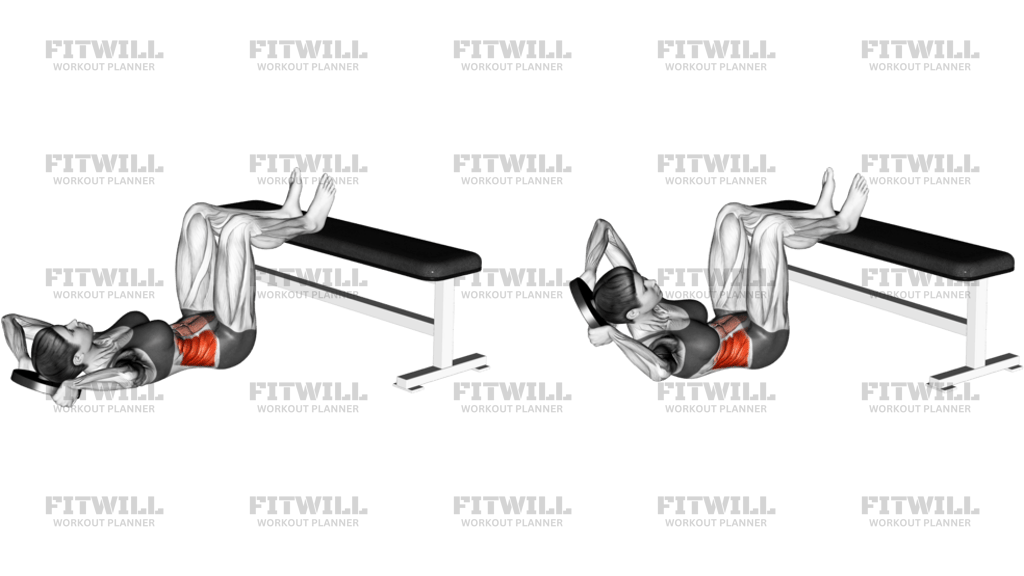
The Weighted Plate Lying Crunch is a floor-based abdominal exercise where you lie on your back with your knees bent and feet flat, hold a weight plate against your chest with both hands, and curl your upper body toward your knees. Adding the plate turns a bodyweight crunch into a progressive strength movement, which is exactly what most people need once standard crunches stop feeling challenging.
This exercise primarily targets the rectus abdominis, the sheet of muscle running down the front of your torso, with support from the obliques as they stabilize your trunk against rotation. The hip flexors assist as your ribs travel toward your pelvis, though the goal is to drive the movement with your abdominals rather than yanking yourself up with your hips.
The weighted setup matters because it creates a load you can measure and increase over time. Instead of chasing more repetitions, you can add a smaller or larger plate, which makes progressive overload simple and keeps your sets in a productive rep range. Holding the plate at your chest also shifts your center of mass slightly upward, which demands more from your abs on every repetition.
To perform it well, keep your lower back in contact with the floor and think of curling your ribs toward your pelvis rather than sitting all the way up. Your shoulder blades should lift clear of the floor at the top, and your lower back should stay down throughout. Moving slowly and pausing briefly at the top produces far better results than bouncing through fast, half-range reps.
This movement suits intermediate lifters who have mastered bodyweight crunches, as well as anyone programming direct abdominal work with limited equipment. It is common in home workouts, core finishers, and hypertrophy-focused ab sessions. Start with a light plate to learn the pattern, and never sacrifice spinal control for extra weight.
[ Workout Log & Planner ]
Put your next workout in Fitwill
Keep your plan and training log ready when you are.


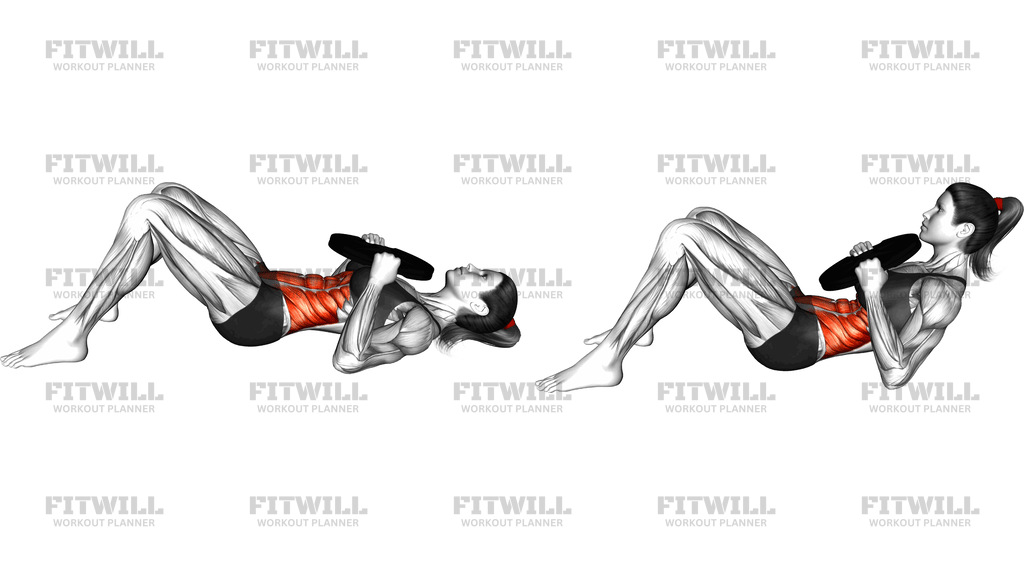
Instructions
- Lie on your back on the floor with your knees bent to roughly 90 degrees and your feet flat on the ground about hip-width apart.
- Hold a weight plate with both hands and rest it flat against your upper chest, just below your collarbones, keeping your elbows tucked in.
- Gently press your lower back toward the floor and brace your abdominals before starting the rep.
- Exhale as you curl your head, shoulders, and upper back off the floor, pulling your ribs down toward your pelvis.
- Continue curling until your shoulder blades are clearly off the floor and you feel strong tension across your abs.
- Pause at the top for a moment and squeeze your abdominals without letting the plate drift away from your chest.
- Inhale as you lower your upper back back down with control, letting your shoulder blades lightly touch the floor before the next rep.
- Keep the plate pressed to your chest for the entire set so the load stays on your trunk, not your arms.
- Complete your planned repetitions, then set the plate aside before standing up to finish the set.
Tips & Tricks
- A common mistake is pulling the plate away from the chest and turning the rep into an arm press. Keep the plate resting lightly against your upper chest from start to finish.
- If your lower back arches or lifts off the floor as you curl up, you are going too heavy or too high. Reduce the plate size and shorten the range slightly.
- Do not yank your head forward. Your hands are holding the plate, so there is no reason to pull on your neck at all.
- Anchor your feet only if your heels keep lifting. Over-anchoring lets the hip flexors take over and reduces the work your abs do.
- Keep your chin about a fist's width from your chest. Tucking too tightly or craning your neck both make the top position uncomfortable.
- The curl is a spine flexion movement, not a sit-up. If your whole torso is hinging at the hips, you are going too far and losing abdominal tension.
- Slow the lowering phase to two or three seconds. Most people rush the eccentric and lose half the benefit of the added weight.
- Start with a 2.5 to 5 kg plate and only increase the load when you can complete all your reps with a crisp pause at the top.
Frequently Asked Questions
Which muscles does the Weighted Plate Lying Crunch work?
The rectus abdominis, the front wall of your abs, does most of the work. The obliques stabilize your trunk, and the hip flexors assist as your upper body curls upward.
Where should I hold the plate during the Weighted Plate Lying Crunch?
Hold it flat against your upper chest with both hands, just below your collarbones. Keeping it close to your chest keeps the load on your abs and stops your arms from doing the moving.
Is the Weighted Plate Lying Crunch suitable for beginners?
Beginners should first master unweighted crunches with solid control. If you can perform 15 to 20 clean bodyweight reps, starting with a light plate is a sensible next step.
Why do I feel the Weighted Plate Lying Crunch in my hip flexors?
This usually means you are sitting up too high and hinging at the hips instead of curling your spine. Shorten the range so only your shoulder blades lift, and focus on pulling your ribs toward your pelvis.
How high should I curl during the Weighted Plate Lying Crunch?
Lift only until your shoulder blades clear the floor and your abs are fully contracted. This is a crunch, not a full sit-up, so your lower back stays down the whole time.
Can I use a dumbbell instead of a weight plate?
Yes, a dumbbell held against your chest works well. The plate is often more comfortable because it sits flat against your torso, but the training effect is very similar.
How heavy should the plate be for the Weighted Plate Lying Crunch?
Choose a weight that lets you complete 10 to 15 controlled reps with a brief pause at the top. If your form breaks down or your lower back lifts off the floor, drop to a lighter plate.
Should my feet be anchored during the Weighted Plate Lying Crunch?
Not necessarily. Feet flat and unanchored on the floor is the standard setup, and anchoring them is only needed if your heels keep lifting during the curl.
Is it safe to do the Weighted Plate Lying Crunch every day?
Your abs respond to progressive training and recovery like any other muscle, so two to four focused sessions per week is a better approach than daily high-rep work. Leave a day between weighted sessions.