Landmine Single Arm Press
The Landmine Single Arm Press is a standing overhead press performed with one end of a barbell anchored in a landmine attachment (or wedged into a corner) while you press the loaded end up and forward with one hand. Because the bar travels along a diagonal arc rather than straight up, this press is noticeably friendlier to the shoulder joint than a strict barbell overhead press, which is exactly why many lifters use it when pressing overhead feels pinchy or restricted.
The main work is done by the front of the shoulder, with strong support from the triceps as you lock the arm out, the upper chest as the bar starts its arc, and the serratus anterior as the shoulder blade reaches forward at the top. Since you are standing and pressing one side at a time, your core works hard to stop your torso from twisting and leaning back toward the anchored end. That anti-rotation demand is one of the quiet benefits of the single-arm setup.
The setup matters because the landmine's pivot point controls the path of the press. Stand close enough to the anchor that the bar sits at roughly shoulder height beside you, and position your feet so you can press slightly forward and out without shrugging or arching. If you stand too far back, the bar drags behind your body and pulls your shoulders out of position; too close, and you lose the natural forward arc that makes this press feel good.
To perform it well, grip the sleeve near the collar with the bar resting at your shoulder, brace your midsection like you are about to be nudged from the side, and press the bar up along the diagonal path until your arm is fully extended and your bicep finishes beside your ear. Pause briefly, then lower under control back to the shoulder. Keep the movement smooth rather than explosive at first so you can feel where the bar wants to travel.
This exercise suits a wide range of trainees: beginners learning pressing mechanics with a self-guiding bar path, and experienced lifters managing shoulder discomfort or looking to train one side at a time without a backrest. It fits well as a secondary pressing movement on shoulder or upper-body days, typically for sets of 6 to 12 reps per side.
A few practical points will keep it safe and productive. Use a moderate weight until the path feels natural, keep your ribs stacked over your pelvis instead of leaning into an arch, and always finish your set on one side before switching. When loading or unloading plates, make sure the anchored end is secure so the bar cannot tip or slide out of the attachment.
Fitwill
Log Workouts, Track Progress & Build Strength.
Achieve more with Fitwill: explore over 9600 exercises with images and videos, access built-in and custom workouts, perfect for both gym and home sessions, and see real results.
Start your journey. Download today!




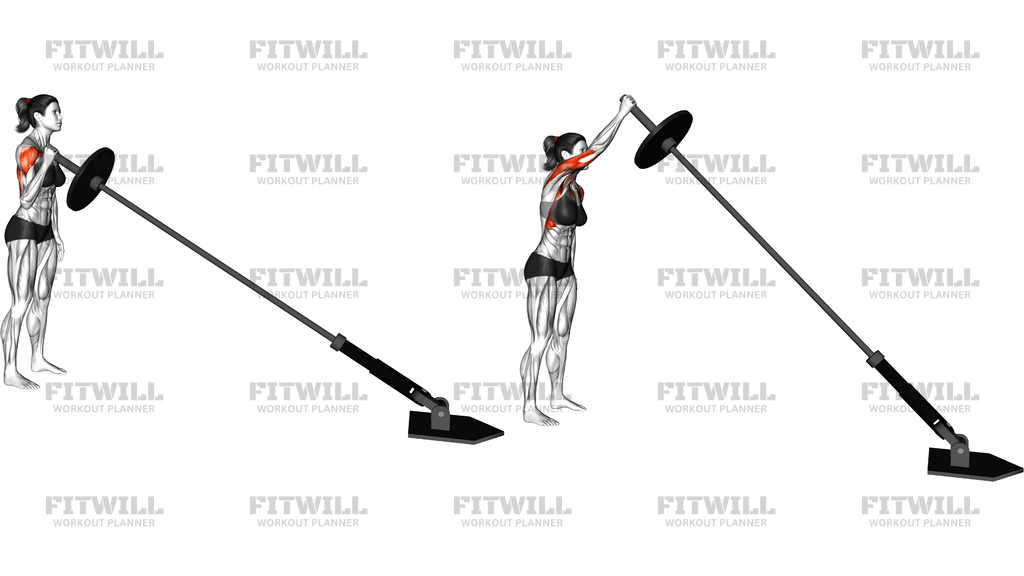
Instructions
- Set one end of a barbell securely in a landmine attachment, and slide a plate onto the free end.
- Stand facing the anchored end with your feet about hip-width apart, knees soft, and pick up the loaded end with one hand so the bar rests at shoulder height beside you.
- Angle the hand on the bar so your palm faces inward toward your shoulder, and keep a slight bend in the elbow of your free arm for balance.
- Brace your abs and squeeze your glutes so your torso is tall and squared toward the anchor before you press.
- Press the bar up and slightly forward along the diagonal the landmine sets for you, keeping your shoulder down and away from your ear as you drive.
- Continue until the arm is fully extended overhead with the bicep near your ear, and hold that locked-out position for a beat.
- Lower the bar along the same arc back to your shoulder with control rather than letting it drop.
- Exhale as you press up, and inhale as the bar comes back down to your shoulder.
- Complete all reps on one side, then re-grip and switch to the other arm while keeping the bar resting at your shoulder between reps.
Tips & Tricks
- If the bar scrapes or catches near lockout, you are probably standing too close to the anchor; step back a few inches until the arc clears your face naturally.
- A common mistake is turning the press into a push by jerking the hips forward; keep your pelvis still and let the shoulder and tricep do the work.
- Watch for the working shoulder riding up toward your ear at the top. Cue yourself to push the shoulder blade forward around the ribcage instead of shrugging, which trains the serratus anterior properly.
- Leaning back into an arch is easy to miss when the weight gets heavy. Brace your abs hard before the first rep and check that your lower back hasn't extended as the bar climbs.
- Because one side works at a time, many people rush the weaker arm. Match your weaker side's rep count and rest before switching so both arms get the same total work.
- Keep the bar resting against your shoulder between reps instead of holding it floating in mid-air; this gives you a stable base for the next press and saves your grip.
- If you feel the movement only in your front delts and not in the arm lockout, slow the last third of the press down and finish each rep with a deliberate squeeze of the tricep.
- Always stay on one side for the entire set. Switching arms mid-set means handling the bar awkwardly near the loaded end, which is where most fumbles happen.
Frequently Asked Questions
Which muscles does the Landmine Single Arm Press work the most?
The front of the shoulder does most of the pressing, supported by the triceps on lockout and the upper chest early in the arc. Your core, especially the obliques on the non-working side, works to keep your torso from twisting.
Why press on a diagonal instead of straight overhead?
The anchored end of the barbell forces a fixed arc that brings the arm up and slightly forward. This path lets the shoulder blade move freely and often feels smoother than a strict vertical press, especially for lifters with limited overhead mobility.
Is the Landmine Single Arm Press good for beginners?
Yes. The guided bar path makes it forgiving to learn, and starting with just a small plate or even the bare bar lets a beginner focus on pressing mechanics before adding load.
How far from the landmine attachment should I stand?
Stand close enough that the bar sits at about shoulder height beside you at the start. If your face gets in the way at lockout or the bar pulls backward, you are too close; if the bar drags behind your body, you are too far.
Should my palm face forward or inward on the bar?
A neutral grip with the palm facing toward your shoulder is the most comfortable and joint-friendly option for most people. Slight adjustments are fine as long as your wrist stays stacked over your elbow.
What can I use if my gym has no landmine attachment?
You can wedge the bare end of a barbell securely into a corner at floor level, ideally padding it with a towel to protect the wall and the bar. Make sure it cannot slip before you load any plates.
Why does my core feel sore after this exercise?
Pressing with one arm creates a twisting force that your obliques and deep core must resist to keep your torso square. That anti-rotation work is a built-in feature of the single-arm setup, not a sign of poor form.
Can I kneel instead of standing for the Landmine Single Arm Press?
Yes, a half-kneeling or tall-kneeling version removes leg involvement and makes the core stability demand stricter. It is a useful variation if you find yourself arching your lower back while standing.
How heavy should I go on this press?
Start lighter than you would for a seated dumbbell press, since the long lever arm of the landmine makes the load feel different. Build up over sets of 6 to 12 reps per side only once the arc feels smooth at lockout.
Is it safe if my shoulder clicks or feels tight during the press?
The diagonal path is often comfortable for shoulders that dislike vertical pressing, but you should never press through sharp pain. Reduce the range, lighten the load, or have a coach or professional review your shoulder position before continuing.