Landmine Half Kneeling Shoulders Press
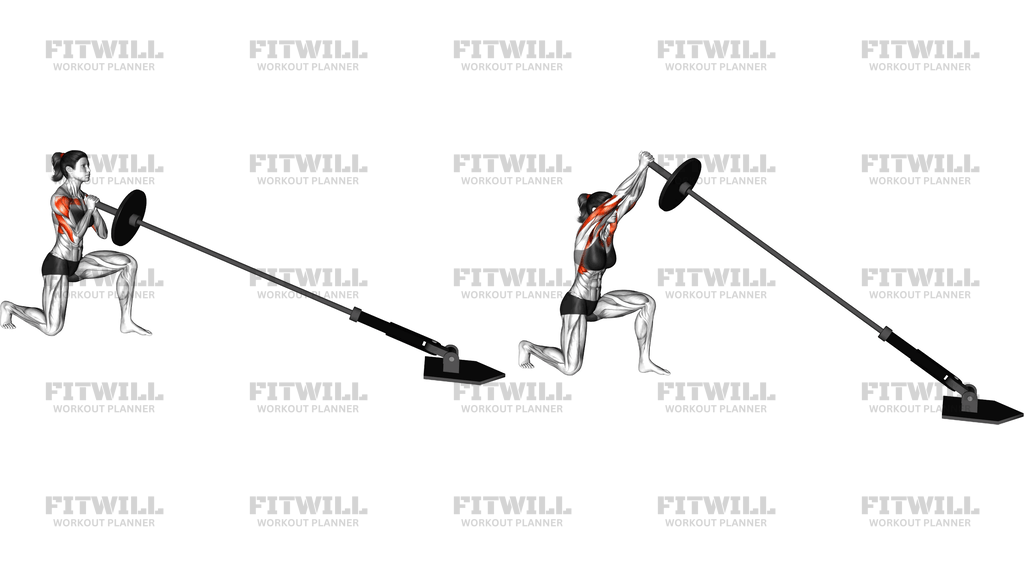
The Landmine Half Kneeling Shoulders Press is an angled overhead press performed with a barbell anchored in a landmine attachment at one end and loaded with plates at the other. You kneel in a split stance with one knee down and the other foot planted in front, hold the sleeve of the bar at shoulder height with both hands, and press the bar up and slightly forward until your arms are extended overhead. Because the landmine fixes the bar on a diagonal path, the press arc is gentler on the shoulder joints than a straight vertical barbell press while still loading the front delts heavily.
This setup rewards people who struggle with strict overhead pressing. Lifters with limited shoulder mobility, anyone returning from a layoff, and pressers who feel pinching at the top of a vertical barbell press often find the landmine arc lets them move through a comfortable range. The half kneeling position removes momentum from the legs, so the press stays honest, and it simultaneously teaches the trunk and hips to resist rotation and extension under load.
The main work goes to the front delts, with strong support from the triceps as you lock out and the upper chest as the bar travels along its angled path. Holding the split kneel trains the glutes, hip flexors, and deep core in a stabilizing role, and the serratus anterior helps you finish the press with the shoulder blade wrapped around the rib cage rather than shrugged toward the ear.
Setup details matter more here than in most presses. Place the barbell in a landmine attachment or wedge it securely into a corner, load the free end modestly, and kneel so the working end is directly in front of you. Your front shin should stay vertical and your torso tall; if you drift toward the bar or let the back hip sag, the angled press quickly turns into a leaning press.
Execution is straightforward once the position is set: grip the sleeve at shoulder height, brace the trunk, and press up along the bar's natural diagonal so the weighted end finishes over your head and slightly ahead of your body. Lower with control back to the shoulder, keeping tension in the trunk the whole way down. Complete all repetitions on one side before switching stance so you can focus on pressing quality instead of repositioning mid-set.
You will see this press used in strength foundations, shoulder-friendly hypertrophy blocks, and athletic training where anti-rotation control under a load matters. It pairs well with rows and pulls on the same day, and it scales easily because small plate jumps change the demand noticeably at the long end of the lever.
[ Workout Log & Planner ]
Put your next workout in Fitwill
Keep your plan and training log ready when you are.


Instructions
- Set one end of a barbell in a landmine attachment, or brace it securely into a corner, and load plates onto the free end.
- Kneel in a half kneeling stance facing the loaded end: front knee bent roughly 90 degrees over the ankle, back knee resting on the floor beneath your hip.
- Pick up the sleeve with both hands and bring it to shoulder height, elbows down and slightly in front of the rib cage.
- Squeeze the front-side glute, tuck the back knee's hip under, and brace your trunk so your torso does not lean or twist.
- Press the bar up and slightly forward, following the bar's natural diagonal path until both arms are fully extended overhead.
- Finish with the weighted end stacked over your shoulder and your biceps near your ears, without shrugging or arching your lower back.
- Lower the bar back to shoulder height under control, keeping your torso tall and tension in your trunk on the way down.
- Exhale as you press and inhale as you lower, keeping a steady rhythm rather than holding your breath for the whole set.
- Complete all repetitions on this side, then switch legs and arms position so the opposite side leads.
- At the end of the set, lower the sleeve to your shoulder, then guide the bar down to the floor before stepping away.
Tips & Tricks
- If the weighted end pulls you toward the anchor, shift your front foot slightly closer to the bar so you can sit tall instead of leaning into the press.
- A common fault is pressing straight up instead of along the bar's angle; let the landmine dictate the diagonal path so the shoulder stays comfortable.
- Watch the back knee: it should point down at the floor in line with the back hip, not flare outward, which usually means the glute has switched off.
- Keep the front shin vertical. If the knee travels past the toes as you press, widen your stance or shorten the distance between your front foot and the bar.
- Do not let the bar drift behind your head at lockout; if it does, you are arching your lower back instead of finishing with the shoulder blade upward.
- Rip your grip too wide and the sleeve becomes unstable; hold the sleeve with hands about shoulder-width apart so both arms press evenly.
- Start lighter than a standing press would suggest. The long lever and kneeling balance demand make small plates feel heavier than expected.
- Place a pad under the down knee if the floor is hard, so discomfort there does not break your bracing.
- If your trunk rotates as you fatigue, that is the signal to end the set rather than chase extra reps with a twisting press.
Frequently Asked Questions
What muscles does the Landmine Half Kneeling Shoulders Press work?
The front shoulders do most of the pressing, supported by the triceps and upper chest as the bar travels its angled path. The glutes, hip flexors, and deep core work isometrically to keep the half kneeling torso upright and square.
Is the landmine press easier on the shoulders than a regular overhead press?
The anchored bar creates a diagonal arc instead of a straight vertical path, which many lifters find more comfortable at the top of the movement. If a straight bar press causes pinching, the landmine angle is a sensible first alternative, though persistent shoulder pain should be assessed by a professional.
Which knee should be down during the Landmine Half Kneeling Shoulders Press?
Either side works, and many coaches start with the knee on the same side as the pressing lead hand down. Since this version uses both hands, simply split the set evenly and switch your stance halfway so both sides get equal stabilizing work.
Can beginners do this press, or should they start with dumbbells?
Beginners can absolutely use it, and many find the fixed bar path easier to learn than a free dumbbell press. Start with one small plate, master the half kneeling position, and only add load once the bar stays steady overhead without trunk lean.
Why does the bar press up and forward instead of straight overhead?
The landmine anchor fixes one end of the bar, so the loaded end must travel along a diagonal arc determined by the bar's length. Fighting that path by pressing vertically creates sideways strain on the shoulder; following it keeps the movement smooth.
What is the most common mistake in this exercise?
Leaning the torso toward the bar or arching the lower back to help the press. Squeeze the glute of the down-knee side and keep the front shin vertical so the shoulders and arms, not momentum or back extension, move the weight.
What can I use if I do not have a landmine attachment?
You can wedge the empty end of the barbell firmly into a corner, ideally with a towel to protect the wall and the bar. Make sure it cannot slip before loading plates, and check the contact point between sets.
How heavy should I go on the Landmine Half Kneeling Shoulders Press?
Choose a load you can press for controlled reps without your trunk rotating or your hips shifting. Because the kneeling position removes leg drive, most lifters use noticeably less weight here than in a standing press.
How does the half kneeling stance change the exercise compared to standing?
Kneeling removes the legs from the press and raises the stability demand on the hips and trunk. It also exposes left-right differences, since the side with the down knee has to control rotation while the arms press.
How many sets and reps should I use?
For strength and pressing quality, 3 to 4 sets of 6 to 10 reps per side works well. For muscle-building emphasis, higher reps of 10 to 15 with a slower lowering phase also fit this movement.