Landmine Kneeling One Arm Shoulder Press
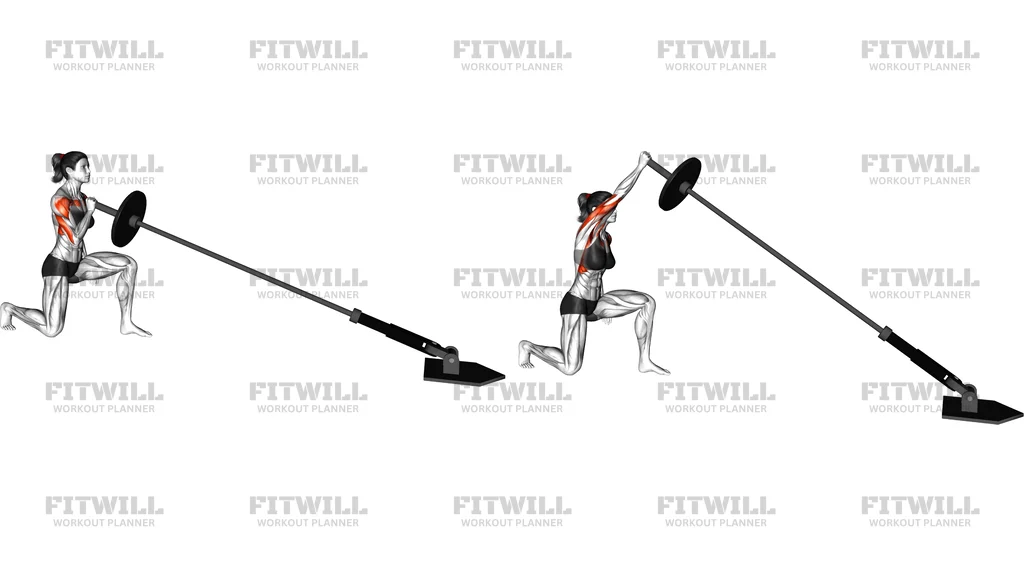
The Landmine Kneeling One Arm Shoulder Press is a single-arm overhead press performed with a barbell anchored in a landmine attachment at one end and loaded with plates on the free end. You kneel on one knee beside the anchor, hold the sleeve end at shoulder height with one hand, and press the bar up and slightly forward until the arm is locked out overhead. Because the bar travels along a fixed diagonal path, the press feels smoother and more joint-friendly than a strict barbell press while still demanding serious shoulder strength.
The half-kneeling stance is what sets this movement apart. With one knee down and one foot planted in front, your hips have very little room to cheat, so your core and glutes have to work to keep your ribcage stacked over your pelvis. This makes the exercise a hybrid of a shoulder press and an anti-rotation core drill. Every rep challenges the front delts and triceps to move the load while the obliques and deep core resist the sideways pull of the off-center bar.
This version suits a wide range of lifters. Overhead pressers with cranky shoulders often tolerate the landmine arc better than a straight vertical press, since the scapula can rotate freely as the arm rises. It is also a smart teaching progression for people building up to standing barbell or dumbbell pressing, because the kneeling position removes leg drive and exposes any tendency to lean back. Athletes in rotational sports use it to train pressing strength with trunk control at the same time.
Setup details matter more here than in most presses. The distance between your knee and the anchor determines where the bar sits at your shoulder, so set up close enough that the sleeve rests comfortably at collarbone height without you reaching or twisting toward it. Grip the end of the sleeve with the bar angled across your body, and keep the working elbow slightly in front of the ribs rather than flared wide out to the side.
Execution comes down to pressing along the natural arc the anchor creates. Drive the bar up and slightly forward so it finishes over your head or just in front of it, with the palm facing forward or angled inward. Keep your down-side glute tight and your torso square; if you notice your chest rotating away from the anchor, the weight is too heavy or you are rushing. Lower the bar under control back to the shoulder, letting the elbow absorb the load before the next rep.
In practice, this press works well as a primary strength lift on shoulder days at moderate to heavy loads for sets of five to ten per side, or as a finisher at lighter weights for higher reps where the core challenge becomes the point. Because one side works at a time, always complete all reps on the weaker arm first and match them on the stronger side.
[ Workout Log & Planner ]
Put your next workout in Fitwill
Keep your plan and training log ready when you are.


Instructions
- Set one end of a barbell securely in a landmine attachment or wedged into a corner, and load the free end with a plate appropriate for your strength level.
- Assume a half-kneeling stance next to the anchor: the knee on the side of your working arm rests on the floor, and the opposite foot is planted flat in front of you with the knee bent about 90 degrees.
- Pick up the free end of the bar with the hand on the same side as your down knee, and rest the sleeve at shoulder height with your elbow bent and tucked slightly in front of your ribs.
- Square your hips and shoulders toward the anchor, squeeze the glute of the down-knee side, and brace your abs as if preparing for a light punch to the stomach.
- Press the bar up and slightly forward along the diagonal path the anchor creates, exhaling as you drive the weight up.
- Lock out the arm overhead with the bar stacked over or just in front of your head, and keep your bicep near your ear without shrugging the shoulder up.
- Pause briefly at the top, then lower the bar back to your shoulder under control, inhaling on the way down and letting your elbow cushion the load.
- Complete all planned reps on one side, then switch legs and arms so the opposite side kneels and presses.
- On the final rep of each set, lower the bar to your shoulder, guide it down the angled bar to the floor, and step away from the anchor before resetting your stance.
Tips & Tricks
- If your torso twists away from the anchor as you press, the load is pulling you off center; drop the weight and focus on keeping your chest square for a few sessions.
- Do not set up too far from the anchor. If you have to lean toward the bar at your shoulder, slide your front foot and knee closer until the sleeve sits at collarbone height without reaching.
- Keep the pressing elbow slightly forward of the shoulder at the bottom rather than flared straight out to the side; this puts the front delt in a stronger line and feels better on the joint.
- Squeeze the glute on the kneeling side throughout the set. A soft glute is usually why the lower back starts to arch and the hips drift as fatigue builds.
- Aim the lockout over your head or an inch in front of it. Chasing the bar too far behind your body shifts stress to the lower back instead of the shoulders.
- Let the bar's natural arc guide the path instead of forcing a straight vertical line; fighting the diagonal is a common reason the press feels sticky at the top.
- If your kneeling knee is uncomfortable on a hard floor, pad it, but keep the shin vertical and the front foot flat rather than searching for a more relaxed position.
- Start with your weaker arm first and match the reps on the stronger side so you do not build a bigger side-to-side gap over time.
- Breathe in a steady rhythm of inhale on the way down, exhale on the press, instead of holding your breath for multiple reps in the half-kneeling position.
Frequently Asked Questions
Which muscles does the Landmine Kneeling One Arm Shoulder Press work?
The front shoulders and triceps do most of the pressing, with the upper chest assisting. Because you are half-kneeling with an off-center bar, your core, especially the obliques on the working side, works hard to stop your torso from rotating.
Why kneel instead of standing for the Landmine One Arm Shoulder Press?
Kneeling removes leg drive, so the shoulders have to produce the force honestly. The half-kneeling base also raises the demand on hip and trunk stability, making the press double as anti-rotation core work.
Is the landmine press easier on the shoulders than a regular overhead press?
Many lifters find it more comfortable because the anchored bar travels in a slight diagonal arc that lets the shoulder blade rotate freely, rather than forcing a straight vertical bar path. If a specific position causes pain, stop and adjust your setup or consult a professional.
Should my hand face forward or inward on the bar sleeve?
Either works. A neutral or slightly angled palm facing inward is usually friendlier to the shoulder at the bottom, while a forward palm is fine as long as the elbow stays in front of the ribs. Choose whichever feels strongest without wrist discomfort.
How close should I be to the landmine anchor?
Close enough that the sleeve rests at your collarbone with your elbow bent and your torso upright, without reaching forward or leaning back. If you feel pulled toward the anchor at the start of each rep, scoot your knee and front foot in a bit.
What is the most common mistake in this exercise?
Letting the torso rotate away from the anchor as the bar goes up, usually because the weight is too heavy or the core is not braced. Fix it by dropping the load, squeezing the down-side glute, and pressing with your chest still square.
How heavy should I go on the Landmine Kneeling One Arm Shoulder Press?
Start lighter than you think, since one arm plus the kneeling position makes the load feel off-balance. A weight you can press for five to eight clean reps per side with no torso twist is a good working range for strength.
What can I use if my gym has no landmine attachment?
You can wedge the bare end of a barbell into a corner with a towel protecting the wall, which mimics the anchor well. A dumbbell pressed overhead from a half-kneel is a reasonable substitute, though it loses the fixed diagonal path.
Should I do the weaker arm first?
Yes. Start with your weaker or less coordinated side, then match the reps and weight on the stronger side. This keeps the two sides from drifting further apart as the weeks go by.
Is this a good exercise for beginners?
It is actually one of the more beginner-friendly overhead presses, as long as you start light. The kneeling position limits how much you can cheat, and the guided arc of the bar teaches a solid pressing path before you progress to standing variations.