Dumbbell Waiter Biceps Curl
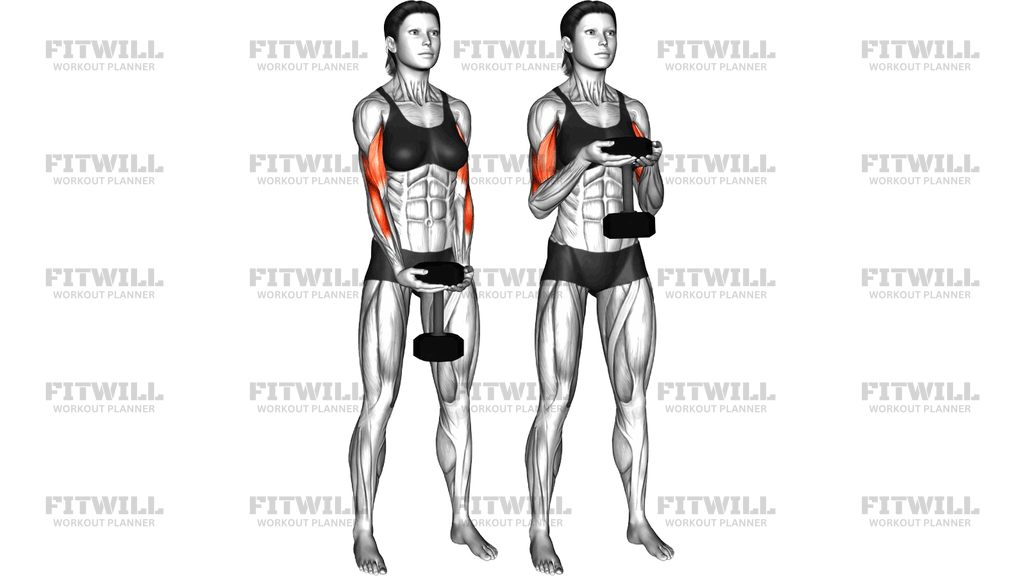
The Dumbbell Waiter Biceps Curl is a two-arm curl performed with a single dumbbell held vertically, the way a waiter carries a tray. You cup both hands under the top head of the dumbbell, let it hang at arm's length in front of your thighs, and curl it up to chest height while keeping your elbows pinned at your sides. Because both hands share one weight and work together through a fixed path, the movement encourages symmetry between your left and right arms in a way that separate dumbbells do not.
This exercise is a solid choice for anyone who wants to train the biceps without heavy bilateral loading, or who trains in a small space or home gym with limited equipment. One dumbbell is all it takes, and the shared grip naturally keeps the resistance centered in front of the body, which makes it easier to stay upright and avoid the side-to-side body sway that creeps into heavy single-arm curls. It also works well as a finishing movement at the end of an arm or pull day, when fatigue makes precise shared-load work more valuable than max weight.
The main muscles at work are the biceps brachii on the front of the upper arm, with the brachialis underneath and the brachioradialis and forearm flexors assisting to hold the cupped grip. The front shoulders and upper back work isometrically to keep the arm and torso steady as the weight travels. Since both hands are locked around the same implement, any imbalance between sides shows up immediately as a tilt in the dumbbell, giving you honest feedback about which arm is doing more work.
Setup matters more here than in a standard curl because the grip is unusual. Your fingers interlock or overlap under the bottom of the top dumbbell head, and if that grip is loose the plate will shift and roll mid-rep, pulling your wrists out of line. Set your feet about hip-width apart, brace the trunk, and keep the elbows fixed against the ribs so the forearms do all the hinging.
To execute well, curl the dumbbell smoothly from thigh level to just below your collarbones, letting the elbows stay stacked under the weight rather than drifting forward. Squeeze at the top, then lower under control until the arms are fully extended again. A slow, quiet descent is the hallmark of someone doing this exercise correctly; if the dumbbell crashes back down, the load is too heavy or the elbows have started to travel.
The most common use cases are hypertrophy-focused arm training, warm-up or technique work for beginners learning what a strict curl feels like, and low-equipment home sessions. Keep the weight conservative at first, since the cupped grip limits how much load the hands can secure safely. Never curl so heavy that the dumbbell could slip from your fingers, and stop the set as soon as your grip starts to loosen.
[ Workout Log & Planner ]
Put your next workout in Fitwill
Keep your plan and training log ready when you are.


Instructions
- Stand upright with your feet about hip-width apart and hold one dumbbell vertically by its top head, cupping the underside with both hands so your fingers interlock or overlap.
- Let your arms hang fully extended in front of your thighs with the dumbbell resting at about mid-thigh level, palms facing forward and up under the plate.
- Draw your shoulders back and down, brace your abdominal muscles, and set your elbows lightly against the sides of your ribs.
- Inhale, then curl the dumbbell upward by bending only at the elbows, keeping the upper arms vertical and motionless throughout.
- Continue curling until the dumbbell reaches just below your chest or collarbone level and your biceps are fully contracted.
- Hold the top position for a moment and squeeze both biceps, making sure the dumbbell stays level rather than tipping toward one hand.
- Exhale as you lower the dumbbell in a slow, controlled arc back to the starting position beside your thighs until your arms are completely straight.
- Pause briefly at the bottom to reset your grip and elbow position before starting the next repetition.
- Keep your wrists firm and neutral so they do not bend backward under the load, and keep your torso still without leaning back to assist the lift.
Tips & Tricks
- Choose a lighter dumbbell than you would use for a regular curl; the cupped two-hand grip has less security than a normal palm-around handle, and a slipping plate is the biggest risk in this movement.
- If the dumbbell tilts to one side at the top of the rep, your stronger arm is taking over. Slow the tempo down and consciously match the push from each hand until the weight stays level.
- Do not let your elbows drift forward as you curl. When the elbows travel toward the front of the room, the front shoulders start helping and the tension comes off the biceps.
- Keep your wrists straight in line with your forearms. Bending the wrists back to balance the plate shifts stress into the forearms and can strain the wrist joint over a long set.
- Lower the dumbbell over two to three seconds instead of dropping it. The shared grip makes the eccentric phase especially easy to rush, and rushing it removes most of the muscle-building benefit.
- If your lower back starts to arch or you lean back at the top, brace your abs harder or reduce the weight. The torso should stay vertical from the first rep to the last.
- Fully straighten the arms at the bottom of every rep. Partial reps that stop short of full extension let the biceps avoid their weakest range and limit the development you get from the movement.
- Chalk or a towel on your hands can help if sweat makes the plate slippery, but if you find yourself re-gripping every rep, the dumbbell is too heavy for this exercise.
- Use this as a strict, lighter movement after heavier curls rather than as your main heavy biceps lift, since the grip limits how much load you can safely control.
Frequently Asked Questions
What muscles does the Dumbbell Waiter Biceps Curl work?
The primary muscle is the biceps brachii on the front of the upper arm, supported by the brachialis and brachioradialis. The forearms also work hard to hold the cupped grip on the dumbbell head.
Why is the dumbbell held vertically instead of by the handle?
Cupping both hands under the top head forces the two arms to share one load through a fixed path, which promotes even effort between sides. It also changes the wrist angle slightly compared with a standard curl grip.
Is the Dumbbell Waiter Biceps Curl good for beginners?
Yes, it is very beginner-friendly because the shared two-hand grip makes it easy to feel the biceps working and to spot uneven effort between arms. Start with a light dumbbell and focus on keeping the elbows pinned to the ribs.
How heavy should the dumbbell be for this exercise?
Use noticeably less weight than you would for a regular dumbbell curl, since your fingers only cradle the plate instead of wrapping around a handle. Pick a load you can lower slowly for all reps without the plate shifting in your hands.
What is the most common mistake in the Dumbbell Waiter Biceps Curl?
Letting the elbows travel forward and turning the movement into a front raise. Keep the upper arms vertical and against your ribs so only the forearms hinge at the elbow.
Can I do this exercise if my grip is weak?
Yes, but respect the limit. If the plate starts to slip mid-set, stop rather than re-gripping under load, and build forearm strength with more secure movements like standard dumbbell curls before pushing this one harder.
What can I substitute if I do not have a dumbbell with a flat, cuppable head?
A kettlebell held by the horns in front of the body works as a close substitute, or you can perform a standard two-dumbbell curl with your palms facing up. The key is keeping both arms working through the same shared path.
Should my wrists stay straight during the curl?
Yes, keep the wrists neutral and firm so they stay in line with the forearms. Bending the wrists back to balance the vertical dumbbell transfers tension away from the biceps and puts unnecessary stress on the wrist joint.
Where should I place the Dumbbell Waiter Biceps Curl in my workout?
It fits best as a strict, moderate-load biceps exercise after your main pulling or curling work, or as a technique and pump finisher. Because the grip limits heavy loading, it is less effective as your primary heavy arm movement.
How many sets and reps should I do?
Two to four sets of 10 to 15 controlled reps works well for most people. Prioritize a slow lowering phase and level dumbbell over adding more weight.