Barbell Overhead Squat
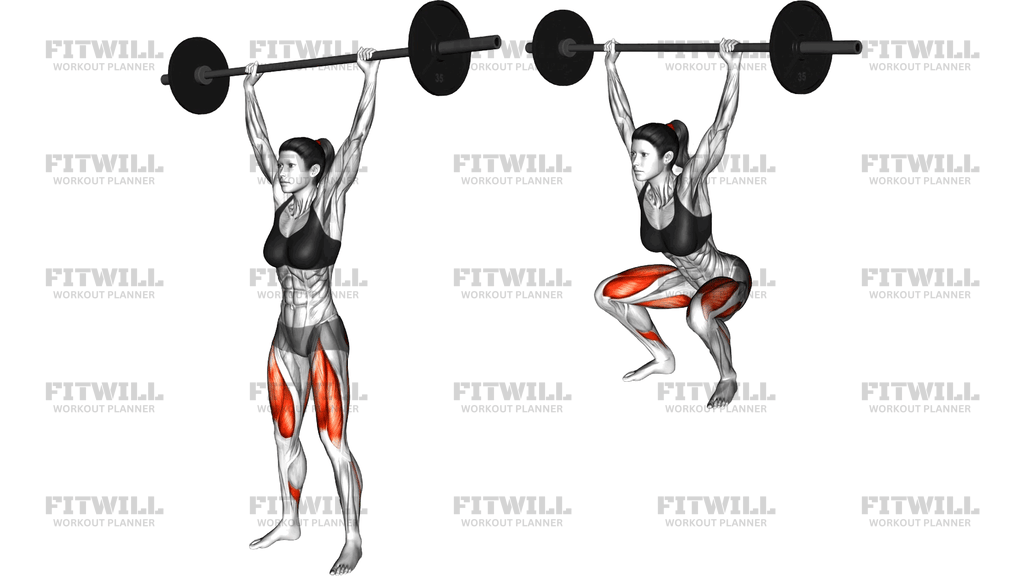
The Barbell Overhead Squat is a squat performed with the barbell locked out overhead throughout the entire movement, rather than resting on your back. Your legs do most of the work of lowering and raising your body, but your shoulders, upper back, and core have to hold the bar steady in a vertical line over your mid-foot from the first inch of descent to the final lockout. This combination makes it one of the most demanding full-body assessments and strength builders in the weight room.
This movement is a staple for Olympic weightlifters, who use it to build the overhead stability and bottom-position confidence needed for the snatch, and it carries over directly to that sport. CrossFit athletes, gymnasts, and anyone who wants to expose weaknesses in mobility will also benefit. Even recreational lifters can use a light bar version as a diagnostic: where the bar drifts, your ankles, hips, shoulders, or thoracic spine are usually the limiting factor.
Muscularly, the quads and glutes drive the squat itself, while the shoulders, traps, and upper back isometrically press the bar up and keep it stacked over the base. The deep core and lower back work hard to stop your ribcage from flaring and your spine from arching as the weight pulls forward. Adductors and calves contribute control at the bottom, where your hips drop between your feet with your torso staying upright.
Setup matters more here than in almost any other squat variation. A snatch-width grip, active shoulders pushing up into the bar, and a stance that lets you sit between your feet all determine whether the bar can stay over your mid-foot. If your overhead position is restricted, the bar will drift behind or in front of you and the rep will fall apart no matter how strong your legs are.
To execute it well, punch the bar to full lockout, brace your trunk, and squat down by bending your knees and hips together while keeping the bar path vertical. Sit between your heels rather than pushing your hips far back, hold the bottom briefly if you can keep the bar stacked, then drive through the floor to stand without letting the bar wander. Start with an unloaded bar or a light load and treat technique, not weight, as the goal.
Because the load sits far from your joints and your arms cannot support the bar against your body, this exercise punishes sloppy positions. Use a rack or a safe overhead press to get the bar up, never squat overhead with a weight you cannot reliably control, and have a plan for bailing, such as pushing the bar forward and stepping back, before you add plates.
[ Workout Log & Planner ]
Put your next workout in Fitwill
Keep your plan and training log ready when you are.


Instructions
- Set a barbell in a rack at roughly your overhead press height, or plan to clean and press it overhead from the floor if the load is light.
- Take a wide, snatch-style grip on the bar, hands well outside shoulder width so you can lock your elbows and press the bar directly over your mid-foot.
- Stand with your feet about shoulder width or slightly wider, toes turned out a little, and press the bar to full lockout overhead with your arms straight and shoulders actively shrugging up toward the bar.
- Inhale and brace your core hard, pulling your ribs down so your lower back is not overarched, and squeeze your glutes to set your pelvis.
- Initiate the squat by bending your knees and hips together, letting your torso stay as upright as possible while the bar remains in a vertical line over your mid-foot.
- Descend until your hips are at or below knee depth, sitting between your feet rather than pushing your hips far behind you, and keep your arms locked with the bar pressing up.
- Pause briefly in the bottom position if you can hold the bar stacked, then drive through your whole foot to stand, keeping your chest up and knees tracking over your toes.
- Exhale near the top of the rep, re-brace, and reset your overhead lockout before beginning the next repetition.
- Once your set is finished, lower the bar safely back to the rack or, with a light bar, control it down in front of you with straight arms.
Tips & Tricks
- If the bar drifts forward as you descend, your ankles are often the restriction; try a slightly wider toe-out stance and work on dorsiflexion before loading the bar.
- If the bar falls behind you, you are likely losing the active shoulder push at lockout; keep punching the bar toward the ceiling throughout the rep instead of passively holding it.
- Flared ribs and an arched lower back at the top are a common compensation; exhale, tuck the pelvis slightly, and re-brace before every descent.
- Elbows that soften mid-rep turn the overhead squat into a partial pressing situation; think about locking the elbows and pressing the bar apart between your hands.
- Knees caving inward under load usually mean weak or untrained adductors and glutes at depth; cue knees pushed out over the pinky toes, especially coming out of the bottom.
- Film yourself from the side: the bar, your shoulder joint, and your mid-foot should form one straight vertical line at every point of the squat.
- Warm up with a PVC pipe or empty bar and a slow three-second descent; most overhead squat errors show up in the first rep and are fixable with light practice volume.
- Do not chase depth before you own it; a controlled squat to parallel with a stable bar beats a wobbly full-depth rep every time.
- Have a bail-out plan: with a light bar you can guide it forward to the floor, but with real weight you should be squatting inside a rack with spotter arms set below your bottom position.
Frequently Asked Questions
Which muscles does the Barbell Overhead Squat work the most?
The quads and glutes do the primary work of squatting the load, while the shoulders, traps, and upper back hold the bar locked out overhead. The deep core and lower back work continuously to keep your torso from collapsing under the bar.
Is the Barbell Overhead Squat suitable for beginners?
Yes, as long as beginners start with a PVC pipe or an empty bar and treat it as a mobility and technique drill rather than a heavy lift. Building the overhead position and bottom-depth control first makes later progress much safer.
Why is the grip so wide in the Barbell Overhead Squat?
A snatch-width grip lets you keep the bar stacked vertically over your shoulders and mid-foot with straight arms. A narrower grip usually forces the bar behind your head and makes the shoulder position much harder to hold.
Why does the bar keep drifting forward during my Barbell Overhead Squat?
Forward bar drift most often comes from limited ankle mobility or a torso that leans too far forward. Try a slightly wider stance with more toe-out, and practice sitting straight down between your feet instead of pushing your hips back.
How deep should I squat in the Barbell Overhead Squat?
Full depth with your hips below your knees is the standard for weightlifters, but you should only go as deep as you can while keeping the bar over your mid-foot and your arms locked. Shallow, stable reps build toward deeper ones safely.
Can I substitute the Barbell Overhead Squat with another exercise?
Dumbbell or kettlebell overhead squats, single-arm overhead squats, and front squats all train similar qualities with less stability demand. The barbell version is the most specific for snatch-type overhead strength.
How heavy should I go on the Barbell Overhead Squat?
Most lifters can overhead squat noticeably less than their back squat, so start with a light bar and increase only when every rep keeps a vertical bar path. If the bar moves forward or back at any depth, the weight is too heavy for now.
How do I get the bar overhead safely for the Barbell Overhead Squat?
Take the bar out of a rack at press height and press or push-press it to lockout before stepping back to your squat stance. Pressing it from the floor works only with loads light enough to control confidently.
Should my shoulders stay shrugged during the Barbell Overhead Squat?
Yes, actively push up into the bar so your shoulders stay elevated and the bar stays supported by a stable structure rather than hanging on your joints. Passive shoulders are one of the most common causes of a collapsing overhead position.