Standing Wall Shoulder Rotation
The Standing Wall Shoulder Rotation is a bodyweight mobility drill that targets external rotation of the shoulder with the arms held in a goalpost position. You stand with your back toward a wall, raise your upper arms out to the sides to roughly shoulder height, bend your elbows to ninety degrees, and rotate your forearms upward so the backs of your hands and elbows press toward the wall. The wall acts as both a reference point and a gentle restraint, which makes it easy to feel exactly where your rotation is limited.
This movement is especially useful for anyone whose shoulders sit forward from desk work, driving, or pressing-heavy training. Because the wall keeps your torso honest, you cannot easily cheat by arching your lower back or shrugging your shoulders to fake extra range. It trains the external rotators of the rotator cuff, the rear shoulder muscles, and the muscles between the shoulder blades that control scapular position, all in a low-load, high-awareness setting.
The setup matters more than it looks. Standing with your head, upper back, and hips touching the wall gives you a fixed frame, so any compensation shows up immediately as a body part peeling away from the surface. The ninety-degree elbow position also places the shoulder in a classic external rotation angle, the same one used in throwing, swimming, and overhead lifting, which is why this drill carries over well to those activities.
To execute it well, move slowly and think about rotating from the shoulder joint rather than pushing with your hands. The forearms travel from a forward or slightly downward position up until the backs of the hands and forearms meet the wall or reach their comfortable end point. Most people find one side rotates noticeably farther than the other, which is exactly the kind of asymmetry this drill exposes and, with regular practice, helps reduce.
Use the Standing Wall Shoulder Rotation as a warm-up before upper-body training, as a reset between long blocks of sitting, or as part of a shoulder health routine alongside wall slides and band rotations. Keep the effort moderate: this is not a stretch to force, but a range you earn through repeated, controlled visits. If you feel pinching in the front of the shoulder or numbness in the arms, reduce the range or step your feet slightly farther from the wall rather than pushing through discomfort.
Fitwill
Log Workouts, Track Progress & Build Strength.
Achieve more with Fitwill: explore over 9600 exercises with images and videos, access built-in and custom workouts, perfect for both gym and home sessions, and see real results.
Start your journey. Download today!




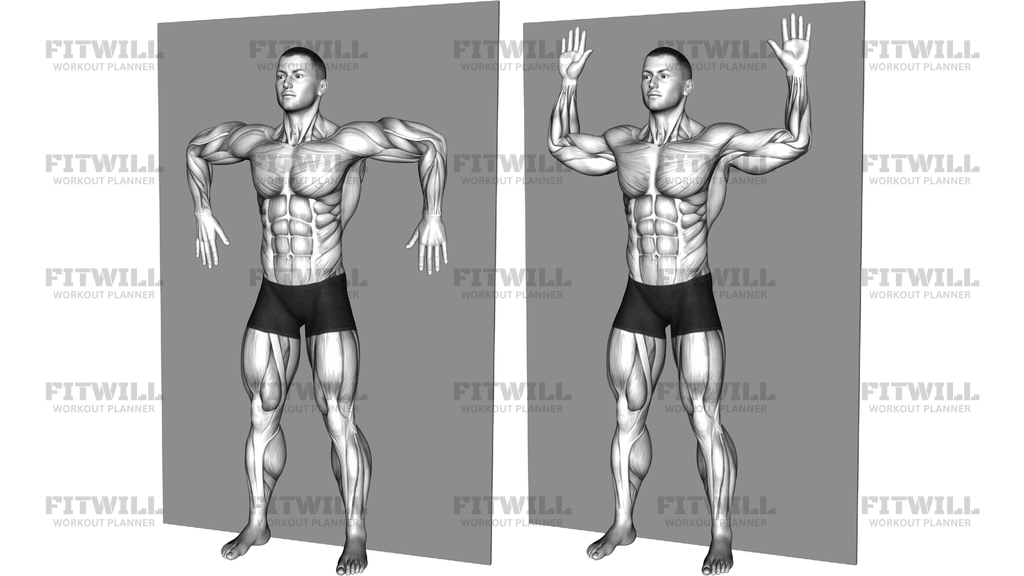
Instructions
- Stand with your back against a flat wall, feet a few inches out from the base so your head, upper back, and hips can all rest lightly against the surface.
- Bend your knees slightly, engage your core, and let your arms hang relaxed for a moment to settle your posture.
- Raise both upper arms out to the sides to shoulder height, then bend your elbows to ninety degrees so your forearms point forward and your palms face down or slightly inward.
- Press the backs of your upper arms and elbows gently toward the wall and keep them there throughout the set.
- Slowly rotate your forearms upward from the shoulders until the backs of your hands and forearms touch the wall or reach your comfortable end range, forming a full goalpost position.
- Pause for two to three seconds at the top, keeping the elbows wide and the shoulders down away from your ears.
- Rotate the forearms back down under control until your hands are forward or slightly below shoulder level again.
- Breathe steadily throughout, inhaling as you rotate up and exhaling as you return, without holding your breath.
- Complete eight to twelve slow repetitions, then check that your head, upper back, and hips are still in contact with the wall before finishing or performing another set.
Tips & Tricks
- If your lower back arches off the wall as the arms go up, bend your knees a little more and tuck your ribs down; the arch is a compensation, not extra shoulder range.
- Do not let the elbows drift forward off the wall during the rotation, since that shortens the lever and removes most of the benefit for the rotator cuff.
- Shrugging toward the ears is one of the most common faults here; consciously pull the shoulder blades down before each rep begins.
- Expect one side to move farther than the other, especially if you throw or swing a racket; work to the weaker side's range rather than letting the loose side set the pace.
- Keep the rotation slow, about two to three seconds each way, because speed lets momentum cover up exactly the restrictions you are trying to find.
- If your wrists or hands tingle at the top position, widen the elbow angle slightly or lower the upper arms a few degrees instead of forcing the forearms flat against the wall.
- A small gap between the forearms and the wall is normal at first; aim for progress over weeks, not contact on day one.
- Pair this drill with wall slides in the same session, since the rotation work and the overhead reaching pattern reinforce each other.
- Avoid pushing into a sharp pinch at the front of the shoulder, which usually means the range or angle is too aggressive for your current mobility.
Frequently Asked Questions
What muscles does the Standing Wall Shoulder Rotation work?
It primarily challenges the external rotators of the rotator cuff, such as the infraspinatus and teres minor, along with the rear shoulder muscles. The muscles of the upper back that control the shoulder blades work to keep the elbows and torso positioned against the wall.
Is the Standing Wall Shoulder Rotation good for beginners?
Yes, it is one of the safest ways to assess and train shoulder rotation because there is no external load and the wall provides instant feedback on positioning. Beginners should simply use a smaller range and avoid forcing the forearms flat against the wall.
Why do my forearms not touch the wall in the Standing Wall Shoulder Rotation?
Limited external rotation range, tight chest muscles, or a forward-shoulder posture are the usual reasons. Practice consistently within a comfortable range and the gap typically narrows over a few weeks without forcing it.
Should my whole back stay flat against the wall during the Standing Wall Shoulder Rotation?
Your head, upper back, and hips should stay in light contact, but there is a natural small curve in the lower back. If that curve deepens and your ribs flare as the arms rotate up, you are compensating and should reset your posture.
How does the Standing Wall Shoulder Rotation differ from a regular wall angel?
A wall angel slides the whole arm up and down the wall, while this drill keeps the elbows at ninety degrees and rotates the forearms around the shoulder joint. The rotation version isolates external rotation more directly, whereas wall angels emphasize overhead reaching and scapular control.
How many repetitions and sets should I do?
Eight to twelve slow repetitions for two to three sets works well, either as a warm-up before upper-body training or as a standalone mobility break. Quality of movement matters far more than volume with this drill.
Can I do the Standing Wall Shoulder Rotation before bench pressing or overhead lifting?
Yes, it makes an effective warm-up because it takes the rotator cuff through the exact rotation range used in pressing and overhead work. Keep it light and controlled so the shoulder is primed, not fatigued.
What should I do if I feel pinching at the front of my shoulder?
Reduce the rotation range so the movement stays pain-free, lower your upper arms slightly below shoulder height, or make sure you are not shrugging or arching away from the wall. Persistent pinching should be assessed by a qualified professional.
Can I substitute the Standing Wall Shoulder Rotation if I have no wall available?
You can perform the same goalpost rotation lying on your back or standing freely, but you lose the wall's feedback and restraint. A mirror or a partner watching your elbows can help fill that role.